


KUALA LUMPUR, Aug 14 — Malaysia’s ringgit plunged the most since 1998 on concern the nation is running out of ammunition to defend its currency amid a political scandal, a yuan devaluation and slumping oil prices. Stocks and bonds tumbled.
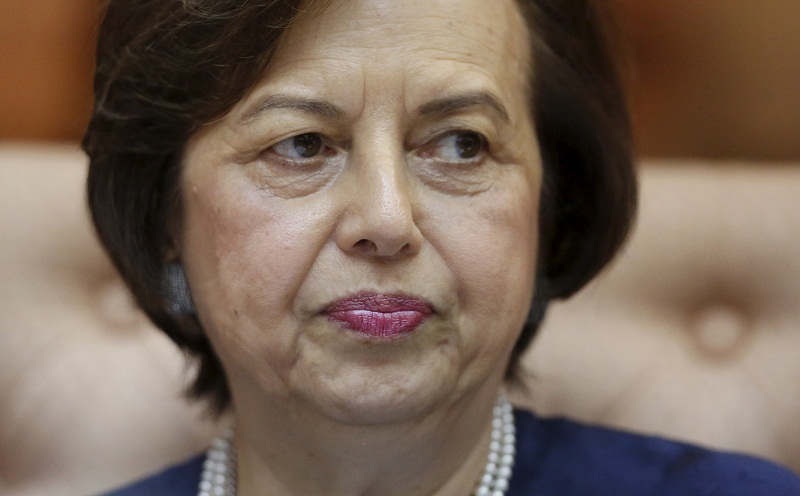
The ringgit led a retreat in Asia this week as Governor Tan Sri Zeti Akhtar Aziz said yesterday the central bank will need to rebuild foreign-exchange reserves that have fallen below US$100 billion (RM 407.7 billion) for the first time since 2010. Better-than-expected economic data yesterday failed to dispel the gloom, with the benchmark stock index closing at its lowest since 2012 and 10— year bonds sliding the most in at least five months.
It’s a “bit of a vicious cycle from the currency,” said Saktiandi Supaat, head of foreign-exchange research at Malayan banking Bhd. in Singapore. “Declines in the ringgit beyond 4.05 a dollar are triggering fixed-income outflows.”
The Malaysian currency slumped as much as 2.8 per cent, its biggest intraday loss since 1998, before closing 1.7 per cent down at 4.0795 a dollar in Kuala Lumpur. The yield on government debt due September 2025 climbed nine basis points to 4.28 per cent, while that on October 2017 notes jumped 24 basis points.
“I think there is a concerted effort to test Bank Negara Malaysia’s reserves,” said Mixo Das, an equities strategist at Nomura Holdings Inc. in Singapore. “Given that the economic fundamentals are still sound” the situation shouldn’t get out of hand, he said.
The benchmark stock index fell 5.1 per cent this week, the most since 2008, and 1.5 per cent today to 1596.82. SapuraKencana Petroleum Bhd., the nation’s largest oil and gas services provider, slid 7.7 per cent, the biggest drag on the gauge that is down 14 per cent from this year’s peak in April.
Bond outflows
The ringgit slid to a 17-year low of 4.1225 per dollar today and is down 14 per cent this year in Asia’s worst performance. Overseas investors cut holdings of Malaysian bonds by 2.4 per cent in July to RM206.8 billion, the least since August 2012, official data showed last week.
China’s surprise devaluation put more downward pressure on the ringgit and shares, which were already reeling from falling crude and a scandal involving Prime Minister Datuk Seri Najib Razak. The impact of the ringgit’s drop is manageable and the economy will remain on a steady growth path, Governor Zeti said yesterday.
“Malaysia is probably a relatively easier target for markets and this is why we’re seeing continued outflows and pressure on the currency,” said Mitul Kotecha, head of Asia Pacific foreign-exchange strategy at Barclays Plc in Singapore. “I don’t think this sort of pressure is justified at these sorts of levels.”
No peg plans
Malaysia’s economy grew 4.9 per cent in the three months through June from a year earlier, beating the 4.5 per cent median estimate in a Bloomberg survey. That was the slowest pace since the third quarter of 2013. The country posted a current-account surplus of US$7.6 billion, which was also better than forecast.
Governor Zeti said yesterday the nation had no plans to reintroduce capital controls nor to re-peg the currency, which it did at 3.8 during the Asian financial crisis.
“I think it is not an issue of 1998 revisited because Malaysia is not held down by a fixed exchange rate and forced to defend that fixed rate,” said Alan Richardson, a Hong Kong— based money manager at Samsung Asset Management Ltd, which oversees US$112 billion. “It appears there is capital outflow because foreign-exchange reserves are declining and the country’s history for draconian policy responses such as capital controls from 1998 to 2005.”
‘Still selling’
A 17 per cent slide in foreign-exchange reserves this year to US$96.7 billion at the end of July suggests the central bank has been intervening to prop up the ringgit, just as Najib faces a probe of fund transfers into his personal bank accounts. Political machinations were among the causes of the ringgit’s decline, the prime minister wrote in his blog yesterday.
Najib is fighting accusations that about US$700 million may have moved through government agencies and companies linked to debt-ridden state investment company 1Malaysia Development Bhd. before ending up in accounts bearing his name. The Malaysian Anti-Corruption Commission said the RM2.6 billion in Najib’s accounts was from donors in the Middle East.
The opposition People’s Justice Party said this week it’s suing Najib, alleging that the premier used RM2.6 billion that was transferred to his accounts for campaign purposes during the last general election, which would’ve been more than 26 times the amount Najib’s alliance was allowed to spend.
“The ringgit remains vulnerable,” said Khoon Goh, a Singapore-based strategist at Australia & New Zealand Banking Group Ltd “Governor Zeti said that the central bank will set about rebuilding reserves, which means there will be a limit to any rally.” — Bloomberg


