


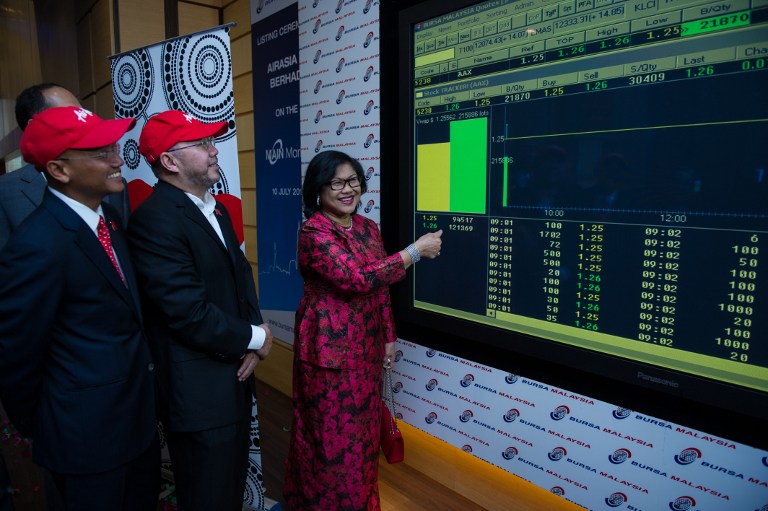


KUALA LUMPUR, Nov 4 — Malaysia is leading global sales of perpetual sukuk as a planned offer by Asia’s biggest budget airline brings Islamic finance to a broader range of investors.
AirAsia Bhd will set up a RM1 billion programme to sell Shariah-compliant notes with no set maturity, according to an Oct 30 stock exchange filing. The company is the fourth issuer since national carrier Malaysian Airline System Bhd’s debut in 2012 and so far $998 million has been raised in the nation, data compiled by Bloomberg show.
The securities appeal to investors who are willing to take on a greater degree of risk in exchange for a higher yield, according to RAM Rating Services Bhd, the bigger of Malaysia’s two credit assessors. Perpetual Islamic bonds are treated as equity rather than debt on a company’s balance sheet, enabling firms to raise funds without affecting their creditworthiness.
“AirAsia’s planned perpetual sukuk will add to the growing list of such offerings that bring a new dimension to issuers and investors in the Islamic market,” Suzaizi Mohd Morshid, Kuala Lumpur-based head of treasury at RHB Islamic Bank Bhd, a unit of RHB Capital Bhd, said in an Oct 30 phone interview.
“These sukuk are gaining popularity because most fund managers are already familiar with the equity part of the issuers.”
Mideast Issuers
Malaysian Airline System priced its perpetual sukuk at 6.9 per cent in June 2012 and the country’s second-biggest pension fund purchased all the RM1 billion on sale. Investors tend to hold Islamic bonds until maturity because of insufficient supply to meet demand, with no pricing currently available for the MAS notes.
The only other Malaysian issuers to date are property developer SP Setia Bhd and plantation group Boustead Holdings Bhd Eight of the 14 perpetual sukuk sold worldwide are from the Southeast Asian nation, data compiled by Bloomberg show. In the Middle East, Abu Dhabi Islamic Bank PJSC and Dubai Islamic Bank PJSC have also sold the debt.
Malaysia Airports Holdings Bhd, operator of the international airport, held investor presentations for as much as RM1 billion of the securities in August. The bonds haven’t yet been sold. Automotive distributor DRB-Hicom Bhd plans to set up a RM2 billion perpetual sukuk programme, according to a statement from Malaysian Rating Corp. yesterday.
AirAsia’s perpetual sukuk will be callable after the fifth, seventh, or 10th year, with the date to be finalized prior to issuance. The notes are of the Mudarabah type, a profit-sharing contract between the investor and company, and they won’t have a credit rating, according to the filing.
Growing Interest
The Islamic debt market is becoming more sophisticated in an industry with US$1.7 trillion in Shariah-compliant banking assets that Ernst & Young LLP forecasts will reach US$3.4 trillion by 2018.
Global sales of sukuk, which pay returns on assets to comply with Islam’s ban on interest, rose 12 per cent in 2014 to $38.1 billion from a year earlier, according to data compiled by Bloomberg. InMalaysia, the world’s biggest Shariah-compliant bond market, this year’s corporate issuance climbed 54 per cent to RM51.3 billion, surpassing 2013’s RM49 billion.
“Now that the sukuk market is well-established, it makes sense for corporates to consider selling perpetuals because the Islamic market has a bigger pool of investors,” Badlisyah Abdul Ghani, chief executive officer of CIMB Islamic Bank Bhd, the top sukuk arranger, said in a Oct 30 phone interview in Kuala Lumpur. “We are seeing a lot of interest from a broad spectrum of companies keen on issuing perpetual sukuk.”
Market Yields
AirAsia will use the proceeds from its bond sale to refinance existing debt and for working capital, according to the filing. The airline last tapped the Islamic market in 2008 when it sold RM420 million of five-year notes at 4.85 per cent. The securities have now matured.
The carrier, which has a market capitalization of RM7.1 billion, has RM4.2 billion in loans due by 2025, according to data compiled by Bloomberg. Its shares climbed 16 per cent this year, compared with a 1.1 per cent drop in the benchmark FTSE Bursa Malaysia KLCI Index.
SP Setia sold its Islamic bonds carrying no set maturity at 5.95 per cent in December 2013 and they yielded 4.35 per cent yesterday, pricing compiled by Bloomberg show. Boustead’s perpetual sukuk was issued at 6.25 per cent in August this year and the notes last yielded 4 per cent.
“Depending on the features of the perpetual, rating agencies and financial institutions may consider perpetuals as partial equity,” Kevin Lim, RAM’s head of consumer and industrial ratings in Kuala Lumpur, said in an interview yesterday.
“Given this, the balance sheets of companies that issue perpetuals will not be as geared as if they had issued regular sukuk.” — Reuters


