


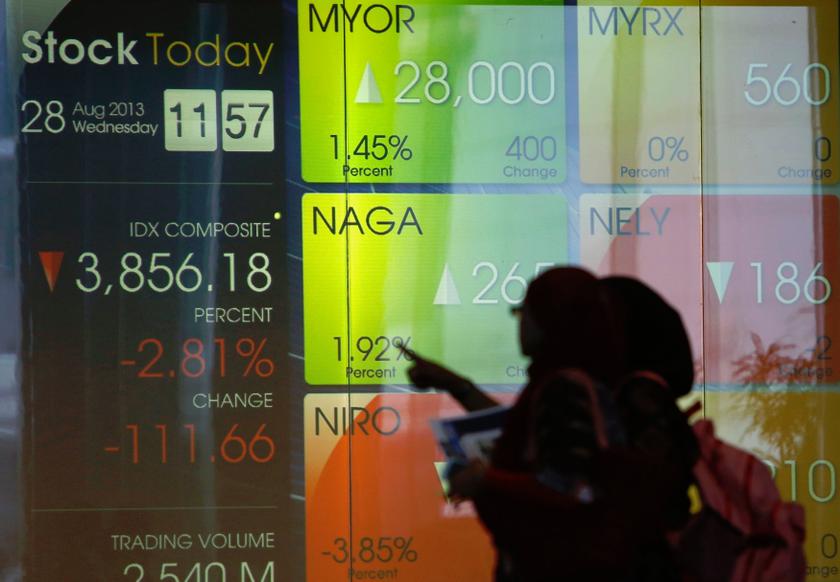


TOKYO, Feb 19 — Asian stocks fell, snapping a three-day advance in the regional index, while Thailand’s baht led declines in higher-yielding currencies. Oil gained a second day before stockpiles data and silver slipped.
The MSCI Asia Pacific Index lost 0.2 per cent by 1pm in Tokyo. Futures on the Standard & Poor’s 500 Index and FTSE 100 Index were down 0.1 per cent. A gauge of Chinese shares in Hong Kong retreated 0.5 per cent and the yuan sank to the lowest level since December 26.
The baht slumped 0.3 per cent after clashes between anti-government protesters and police in Bangkok escalated. Australia’s dollar slid 0.2 per cent. Crude added 0.3 per cent, while silver fell 0.9 per cent following a 13-day rally.
Minutes of the Federal Reserve’s January meeting and data on US housing starts and UK employment are due today, before a preliminary report tomorrow on China’s manufacturing. Clashes in Thailand killed four people, while fighting in Ukraine left at least 18 people dead. In the US, snow has bolstered demand for heating before a report tomorrow that is expected to show stockpiles declined for a third week.
“The market has had a good run in the past week,” said Stan Shamu, a Melbourne-based market strategist at IG Ltd. “Unless we’ve got continuing catalysts to push the market higher, investors will stay on the sidelines.”
About five stocks fell for every four that rose on the MSCI Asia Pacific measure, which climbed 1 per cent yesterday after the Bank of Japan doubled a low-cost funding facility. The Japanese gauge dropped 0.4 per cent today.
Fed minutes
The yen strengthened against all its 16 major peers, adding 0.1 per cent versus the dollar, following a 0.4 per cent decline yesterday. While the Federal Reserve pushes ahead with stimulus cuts, the BOJ maintained asset purchases, boosted lending programmes and pledged to continue easing at the end of a policy meeting yesterday.
The dollar was at US$1.3761 per euro after earlier touching US$1.3773, the weakest since January 2. The Fed is scheduled to release minutes of its January meeting, where policy makers agreed on a further US$10 billion reduction in monthly bond purchases after announcing in December it would start paring stimulus by the same amount.
S&P futures signalled the gauge may retreat after gaining 0.1 per cent yesterday. US housing starts probably fell 4.9 per cent in January following December’s 9.8 per cent drop, according to economists surveyed by Bloomberg.
China economy
Australia’s dollar dropped to 90.09 US cents before a private manufacturing report tomorrow in China, the nation’s largest trading partner, that may show contraction. New Zealand’s currency lost 0.1 per cent to 82.94 US cents.
The yuan fell to this year’s low of 6.0761 after the central bank lowered the currency’s daily fixing by 0.05 per cent amid concern growth is slowing. China has reduced its 2014 forecast for expansion in factory output to about 9.5 per cent, from last year’s 10 per cent, Mao Weiming, deputy minister at the Ministry of Industry & Information Technology, said yesterday.
The Hang Seng China Enterprises Index in Hong Kong decreased for a second day. A flash estimate of China manufacturing PMI was unchanged at 49.5, HSBC and Markit Economics will say tomorrow according to economists in a Bloomberg survey. A reading below 50 indicates contraction.
“People are very sensitive to the prospect of a growth shortfall there,” said Tim Condon, Singapore-based head of Asian research at ING Groep NV.
Thai clashes
The baht slipped to 32.57 versus the dollar, set for the biggest two-day loss since August. Thailand’s currency may drop further today if “violence escalates” in Bangkok, said Leslie Tang, a Singapore-based strategist at Malayan Banking Bhd. The Philippine peso retreated 0.2 per cent and the South Korean won weakened 0.2 per cent.
Ukrainian bond yields approached record highs and the currency has tumbled 7 per cent in 2014 to a five-year low as President Viktor Yanukovych’s government failed to quell tension with opposition forces calling for his ouster.
West Texas Intermediate crude rose to US$102.70 (RM339) a barrel after surging 2.1 per cent yesterday to the highest settlement price since October 10. Supplies probably fell at Cushing, Oklahoma, the biggest US oil-storage hub, according to estimates from five analysts. Natural gas futures gained 0.8 per cent.
Silver dropped to US$21.75 an ounce, after jumping 1.2 per cent yesterday. Gold fell 0.3 per cent, extending yesterday’s 0.5 per cent decline.
Palm oil for May delivery advanced as much as 0.7 per cent to RM2,719 a metric ton on the Bursa Malaysia Derivatives, the highest level at close for a most-active contract since September 2012. Prices have risen for six days, the longest such run since May 2013. — Bloomberg


