














HONG KONG, July 22 — Most equities fell today after the previous day’s strong rally, with optimism over a possible coronavirus vaccine tempered by profit-taking and concerns about the slow progress being made by US lawmakers in drafting a new stimulus package.
News that trials on a vaccine had shown early promise provided a much-needed boost to equities, particularly as a spike in new infections around the world has caused governments to reimpose business-strangling containment measurements.
But with the European Union finally locking in their US$860 billion (RM3.7 trillion) deal yesterday, attention turns to Washington, where Republicans are struggling to put together a new bill to support the world’s top economy, with the US$3 trillion of measures passed earlier this year about to dry up at the end of the month.
The wall of government cash and central bank back-stop, along with similar measures in other countries, have helped fire a surge in equities across the planet since they hit their March depths.
However, while Democrats have drawn up a new US$3.5 trillion plan, Republicans and officials in the White House are bogged down trying to draw up their own package, which is said to be around US$1 trillion.
Among the sticking points are the extension of a supplement to unemployment benefits and Donald Trump’s desire for tax cuts, and with Congress due to take a break in August there is a concern a deal will not be agreed, leaving millions without cash.
Still Trump said he was optimistic, telling a White House briefing: “We’re working very hard on it, we’re making a lot of progress.
“I also know that both sides want to get it done.”
AxiCorp’s Stephen Innes added: “I do not understand why the market is fretting about the US stimulus plan. It has been widely telegraphed there could be a delay, not to mention the slow bipartisan tango that always seems to happen around these events.
“No lawmaker, especially in an election year, wants to... be accused of being frugal when people are dying across the US Sunbelt at record levels.”
With one eye on developments on Capitol Hill, Asian equities moved in and out of positive territory through the day.
‘Tougher period for stocks’
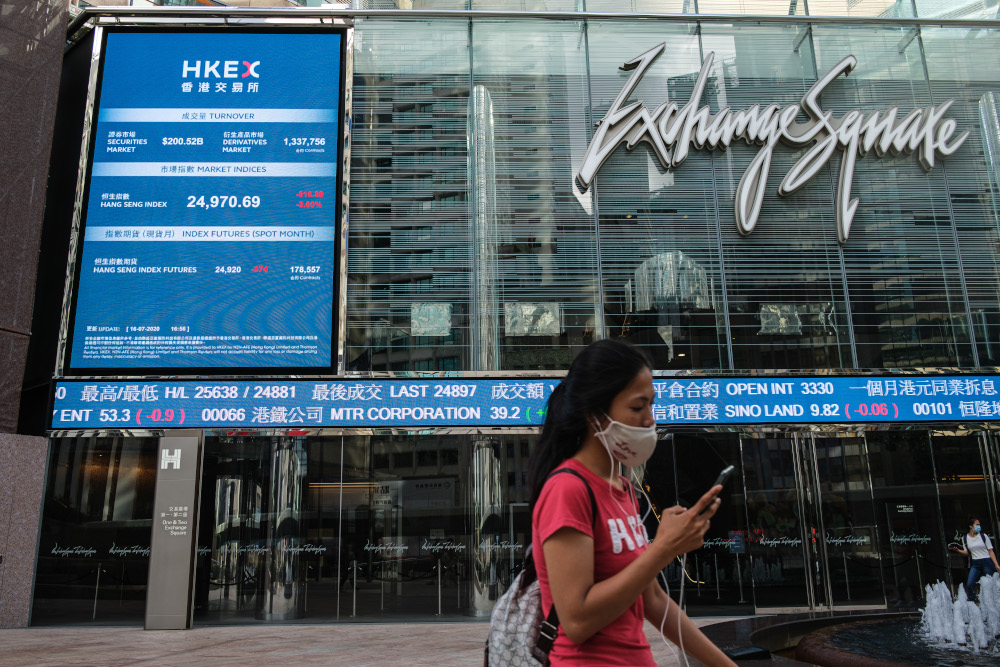
Hong Kong led losses, tumbling 2.3 per cent after rising more than two per cent yesterday, and following figures showing another record rise in new infections in the city that has led to new fears of tighter restrictions being imposed.
Tokyo shed 0.6 per cent and Sydney lost 1.3 per cent, while Singapore, Manila, Bangkok, Wellington and Jakarta were also down.
London, Paris and Frankfurt were also all in the red.
But Shanghai rose 0.4 per cent, Mumbai added 0.1 per cent and Taipei put on 0.6 per cent.
Morgan Stanley strategist Andrew Sheets said stocks would have trouble pushing much higher without a key driver.
“I’m more concerned going into the August, September period: what’s going to then be the next catalyst to take the broader market higher?” he told Bloomberg TV, adding it was going to be “a tougher period for stocks”.
The euro held gains against the dollar following the EU agreement and was sitting at its highest levels since early 2019, while the Federal Reserve’s ultra-low interest rates continue to help higher-yielding currencies including the Australian dollar, Indonesian rupiah and South Korean won.
Expectations that rates will remain low for some time, and ongoing uncertainty over the spread of Covid-19, have also led traders into gold, which is considered a hedge against turmoil.
The metal was sitting at US$1,860 an ounce today and is approaching its record high above US$1,900.
The rally in gold, which is up almost a quarter this year, has helped drive silver to a seven-year high of US$22.84 per ounce.
“Silver is surging, and we think it is likely to remain strong,” James Steel, chief precious metals analyst at HSBC Securities (USA), said.
“Some investors who may not have participated fully in the gold rally could find silver attractive. We believe this is happening and may sustain silver at higher prices still.” — AFP