


PETALING JAYA, Dec 9 — What does the Attorney General (AG) plan to do about corruption cases where politicians have been temporarily released through a Discharge Not Amounting to Acquittal (DNAA), non-governmental organisation Projek SAMA asked today.
Although a DNAA means the AG could press the same corruption charges against these politicians at any time in the future, Projek SAMA today cautioned that waiting too long to charge them again could result in them securing an acquittal.
Projek SAMA’s convenor Ngeow Chow Ying noted that hundreds of days, or even years, have gone past since DNAA was given for former prime minister Datuk Seri Najib Razak’s case and Deputy Prime Minister Datuk Seri Ahmad Zahid Hamidi’s cases.
“But we are concerned about cases given DNAA, which means they can be recharged, but the days have passed. Like for example, Najib’s case has passed 377 days, Zahid’s case has passed 807 days.
“So as time passes, there is a possibility that the DNAA can be converted into a full acquittal, because it’s unfair for a charge to hang over somebody for so long.
“So our next question is really what the AG wants to do in these cases,” she asked in a press conference today here.
Ngeow was speaking at Projek SAMA’s launch of its latest report titled “Do politicians still get away with corruption after 2018?”
In its report, Projek SAMA noted that those who have been charged again with the same charges would have a stronger chance to seek for an acquittal (Discharge Amounting to Acquittal or DAA), if the period since they were granted DNAA goes on longer.
“This potentially makes DNAA a precusor for DAA, if assisted by delays or other failures on the part of the AGC,” the report said.
Projek SAMA’s report lists five outstanding DNAA cases, and the length of time since DNAA has been granted until today:
- Former Bachok MP Datuk Nasharudin Mat Isa’s case (1,917 days);
- Former federal territories minister Datuk Seri Tengku Adnan Tengku Mansor’s case (1,828 days);
- Zahid’s Yayasan Akalbudi case (827 days);
- Najib’s RM6.6 billion IPIC case (377 days);
- Najib’s RM27 million SRC case (172 days).
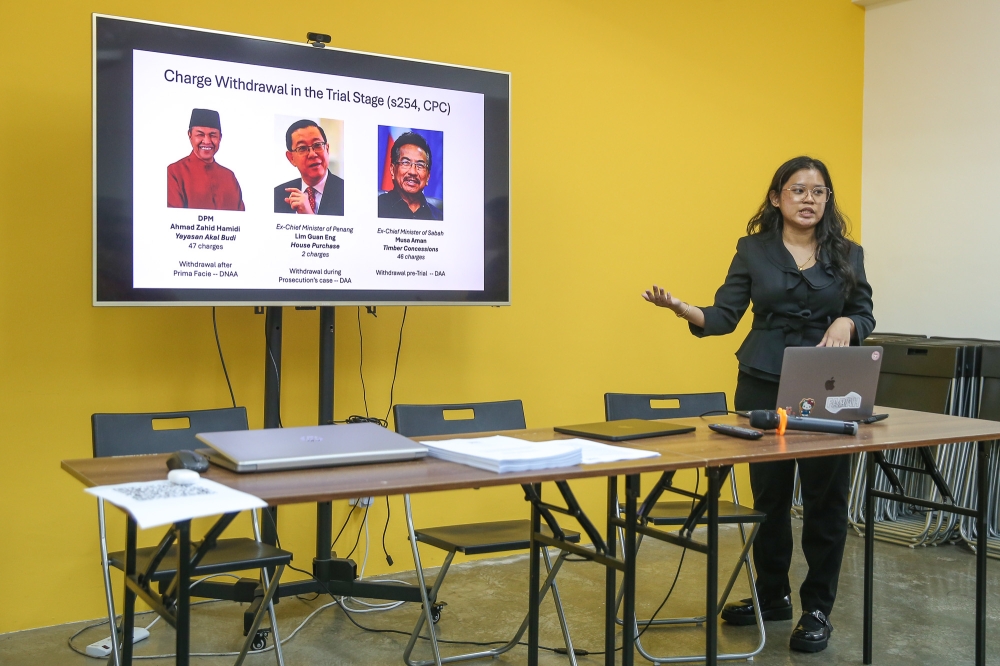
While there may be cases where lawyers provide solid grounds in letters of representation to the AG on why their clients should be released from criminal charges, Ngeow said the problem is that all the representations sent to the AG in high-profile corruption cases have been “so secretive”.
“We don’t know what is the real ground of such representations and decisions by the AG to withdraw the cases.
“It may be valid ground, but the problem is that if you don’t explain that properly, the perception is that a good letter of representation written by bigshot lawyer, supported by the government, you will get the letter of representation,” she said.
Ngeow said the AG’s Chambers should explain its reasons for discontinuing high-profile corruption cases, as it involves public interest and public funds, and as more transparency and accountability would help “address the issue of whether there is indeed political interventions into all these cases.”
While Projek SAMA’s report focuses on the AG’s exercise of powers to drop corruption cases against politicians, Ngeow said the report does not draw conclusions on whether “sharks” get different treatment in corruption cases as compared to “anchovies”, and leaves it to readers to draw their own conclusions from the facts in the report.
The report, written by Projek SAMA’s legal researcher Farah Izzah Haron, will be made available on Projek SAMA’s website.


