


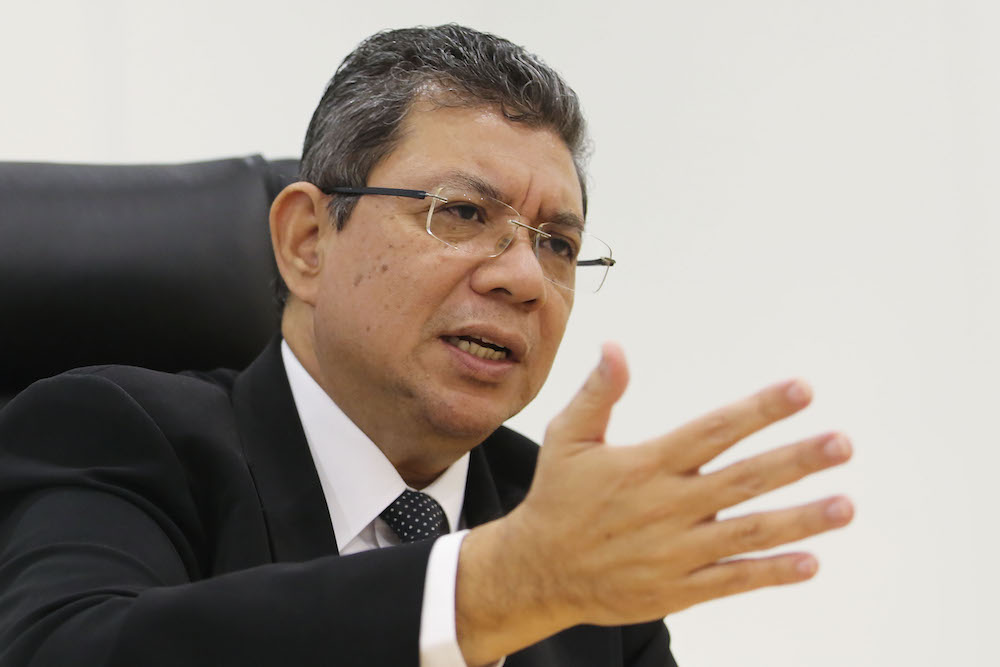
KUALA LUMPUR, July 29 — The new government may not be ready to deliver on all demands for increased civil liberties but is at least open to engagement even on controversial topics such as lesbian, gay, bisexual and transgender (LGBT) rights, said Datuk Saifuddin Abdullah.
The foreign minister said this was unlike the previous Barisan Nasional (BN) administration that would not even entertain such notions.
He added that the Pakatan Harapan (PH) government will do its best to improve in the area of human rights and ratifying treaties relating to civil liberties.
“The previous government did not want to talk about it. The current government is saying, ‘let's discuss it’.
Are we recognising it (LGBT rights)? I haven't gone there… but it is an elephant in the room we have to address,” Saifuddin told Malay Mail in an exclusive interview.
Ahead of the Universal Periodic Review (UPR) by the United Nations’ Human Rights Council this year, groups like Comango have urged Putrajaya to be more transparent in its report to the world body.
They also said the government should make principled efforts to list down concrete steps to address the “severe deterioration” of human rights here.
Held every four-and-a-half years, the UPR is a UNHRC mechanism that was established in 2007 to improve the treatment of human rights in all 193 UN member states.
The process involves a three-hour interactive dialogue, during which UNHRC members will ask questions of Malaysia based on reports prepared by the government and UN agencies along with stakeholders’ meta-report.
The last UPR on Malaysia was in 2013, when the country accepted 150 recommendations from its peers.
However, Saifuddin said the latest report, which the Cabinet approved on Wednesday, will be based on the previous BN government's efforts.
“The report is from November 2013 until March 2018. But to be fair, we have done quite well so far as meeting a considerable number of UPR targets like education and public health.
“Our issue has always been on the human rights side. On specific human rights issues, we are not there yet,” the Indera Mahkota MP conceded.
Saifuddin said the government is committed to repeal some laws viewed as detrimental to local rights such as the Sedition Act, and to replace others such as the University and University Colleges Act (UUCA).
He also said Malaysia has to date acceded to three of the nine core human rights treaties, namely the Convention on the Rights of the Child (CRC), Convention on the Elimination of All Forms of Discrimination against Women (Cedaw), and Convention on the Rights of Persons with Disabilities (CRPD).
The six others are the International Convention Against All Forms of Racial Discrimination; Covenant on Civil and Political Rights; UN Convention against Torture and other Cruel, Inhuman and Degrading Treatment and Punishment; International Covenant on Economic, Social and Cultural Rights; International Convention on the Protection of Migrant Workers and Members of their Families; and International Convention for the Protection of All Persons from Enforced Disappearance.
“It’s like a low-hanging fruit, some conventions are easier to ratify compared to others. We are committed to ratifying all six, but one or two will be tougher than the rest,” he said.
Treaties relating to racial discrimination and economic rights will be tougher because they would require a long and frank discussion on Bumiputera rights in the country, which Saifuddin said must be had regardless.
“We'll have to address (the issue of) Bumiputra rights. It’s something even the NUCC addressed but there was no conclusion reached,” Saifuddin said, referring the previous administration's National Unity Consultative Council (NUCC).
He said addressing the issue would require an unbiased examination of the concept of affirmative action, and how it should be needs-based instead of race.
“Many people, including some MPs, do not comprehend that Bumiputera rights has its limits, that it does not cover everything,” he explained.
As an example, Saifuddin pointed out how the Bumiputra quotas exist in the hiring of civil servants, but in terms of appraisals, it is based purely on merit.
“Once we understand that it is needs-based, only then will we be able to move forward.”


