


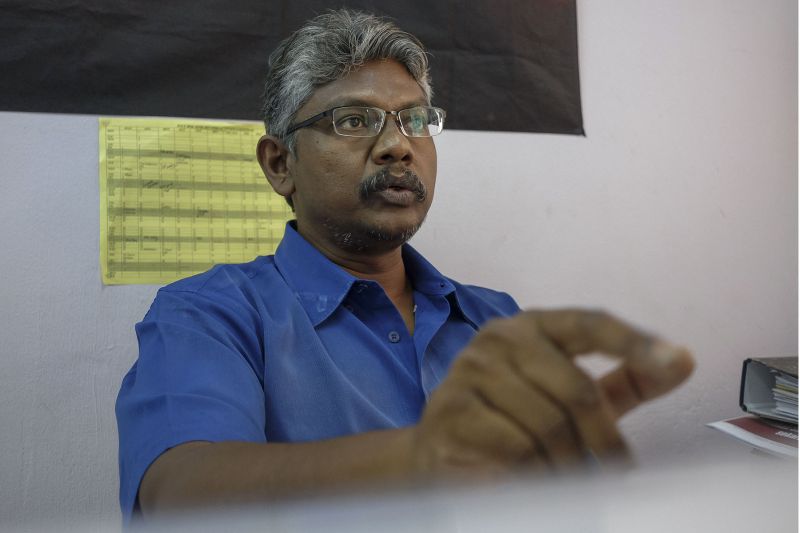
KUALA LUMPUR, May 29 — Parti Sosialis Malaysia (PSM) will field farmers and an Orang Asli activist in the next general elections, unlike other bigger parties that favour professionals and career politicians.
Beyond featuring such unusual candidates for the first time, PSM secretary-general A. Sivarajan confirmed that this is also the first time the political party will field all its candidates under the PSM banner, instead of under its allies’ name. In 2013, PSM contested in some seats on a PKR ticket and had back in 1999 contested the Sungai Siput seat using a DAP ticket.
On top of that, PSM’s plans to field at least 20 candidates in a mix of federal and state seats in the 14th general elections is also the highest in its almost two-decades history — a mark of its growth from a tiny outfit of just a few hundred members in Perak and Selangor when it started in 1998 to its current nationwide set-up with about 25,000 members.
For Sivarajan, the move to put in at least five times more candidates than in previous polls is a natural result of PSM’s growing membership with branches even in Sabah and Sarawak, as well as the expanded scope of its activist work for those who are marginalised.
PSM’s pull as an alternative platform
Citing examples abroad where socio-economic conditions had boosted voter support for the Labour party in the UK and Bernie Sanders in the US, Sivarajan said Malaysians were similarly becoming disillusioned with ruling coalition Barisan Nasional (BN) and Opposition pact Pakatan Harapan.
“I think people can see if you are not offering any alternative, people can see you are not going to solve our problem, that’s when they look for a third person — someone else — who can do a better job.
“So that’s why we find there is a great increase in our membership, because people want an alternative, we have members who are previously PAS members, DAP members, PKR members; we have a lot of young Malay youths joining us, so this is what shows they want a new solution,” he said, adding that former Umno members have to a smaller extent also joined PSM.
PSM had started doing work on the Orang Asli community’s land rights issues after 2008, beginning with Cameron Highlands, and is now voicing out on these issues from Kelantan right up to Johor. The party has also started fighting land grabbing problems faced by farmers around the same period, he said.
With PSM’s enlarged scope of grassroots work and areas where they are active in, more Malaysians have been getting involved in activism and there is now more of them who think “they should take up the election platform to raise their issues”, instead of waiting for ineffective elected representatives, he said.
“So they find that BN is the one grabbing their land and they find that Opposition in the state assembly is not voicing their own issues, so that’s why they decided they are putting up their own candidates,” he said of farmers in Perak affected by alleged eviction from their farms.
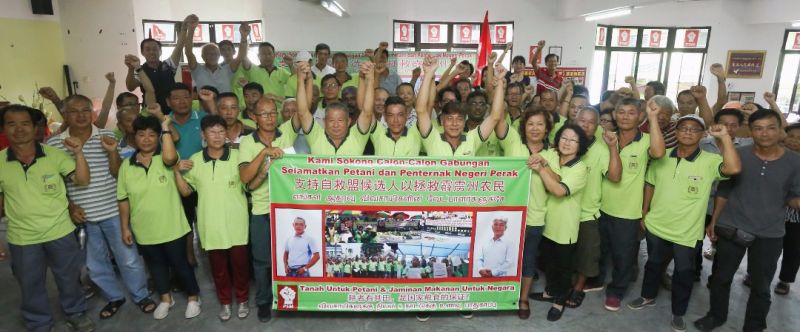
On May 21, farmer brothers Leon Chin Kwai Leong and Andy Chin Kwai Heng of Perak’s Gabungan Selamatkan Petani dan Peternak were confirmed to be PSM’s candidates for the state’s Menglembu and Tronoh state seats.
“So this shows no matter what politicians say, ‘We should go for two-party system, Ini Kalilah, get rid of BN, let us vote Pakatan in, let us give Pakatan a chance’, but on the ground, people are not waiting for you, people are already moving,” he said.
Sivarajan said the party’s entire candidate line-up, which is expected to be finalised by July, will be multiracial and contain a mix of party members and grassroots activists, such as the farmers and the Orang Asli candidate, with those from the working class background to form the majority.
While this speaks to the party’s roots as a movement fighting for workers’ rights, Sivarajan said PSM’s candidates could also include activists who are professionals, stressing however that the profession would be a secondary consideration.
“But we are not handpicking. Our basis would not be this guy is a professional, engineer, accountant, doctor, so I just bring him inside just to make my profile look better. I would not do that.
“He must have his own credibility within the struggle...he has done work. Even Dr (Jeya)kumar, it’s not because he is a doctor. He has done work already for four decades since the 1970s...we are keen on how committed you are, that’s the main criteria,” he said.
Want to be a YB? See if you measure up first
Sivarajan said none of PSM’s GE14 candidates are “parachuted” candidates that have never served the locals in the seats they are contesting for, adding that the political party has “high standards” for potential contestants.
“We have certain criteria for what they must achieve — they must be doing work in that particular area no less than two years, best is five years; they must have committed to declare their assets openly to public.
“They must be committed to set up a service centre to service that area even though they lose or win; they must not play racial politics; they must only bring up issues on a class basis; they must be a candidate for all, meaning even (as) an Orang Asli candidate, he should be able to talk on all other issues, talk about human rights, policies and so on,” he said.
Sivarajan stressed the importance of asset declaration for election candidates to instill a sense of responsibility and accountability, noting that the perks of an elected lawmaker’s job puts politicians at a high risk of becoming corrupt.
“Because if you don’t do this as a first step, it will change you as a person completely...unless you are a very strong person. The system is created in such a way that you would be changed into the top ruling elite, you will not ever understand what the rakyat feels and you continue to make policies for the rich, that’s what happens,” he said.
“That is why we say before you come as a candidate, you must stand in front and declare your assets, because that itself is a training ground for a parliamentarian to be transparent. It is an educational process for candidates. When he declares, he will develop a sense of responsibility within himself when he makes that oath because the system which he is going to get into will corrupt him,” he said.
“Because our principle is that politics is not for you to make money. We are very clear on that. If you want to make money, go to the corporate sector, don’t be a politician. We feel that those who come into politics, when they leave politics, their wealth must be the same. You should not gain wealth which is exorbitant or unexplained for,” he said.
On May 17, PSM’s Sungai Siput MP Dr Michael Jeyakumar Devaraj declared his assets publicly — the ninth consecutive year he has done so since he was voted into office in 2008 and 2013. PSM had declared that on its Facebook page that it is the only party in Malaysia whose elected lawmakers make annual asset declarations without fail.
According to Sivarajan, PSM has already finalised about 80 per cent of the seats it will be contesting in the currently determined six states of Johor, Kelantan, Negri Sembilan, Pahang, Perak and Selangor. He ruled out Sabah and Sarawak as states where PSM will be contesting in GE14 owing to the differing demands and political scenario there.
The seats are mostly mixed-ethnicity and semi-urban constituencies, with PSM’s voter base largely drawn from those whom they work with such as workers, the urban poor, plantation workers, farmers, the Orang Asli community, groups championing for women’s rights, and the lesbian, gay, bisexual and transexual (LGBT) community.
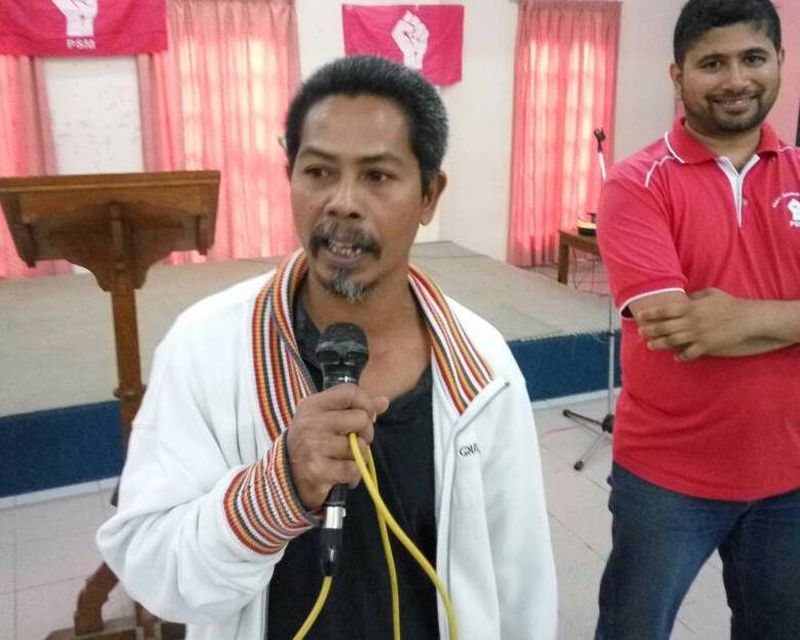
Mat Noor Ayat from the Pos Lanai Orang Asli settlement that was affected by the Telom hydro-electric dam project will be standing for PSM in Pahang’s Jelai state seat, while Jeyakumar will defend his seat and PSM’s Suresh Kumar will be contesting the Cameron Highlands federal seat after over a decade of work there.
Sivarajan said he himself, PSM committee member V. Selvam, and PSM chairman Mohd Nasir Hashim will be contesting likely within the Subang federal constituency, while PSM committee member S. Arutchelvan will be contesting likely within the Hulu Langat federal constituency.
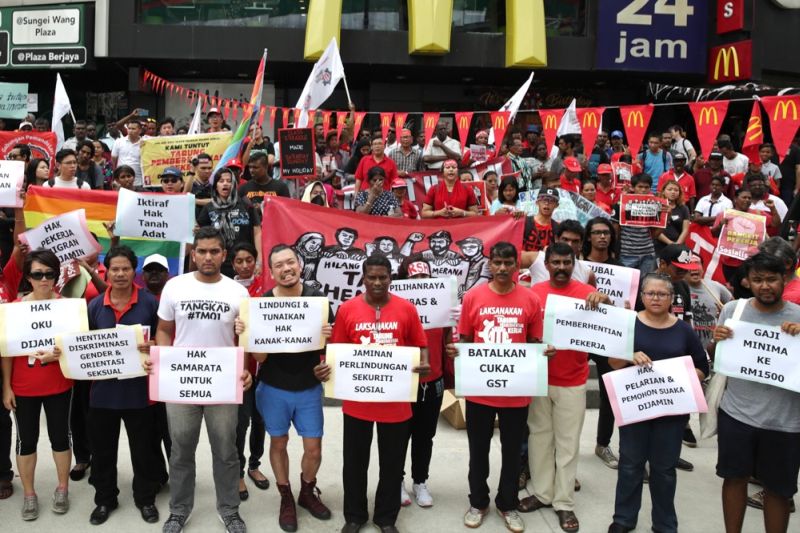
Themes in election manifesto
While PSM is still developing and finalising its GE14 election manifesto, Sivarajan said some of the themes and policies that would likely be considered for inclusion are the need to address inequality and to shift from the concept of minimum wage to “decent living wage”.
Explaining the concept of decent living wage which he said is more “realistic” and could help drive the economy by boosting domestic spending, Sivarajan said it would reflect the real wages needed to afford the basket of goods used to calculate the Consumer Price Index (CPI).
“So actually if you look today, we have also done the calculation — your food basket for a family of five, you should be earning at least RM2,000 then only you can really survive...PSM has always demanded RM1,500 minimum wage but not keeping it there. We want to develop this concept further whereby we want to move away from minimum wage calculation to decent living wage calculation,” he said.
Minimum wage for the private sector in Malaysia is currently fixed at RM1,000 per month for the peninsula and RM920 per month for Sabah, Sarawak and Labuan.
Other themes that may be included are education, the environment, Orang Asli land rights and the need for law reforms and revamp of logging concessions, as well as the need for the government to ensure truly affordable housing for the bottom 40 per cent (B40) segment of society and divert tax breaks for multinational corporations to help subsidise these property developments, he said.
Healthcare will also possibly feature in the manifesto, he said, suggesting that the government increase its allocation for this and to scrap private paid wings under public hospitals and to halt the mushrooming of private hospitals where specialists may flock to.
GE14 must be held by mid-2018, but there is much speculation that it will be called earlier.


