













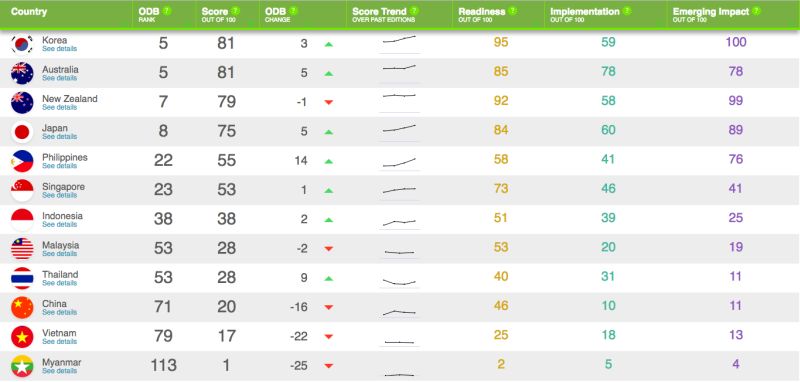
KUALA LUMPUR, May 24 ― Malaysia fell two spots to 53 out of 115 countries in the Open Data Barometer (ODB) that ranks governments based on public access to taxpayer-funded data.
In the fourth edition of the ranking by the World Wide Web Foundation released on Tuesday, Malaysia scored just 28 out of 100, a slight increase over last year’s score of 25, but a drop from 31 in 2015.
Malaysia scored 53 out of 100 when it came to readiness to capitalise from open data initiatives, 20 out of 100 for the implementation of open data, and 19 out of 100 on the impact of such initiatives.
Despite that, Malaysia received a mention for publishing its education datasets as truly open data with eight other governments, when only 8 per cent of the countries surveyed did so.
The ODB report showed that in Malaysia, data on sectors such as census, government spending, public transport, health, education, crime statistics, and public contracts do exist, but not all of them are made available online.
For example, Malaysian data of land ownership, government spending, public transport timetable, health sector performance, crime statistics and environment statistics are all not available online to the public.
For data that is available online, only the national census and education data is available as a whole, and can be read by machines so it can be reused by the public.
Whereas when it comes to readiness, Malaysia scored 66 in government policies, 50 in government action, 34 in citizens’ and civil rights, and 58 in entrepreneurs and business.
93% of government datasets are still not open, says the latest #ODBarometer. Explore the findings: https://t.co/SnwIwMHKS3 #OpenData pic.twitter.com/3hfvZRmiKO
— The Web Foundation (@webfoundation) May 23, 2017
In the region, Malaysia tied with Thailand, compared to the Philippines (22nd place), Singapore (23rd), Indonesia (38th), Vietnam (79th), and Myanmar (113th). Brunei, Cambodia and Laos were not covered by the study.
Globally, the ranking was led by the United Kingdom, followed by Canada, France, the United States, and South Korea.
This comes as the ODB found that data on key accountability metrics such as government spending, public contracts, company ownership and land ownership are among the least open, and are often of poor quality.
The ODB was based on the following data: a survey carried out between May and September 2016, a self-assesment done by governments, and secondary data from the World Economic Forum, World Bank, United Nations e-Government Survey, and Freedom House.
Earlier this month, the Department of Statistics launched two mobile apps as part of its “Merakyatkan Statistik” initiative to make national statistics more public.
And Minister in the Prime Minister’s Department Datuk Seri Abdul Rahman Dahlan reportedly told local governments to capitalise on the statistics when formulating their policies.