












PUTRAJAYA, Nov 25 — Selangor’s Islamic Religious Department (Jais) overrode its own guidelines on mosque sizes in pursuing the construction of a mega mosque on a 26-acre piece of land in Bestari Jaya, a lawyer told the Court of Appeal yesterday.
Rosli Dahlan, whose client United Allied Empire Sdn Bhd (UAE) owns the private land, argued that the state Islamic authority has no justification for forcibly acquiring so much land to build such a large mosque when the town’s Muslim population was relatively small.
"At the material time, the Muslim population is only 11,663 people," he said, referring to the area in the Kuala Selangor district formerly known as Batang Berjuntai where UAE's land is located.
To support his argument, the lawyer cited from Jais’ own manual on planning for mosque facilities.
It specified that a state mosque should be between 7.4 to 12.4 acres while a district mosque that caters to a population of 500,000 should be on 2.5 to 7.4 acres of land. A local mosque for a population of 20,000 should be built on a site measuring between 2.9 and 6.2-acres, and a surau for 2,500 people should be on a 0.5-acre plot of land.
The lawyer pointed out Bestari Jaya already has a mosque named Masjid Ar-Ridwan, which is located on the land owned by his client. He added that UAE had in its plans to develop the 26-acre land already set aside a total of one acre for the mosque.
Presently, the Masjid Ar-Ridwan is not even fully occupied and sometimes struggles to fill up even one row, Rosli said, explaining that there were 22 other mosques in the area.
He also described the Selangor Islamic authorities as being "evasive" with his client when pressed for the purpose for their compulsory acquisition of the land.
He noted that the state government gazette specifically stated the purpose for the acquisition was for a "mosque", and that it was only later that the authorities added that the land was needed for other things, such as a Muslim cemetery.
He further argued that the Kuala Selangor land administrator was clueless on the purpose of the land acquisition by Jais.
However, the appellate court was told by the assistant legal adviser for Selangor, Naziah Mokhtar, that there has been "no change" in the purpose for Jais’ bid to acquire the private land.
“What has been disputed is why a mosque needs 26 acres when allocation has been made for 0.8 acres.
“This has been explained by the third respondent (Jais), stating that the mosque's component is the mosque, a religious school and a burial site, so to merely interpret the mosque site as only the mosque is not correct," she said.
Naziah said Jais had in its affidavit explained the plans for five acres of land for the mosque, six acres of land to be carved out for the school and also noted the lack of a burial site at the mosque area.
"To sum up, I say there is no basis for the appellant to dispute the acquisition that is done for public purpose… there is no bad faith, there's no evidence that shows the acquisition had breached the laws," she said.
During the hearing at the Court of Appeal yesterday, Rosli also pointed out that the Selangor authorities had skipped the first step that he argued was mandatory under the Land Acquisition Act 1960 for a land acquisition process, saying that they had failed to issue Form A — a public notice to notify that the land will be acquired — and admitted their failure to do so.
He also said it was dubious that the Selangor authorities had completed the vesting of UAE's land in the state authority, arguing that the law requires an endorsement of memorial or registering the changes in land title records after Form K — a notice of the formal possession of the acquired land — is issued.
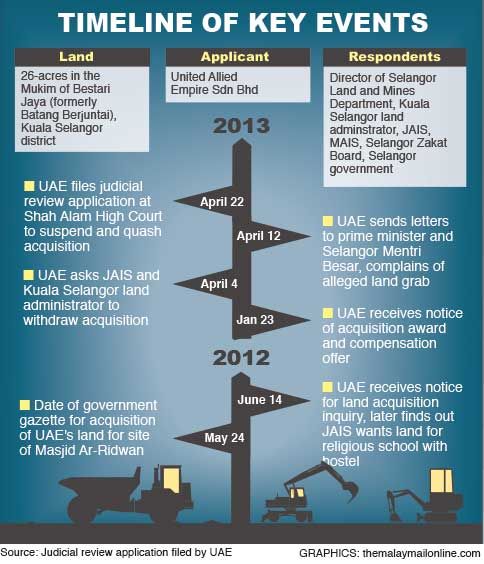 Naziah had earlier argued that the Kuala Selangor land administrator had in a sworn court document said Form K was issued on March 18, 2013 as part of the land acquisition process and that the endorsement was made on March 27, 2013.
However, she admitted that the endorsement document was not tendered in court as evidence, prompting the judges to question its exclusion.
Justice Datuk Zamani A. Rahim who was on the Bench said: "If there is no (evidence), then there is no evidence. Don't try to improvise the evidence."
The question of whether UAE still had the legal standing or right to continue with its lawsuit to challenge the land acquisition is related to whether their rights ended at the time Form K was issued or only after the endorsement was made.
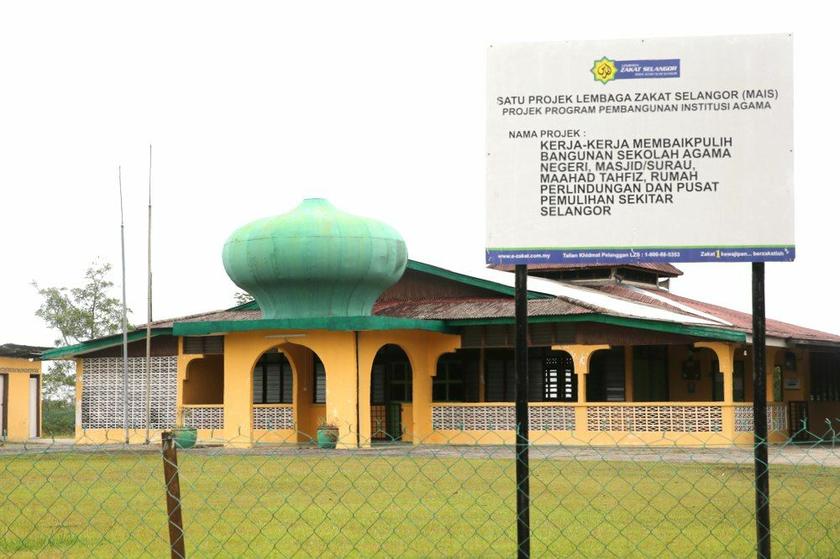
Lawyer for the Selangor Islamic Religious Council (MAIS) and the Selangor Zakat Board (LZS), Kamaazura Md Kamel, told the court that her two clients were not involved in the acquisition — despite a signboard on the works to be done previously erected at the mosque's site and bearing their names.
The Court of Appeal panel was chaired by Datuk Abang Iskandar Abang Hashim and also included Datuk Zaleha Yusof. The three-judge panel will deliver their decision at a date to be fixed later.
Yesterday was the hearing of UAE's appeal against the High Court's dismissal of its lawsuit on December 3 last year.
The Chinese company had filed for a judicial review in April 2013 as a last resort to revoke the compulsory acquisition of its land that is roughly the size of 20 international football fields.
In the lawsuit, UAE had accused the Selangor authorities of purported racial oppression and violation of its constitutional rights, claiming that the religious bodies had abused their powers to avoid paying fair compensation for the land and had shored up their land bank for future development.
According to UAE, compulsory acquisition of private land was only allowed under Article 13 of the Federal Constitution if it benefited the public and if property owners receive adequate compensation.
In a typical compulsory acquisition process, property owners can expect to be paid lower than the market value, or lower than the sum they may have received if they had sold the property.
In its judicial review application, UAE named the director of Selangor’s Land and Mines Department, the Kuala Selangor land administrator, Jais, Mais, LZS, and the Selangor government as respondents.