


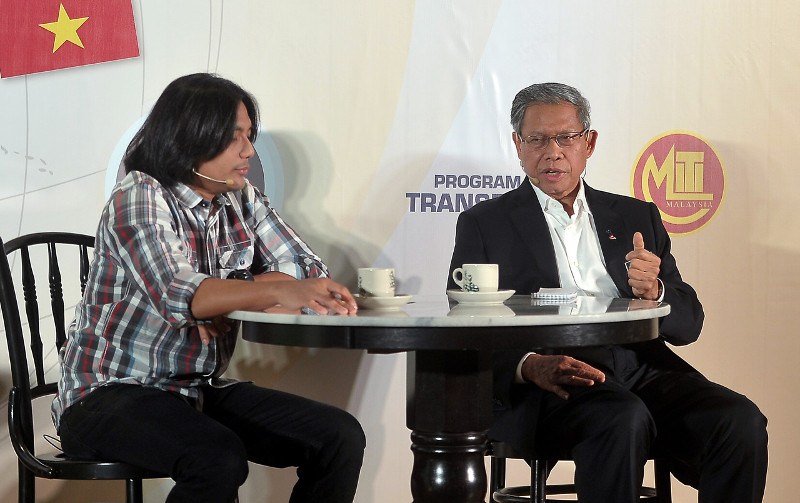
KUALA LUMPUR, Oct 16 — Malaysia has the option of withdrawing from the Trans-Pacific Partnership Agreement (TPP) even after ratifying it, as there are no penalties, according to International trade and industry minister Datuk Seri Mustapa Mohamed.
He said the only “penalties” Malaysia may face are in the forms of the country becoming less competitive in international trade.
“There are a few possible outcomes. Even after we sign, ratify and implement by 2018, and we feel uncomfortable, we can withdraw, no problem,” he said today at the #TanyaGomen engagement programme organised by the Economic Transformation Programme.
“It is not as though anyone is going to attack our country if we get out of the TPP. This is voluntary. We are entering negotiations voluntarily. We can leave, and if we leave, there are no penalties. The penalty would be that our country would be less competitive.”
Among the other possibilities he said, was if during the ratification process, Parliamentarians reject the necessary amendments to the laws by 2018, Malaysia would not be qualified to participate in the implementation of the TPP.
However he said that withdrawing was not the aim of the government as he believed that the benefits of the TPP outweighed the drawbacks. He did not elaborate on the latter.
Mustapa added that entering the TPP during its negotiations stage was important because it ensured Malaysia could influence the deal to ensure that the country’s core policies would not be compromised as opposed to joining the trade deal at a later stage.
“I admit that it has its pros and cons, but the government’s view on it is that the good outweighs the bad. We will wait for the decision of parliamentarians, and we will wait for the cost-benefit analysis. We want the decision to be made fairly, objectively and viewed from different perspectives,” he said.
“If we only choose to join, say 10 years later, when instead of 12 countries, there are already 20 countries involved, and we are pressured as a country dependant on trade to join, by then we would not be able to negotiate as we have today. We would have to accept the terms based on what had been decided by other countries.”
It was announced on October 5 that the countries had reached an agreement on the trade deal, with those representing the countries involved in the pact now set to each seeking approval to ratify the deal.
The text on details of the deal will be released in 30 days from October 5.
The TPP is a free trade agreement that has been negotiated by the US, Malaysia and nine other nations as part of the larger Trans-Pacific Strategic Economic Partnership since 2010.
According to international reports, the Pacific agreement would phase out thousands of import tariffs as well as other barriers to international trade and establish uniform rules on corporations’ intellectual property, and open up the Internet.
Critics have criticised the secrecy with which the deal was negotiated, claiming that it would, among other things, undermine the sovereignty of signatory nations and make drugs more expensive in member countries.
Following the agreement on the trade deal, lawmakers have expressed a possible special Parliamentary sitting to debate whether to ratify it.


