


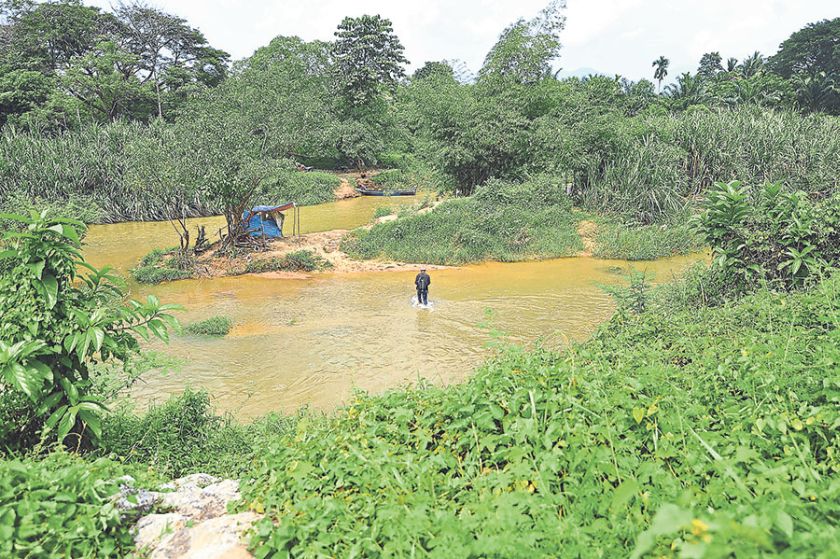
TANAH MERAH, Oct 12 — Ee (not his real name) is a boatman who plies his trade along Sungai Golok, Kelantan.
The 35-year-old is Thai and lives on the opposite side of the river in the Narathiwat province.
Sometimes, business is good and he earns enough to see him through.
There are also the not-so-good times.
Regardless, Ee needs enough money to buy an item to get him through the day.
Drugs.
The injecting drug user (IDU) is among the many who seek refuge in a “no man’s land”, where he can indulge in his “fix” with less fear of being caught.
Situated in Bukit Bunga, Tanah Merah, an islet in Sungai Golok allows IDUs to go about their daily routine without disturbance.
It takes just a walk to enter “no man’s land”, as was shown to the media who were taken on a field trip recently in conjunction with the upcoming Harm Reduction International biennial International Harm Reduction Conference with its partner, the Malaysian AIDS Council.
For those who do not want to get their feet wet in Sungai Golok, there is a boat to make the crossing to the islet easier.
The “no man’s land” is where IDUs make their way either from Malaysia or Thailand daily to use drugs.
They have an ever-ready supply because there are peddlars plying their trade there.
A makeshift tarpaulin canopy shields them from the heat and sun.
There are also bamboo trees on the islet.
It is here in Bukit Bunga that, for the past three years, governments and non-governmental organisations from both sides have been fighting to bring down HIV infections among IDUs.
This is done through harm reduction, through the needle and syringe exchange programme (NSEP) at the site, and methadone maintenance therapy (MMT), carried out at a nearby health clinic.
Bukit Bunga is one of the chosen sites because of its porous border that allows undocumented cross-border movement and other illegal activities, including illicit drug use.
The IDUs are either Malaysian, Thai or those with dual nationalities.
Ee started using drugs beginning with marijuana.
“I started using with my friends. Then, I started injecting drugs like heroin 11 years ago. I do it two to three times a day,” he said.
“It costs about RM10 to RM15 each time. I have never shared needles because I am afraid of getting infected. Since this programme started here, I am sure of getting clean needles.”
Every Thursday, Ee gets his supply of clean needles either from Malaysian NGO Kelantan Patient Intermediary Association (Sahabat) or its Thai counterpart, Population Services Population (PSI).
Funding for the NSEP for Malaysia is through a Health Ministry grant.
The Bukit Bunga project was started by the Community Action on Harm Reduction under the International HIV/AIDS Alliance.
In addition to the NSEP, Sahabat provides health outreach activities like counselling, HIV testing and referrals for antiretroviral medication and other healthcare referrals.
They serve about 30 IDUs during each visit.
Thai nationals who want to get on MMT and other medication are looked after by PSI based on Sahabat’s recommendation.
“I want to quit by getting on methadone,” said Ee.
“I did stop three times before. It didn’t last. I want to do it for my wife and kids.”
For recovering IDU Pak Cik, coming home after years of working away from his hometown of Golok has seen him go from using drugs to being on methadone now.
“You just stop wanting the drugs. The gian (urge) stops,” said the 45-year-old of being on MMT.
The HIV positive man has been one of Sahabat’s clients for 18 months and started using drugs when he was a teenager, also beginning with smoking marijuana with friends.
“I used to get my drug supply from Golok when I came back here. I started doing heroin when I was 21 when I left my home to work in places like Johor and Kuala Lumpur. I was even a cook in Singapore and cooked Western and Thai food,” he said.
“We used to share needles until they became blunt. The drugs cost about RM20 to RM30 a dose and it made you feel syiok gila (really nice). I did it three to four times a day.”
He currently does jobs like tapping rubber and farming.
“I am divorced now with one child. My 25-year-old wife just didn’t want to listen to me,” he said.
“I was diagnosed with HIV in 2002 but I’m doing fine. My eldest brother died of HIV.”
Of his decision to use methadone, Pak Cik said he just got tired of using drugs.
“You get up in the morning and within an hour or two, you start thinking about drugs again. It was also a waste of money. I have no savings,” he said, adding that his usage depended on how much money he had.
He said the sale of drugs and the number of IDUs at the Bukit Bunga port had reduced in the past few years.
“There used to be up to 100 drug users here in a day. They would queue to buy the drugs from about 7.30am. There are two suppliers now compared to the six or seven tauke previously. They sell until their stock for the day is finished,” he said.
Pak Cik also said about 30 of his friends had since died, with only five or six of them still alive.
“The number of users has dropped. It’s either because they died or they stopped using with the help of things like methadone,” he said.
“I just want to get on with my life. There is no point regretting.”
Sahabat outreach worker Harosdi Hassan used to earn a living delivering goods like oil and rice in Rantau Panjang.
Also a recovering IDU on methadone, Harosdi has been doing outreach work for Sahabat since May.
He used to be a client of Sahabat and obtained clean needles from the NGO.
Subsequently, he went on MMT.
Besides the Bukit Bunga site, Harosdi goes to five other sites under Sahabat for outreach work.
Having started with marijuana and cough syrup with friends when he was 20, Hasrodi “graduated” to “chasing” heroin, which stopped having an effect after some time.
He then started injecting the drug four to five times daily when he was 24.
“I always wanted to quit. I want to live,” he said.
“Methadone has saved my life. If not, there is no way I could’ve quit. My wife and two kids are so happy that I have stopped.”


