


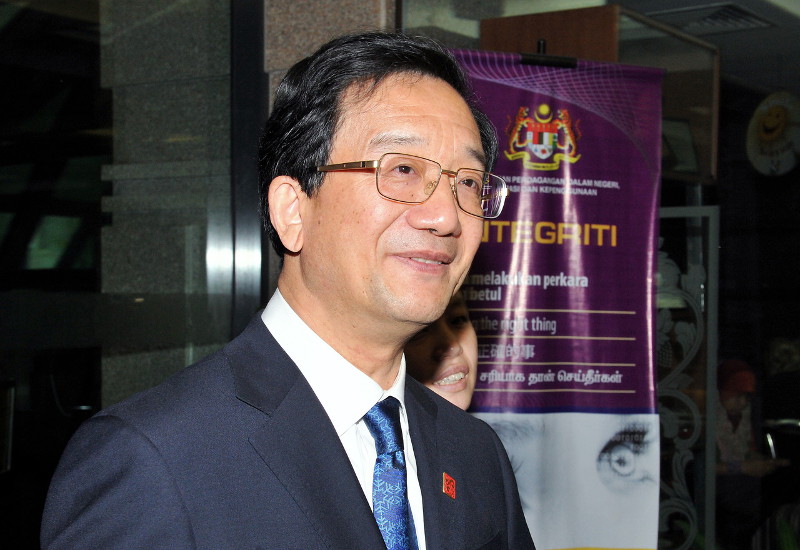
KUALA LUMPUR, Sept 29 — Malaysian leaders and opinion makers angered by Dr Huang Huikang’s criticism of alleged racism in the country should seek an amicable resolution instead of pressing for the Chinese ambassador’s expulsion, political analysts said.
The diplomatic faux pas may have struck a nerve among some groups in the aftermath of the red-shirted pro-Malay rally earlier this month, but the pundits believe Southeast Asia’s third largest economy should weigh its options carefully in dealing with its biggest trade partner, which is also the world’s second largest economy.
“China is such an important country in the region and the world, so you don’t want to jeopardise our good relations just over this,” Dr Faisal Hazis told Malay Mail Online when contacted.
The Universiti Malaysia Sarawak (Unimas) political scientist was asked to comment on calls propagated by Umno-linked broadsheet Utusan Malaysia in its Sunday edition, for the Chinese ambassador to Malaysia to be ejected for purportedly trying to interfere in a domestic issue.
Faisal added that if Malaysia really wanted to protest against the Chinese government, it should have done so when the Asian superpower first moved into Malaysian and Southeast Asian waters to lay claim to the resource-rich region.
China’s bid to expand its territory into the South China Sea through the Nine Dash Line was “clear interference” and “them trying to flex their muscles”, the Unimas lecturer said.
“Why you want to be bothered with such a petty thing? I agree with him, this should stop, we should not stoke this ethno-religion nationalism,” Faisal added.
Huang was reported to have said that China opposes “any form of discrimination against races and any form of extremism” during a walkabout last Friday in Petaling Street, dubbed the capital city’s Chinatown.
He was speaking ahead of a planned rally by a pro-government group that was reported to be demanding more Malay participation in the touristy shopping street.
The suspected ringleader was arrested the same day and held overnight, resulting in the rally being called off.
Deputy Director of Institute of Southeast Asian Studies (ISEAS) Dr Ooi Kee Beng said it is not the norm for ambassadors to make public comments about domestic events in the country which they are assigned to.
“To that extent, it was a faux pas by him. But worrying about ties between the two countries declining, and he was probably concerned that opinions back home would deteriorate to an extent worse than after the MH370 disappearance should anti-Chinese demonstrations continue, speaking out in a guarded way would have appeared necessary to him.
“I suppose the ambassador was trying to walk the thin line between being an unaffected observer and being a strategic actor,” the Singapore-based analyst told Malay Mail Online in an email last night.
He said in today’s world, all issues and debates have a global audience with the speed and accessibility of technology and the social media and for “something as distasteful as racism” is not something that can be promoted without “people everywhere feeling very upset by it”.
Dr Oh Ei Sun, senior fellow at the S. Rajaratnam School of International Studies in Singapore, also voiced similar views, saying it is quite common for countries with good relations to have occasional misunderstandings.
“In which case, they must clear it up fast so as not to affect the overall bilateral relations.
“I think this episode actually deepens the understanding of the social and cultural nuances between the two countries, hopefully lay stronger foundations for even better bilateral relations,” he said.
Ibrahim Suffian, executive director of independent pollster Merdeka Centre, said both Malaysia and China must resolve the diplomatic row amicably.
He pointed out that China is Malaysia’s biggest trading partner, but if Malaysia feels the need to do something to maintain its national self-respect, then it must do so.
“The national leadership needs to find a way to resolve this issue without having it debated or discussed in the media, they need to find a face-saving way.
“The government also needs to do what is necessary to maintain its prestige and tell other countries to not interfere in domestic affairs,” he said.
However, Ibrahim said it is too early to tell if Huang’s remarks was timed to reflect China’s attempt to exert its influence in the region.
Centre for Policy Initiatives (CPI) director Dr Lim Teck Ghee said it was appropriate for Wisma Putra to summon the Chinese ambassador for an explanation.
He noted that there will be individuals and groups that will want to agitate and demand a stronger response from the Malaysian authorities.
“However, common sense and the larger national interests call for us to move on and not make a mountain out of a molehill from this particular episode,” Lim said.


