


PETALING JAYA, Sept 28 — The exposure to haze will not result in long-term health implications, the Health Ministry deputy director-general Datuk Dr S. Jeyaindran said yesterday.
He said there was no reason for healthy Malaysians to worry, although some minor discomfort could be expected.
“Haze mainly contains particles of sulphur dioxide, nitric oxide and a small amount of ash,’’ he said.
“When these particles come in contact with watery surface, such as our eyes and throat, they would converge and become acidic. That’s when it burns and itch,” he said, adding the public should immediately go to the nearest hospital or clinic to seek treatment in case of painful reactions.
“We provide heavily subsidised treatment and medications. The most you’ll end up paying is RM2 to RM5,” he said in response to Singapore’s move to subsidise treatments for haze-related illnesses.
Dr Jeyaindran said the recurring haze problem is a short-term issue, which lasted for two to three weeks at a time.
“It doesn’t last long enough to be detrimental to our health. The worst we had was in 1997 where it lasted for more than three months, it didn’t leave anyone with any lasting illness.
“Please don’t compare this to the air pollution in China where the people there are stuck without proper air to breathe for years.”
He advised those with sensitive skin and pre-existing respiratory conditions, like asthma and bronchitis, to take extra caution.
“Those under medication should continue their prescriptions religiously, and if there are signs of deterioration in their health, get treatment immediately,” said Dr Jeyaindran, adding the same advice goes for children and the elderly.
For those who work outdoors, he advised them to reduce its frequency if possible.
“But if their job is not flexible, they must wear the N95 mask once.
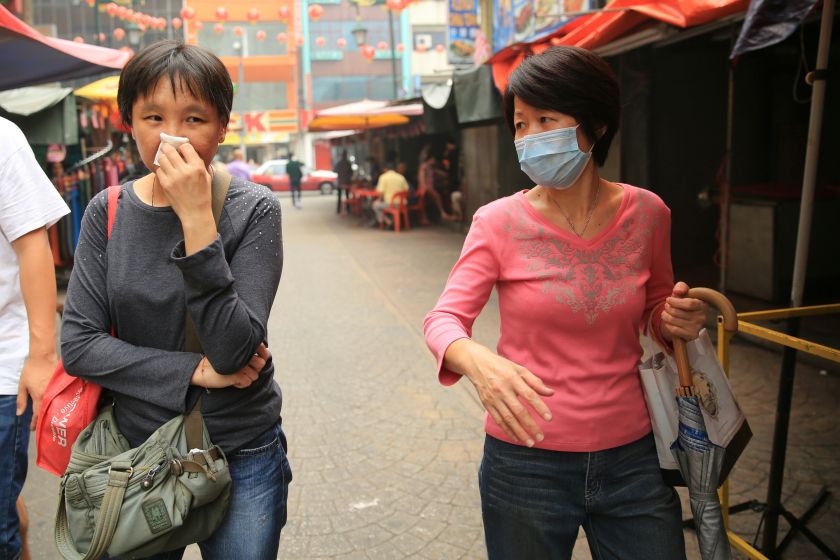
“I see people using surgical mask which does not give proper protection.
“The N95 mask can be used multiple times and filters the haze particles. The surgical mask only keeps away smell.”
In a statement yesterday, Health Ministry director-general Datuk Dr Noor Hisham Abdullah said the ministry was keeping tabs on the number of patients with haze-related illnesses.
“Through the state Health Department, we are monitoring the number of incoming patients due to haze-related illnesses, such as upper respiratory tract infection, asthma and sore eyes or conjunctivitis at selected clinics,’’ he said.
“The observation carried out revealed for the past four weeks that the arrival of patients with such illnesses showed an increased but was not consistent as a whole,” he said.
Dr Noor Hisham advised the public to ensure the air in the house or building is clean by reducing indoor pollution sources, such as cigarette smoke.
“When driving, use the air conditioner by selecting the indoor air cycle mode.
“Drink plenty of plain water, at least eight glasses a day; wash hands and face with soap and water after outdoor activities.”
Dr Noor Hisham also said if possible, install air-conditioners, air filters or purifiers at home.
“The air filter’s efficiency is higher because it blocks most of the fine particles associated with smoke and it may reduce the amount of air pollution in the house.”


