


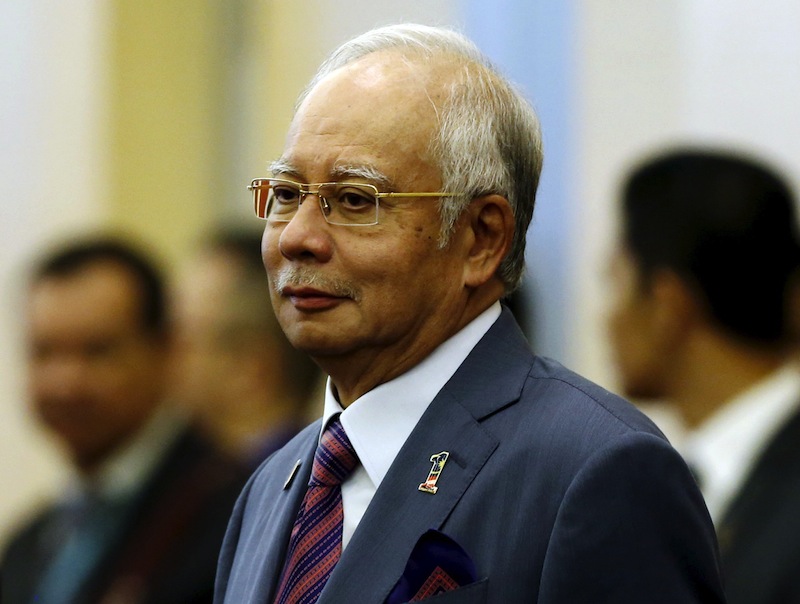
PUTRAJAYA, Aug 20 ― Government-linked corporations (GLC) and Malaysian firms should bring liquid assets abroad back to Malaysia and aid in the country's economic recovery, the prime minister said today.
Datuk Seri Najib Razak added that apart from boosting the domestic economy, the companies would also enjoy a foreign exchange “surplus” due to the ringgit’s current value.
“...Even some of our corporations they can bring back some of our liquid assets in foreign currency back into ringgit, that'll be a good move.
“They should try to consider bringing back some of their liquid assets. Although there might be some fixed assets that might be a bit difficult although if they were to liquidate just on exchange rate differential they'll make quite a significant surplus,” he said during a press conference at the Prime Minister's Office today during a rare question and answer session.
Najib announced earlier that Putrajaya would not impose capital controls or peg the ringgit to the US dollar despite the currency depreciation.
He also said that the ringgit depreciation was mainly due to the strong US dollar, which has plagued other currencies as well including Australia and New Zealand.
Najib said the private sector has been receptive to the government’s announcement as they too realised that the ringgit drop was due to external factors.
“The private sector understands and they are aware of the government policies, they consider our policies as market friendly.
“Basically they like our policies but they also realise that [it’s] mainly external factors affecting ringgit,” he said.
Najib urged foreign investors to stick with Malaysia and to look beyond the short-term economic downturn, saying Putrajaya has implemented various moves to boost the economy.
“Investment is still strong. We hope that they will see more, not just short term but long term where our new economic strengths, fiscal consolidation, balanced budget, and other transformation steps will have an effect on our economy that will be strong,” he said.
Since last year, the ringgit has lost over a fifth of its value against the US dollar, now hovering around RM4.10 to the greenback and below the RM3.80 peg that was imposed during the 1997 Asian Financial Crisis.
Although the sharp drop was not unique as it was similarly observed in other commodities-driven countries including Indonesia and Australia, Malaysia faces political instability amid the 1Malaysia Development Berhad (1MDB) controversy.
Investors, particularly foreigners, have begun to shift their funds to less volatile locations, sparking speculation of currency and capital curbs, but Bank Negara has said it will not take such measures.


