


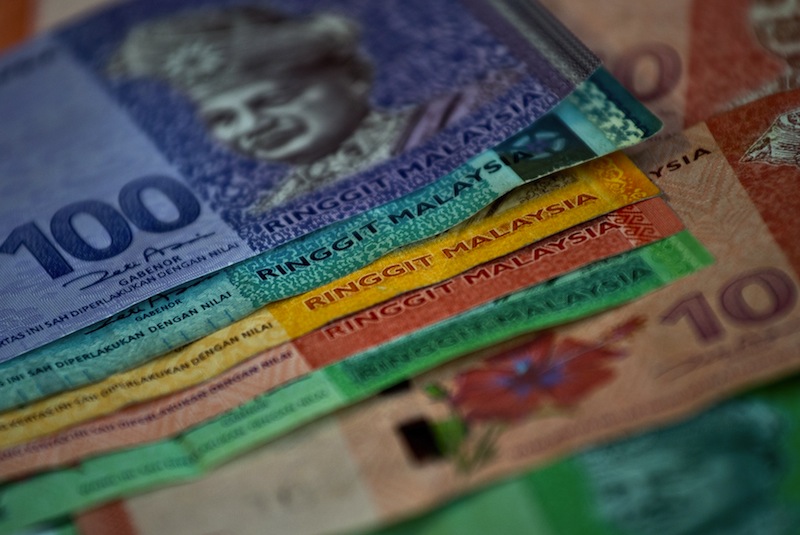
KUALA LUMPUR, Aug 12 ― Economists have backed Putrajaya’s decision not to peg the ringgit that has now fallen below RM4.00 against the US dollar, but said the government must take active measures to restore the confidence of investors spooked by local developments.
Asian Development Bank lead economist (trade and regional cooperation) Jayant Menon pointed out that foreign capital has exited Malaysia for months, evidenced by RM11.7 billion in foreign funds leaving the Malaysian bourse for the year to date, compared to RM6.9 billion for the entirety of last year, according to MIDF Equities Research.
“In the short run, the current slide in the ringgit could be stemmed if the uncertainty surrounding the 1MDB debacle and its political ramifications could be resolved,” Jayant told Malay Mail Online, referring to the state-owned 1Malaysia Development Berhad (1MDB) that is being investigated for corruption.
“In the long run, the underlying factors that allowed such an outcome, including the failure of good governance, needs to be addressed in order to restore confidence.
Fundamental reforms addressing poor governance, the quality of institutions and the macroeconomic instability would be a step in the right direction in restoring confidence, he added.
While part of current drop in the ringgit’s value was due to how falling oil prices have affected the economic fundamentals of oil-exporting Malaysia, some of the recent downward pressure is viewed as stemming from a local political controversy.
National newswire Bernama reported Second Finance Minister Datuk Seri Ahmad Husni Hanadzlah as saying Saturday that there were no plans to peg the ringgit as the government expected the currency to stabilise due to strong economic fundamentals in Malaysia.
The ringgit fell below the psychological RM4.00 barrier against the US dollar in late trading yesterday, surpassing the levels that prompted the government to fix its value during the 1997 Asian Financial Crisis.
During the crisis, the Mahathir administration had locked the ringgit at RM3.80 to the dollar and placed restrictions on the movement of capital into and out of the country.
Maybank Investment Bank group chief economist Suhaimi Ilias supported Putrajaya’s move not to re-peg the ringgit, saying such a move would necessitate capital controls to prevent Malaysia’s dwindling foreign reserves, which fell below US$100 billion last month, from being overwhelmed.
The last time the country’s external reserves fell below US$100 billion was almost five years ago in September 2010 at US$95.9 billion (RM383 billion).
“Capital controls are costs to investors in terms of compliance, uncertainties, etc. Why should foreign investors bother with the trouble of investing in Malaysia when there are other countries that allow free flow of capital/ investments?” Suhaimi told Malay Mail Online.
“Alternatively, like HK-USD peg, the currency peg to USD can still operate with no capital control, but at the expense of local interest rate which must move in tandem with US interest rate.”
The economist noted that without imposing capital controls, Malaysia will be forced to match the US in raising interest rates at a time when the local economy was already showing indications of a slowdown.
Maybank Investment Bank’s report this week on Malaysia’s external reserves said the authorities could use foreign exchange administrative rules to curb speculative currency trading and direct government-linked companies and investment funds to slow down their overseas investments, in order to stabilise the ringgit, capital flows and external reserves.
“In addition, resolving issues on 1MDB and domestic politics are important in restoring confidence, sentiment and perception,” said the report.
The Maybank Investment Bank report noted that the ringgit peg and capital controls were imposed in September 1998 when Malaysia’s external reserves were around US$20 billion.
Malaysia, like other countries that underwent the Asian Financial Crisis, had built up a significant war chest to prevent a repeat, but the ringgit’s continued slide despite Bank Negara Malaysia’s efforts to prop it up has already consumed tens of billions of dollars.
Kenanga Investment Bank senior vice-president of research Wan Suhaimie Saidie said the benefit of pegging the ringgit was less susceptibility to US dollar fluctuations, but stressed such a drastic measure would only be advantageous if Malaysia was a low-cost production country.
“No need to repeat it again unless we want to turn back time. Malaysia needs to move forward in order to be on track to achieve a developed nation status by 2020,” Wan Suhaimie told Malay Mail Online.
Dr Yeah Kim Leng, dean of the school of business at the Malaysia University of Science and Technology, said capital controls were unnecessary at this point because there is an adequate foreign reserves buffer and sound financial institutions, while the central bank has an array of tools to use should the need arise.
“The focus should be on addressing the underlying problems and not the adjustment mechanism which corrects itself once the root cause ― in this case, confidence in the country's administration ― and rule of law is reestablished,” Yeah told Malay Mail Online.


