


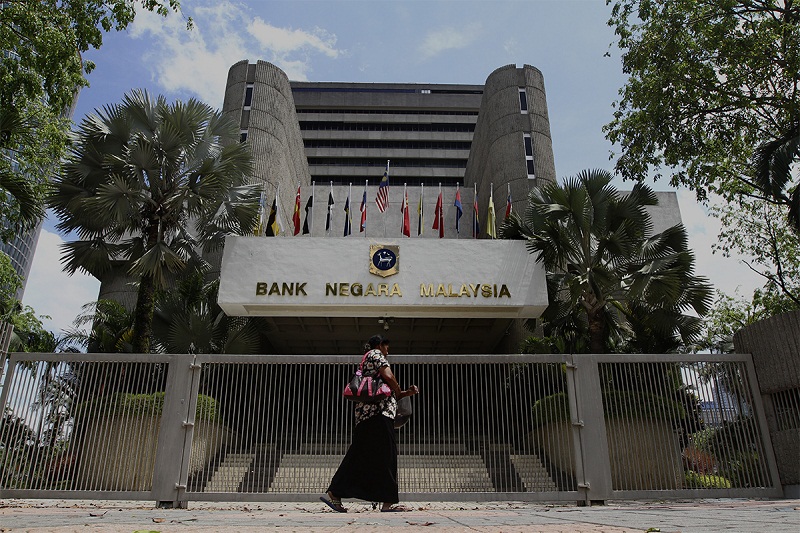
KUALA LUMPUR, Aug 8 — Bank Negara Malaysia is in an uphill battle to halt the ringgit’s slide as declining oil prices and an ongoing controversy over a state-owned development firm has attracted currency speculators looking for an easy profit.
The central bank is burning up its foreign exchange reserve at an alarming rate to stem the devaluation of the ringgit, and last month saw its war chest dip below the psychological US$100 billion (RM393 billion) mark.
But its efforts in preserving the value of the local currency amid international and local international pressure has drawn punters eyeing a repeat of the 1997 Asian Financial Crisis when the ringgit had been battered by speculators, to the point that the government was forced to impose a peg on its value.
The Mahathir administration had then locked the ringgit to RM3.80 to the dollar and placed restrictions on the movement of capital into and out of the country, but the value of the ringgit has now gone even lower.
The Malaysian currency fell as much as 2.4 per cent against the US dollar this week and 12.3 per cent for the year to date, and is projected to hit RM4 to the greenback before the year is out.
“Although recent efforts by [Bank Negara Malaysia] have helped to smooth spot movements, the pressure on the currency is evident in [foreign exchange] forwards,” analysts from Barclays was cited in a Wall Street Journal report yesterday.
Worryingly for Bank Negara is that is declining reserves could be construed as a signal for currency speculators to begin ramping up their bets against the ringgit, in the hopes that the central bank either capitulates or runs out of ammunition before then.
According to another report by the Business Times in Singapore, RHB Investment Bank senior economist Peck Boon Soon said “confidence levels will drop” if Malaysia’s reserves continue to fall, adding that only having enough reserves to cover 1.1 times of the country’s short-term debt was constricting.
Exacerbating the issue is the massive capital flight the country is experiencing, with foreign investors having already withdrawn over US$3 billion from the country in the fastest exodus experienced by any nation in Asia.
Already there are signs that the pressure on the ringgit is approaching levels beyond Bank Negara Malaysia’s ability to contain, prompting rumours that Putrajaya may reintroduce the currency and capital controls from the Asian Financial Crisis.
While part of the heavy decline in the ringgit’s value was due to how falling oil prices have affected the economic fundamentals of the oil exporter, some of the recent downward pressure came from a local political controversy, according to the Straits Times.
“Still, many funds ― portfolio in particular ― have been motivated to leave because of the manner in which Prime Minister Najib Razak and his administration have dealt with official investigations into scandal-ridden and debt-laden 1MDB,” the Singapore paper reported.
A multi-agency special taskforce ostensibly set up to investigate claims that funds from 1Malaysia Development Bhd (1MDB) were transferred to the prime minister appears to have been scuttled as investigators are now being investigated for leaked information from the probe, which Putrajaya has deemed to be action against parliamentary democracy.
Police have questioned officials from other agencies involved in the special taskforce, notably the Malaysian Anti-Corruption Commission (MACC) that yesterday had two outspoken officers abruptly transferred to the Prime Minister’s Department.
“In any event, the ringgit continues to bear the brunt of scepticism over the entire fiasco ― which has also tarnished Malaysia, and the rush to exit has noticeably accelerated in recent weeks,” the Singapore business paper added.


