


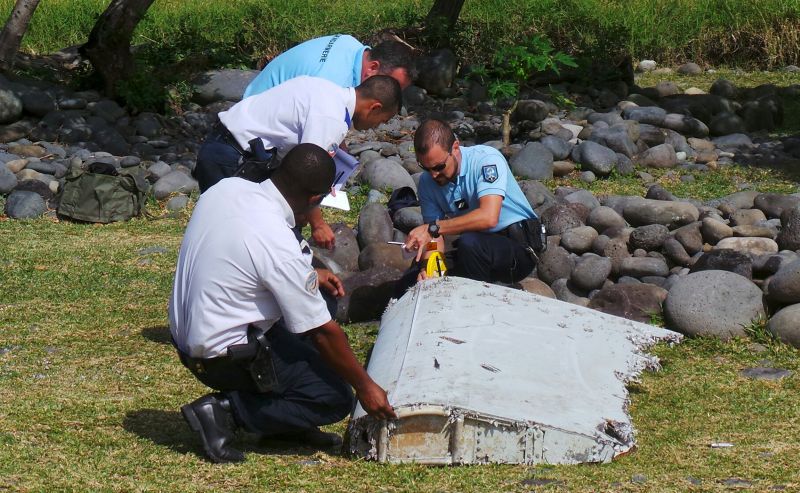


KUALA LUMPUR, July 31 — An aviation expert yesterday said only Boeing has the key to unravel the mystery of the aircraft part that drifted ashore Reunion Island.
Professor Captain Mohd Harridon Mohamed Suffian, head of research and innovation at Universiti Kuala Lumpur, said the aircraft manufacturing company stamps identification numbers on every part.
“It’s a quick process to match the number on the debris with their list,” said Harridon.
“It would take a couple of days at most, not that difficult. But be warned that some of the numbers might have been erased due to salt water corrosion,” he said.
The manufacturers would also check the type of material and coating to see if it matches, but that too might have been marred by seawater, he said.
Harridon also said the possibility of the flaperon belonging to MH370 was quite high as it was found within the seventh arc of the search area.
“It is part of the speculated area. It’s just that they haven’t searched that far yet.
“But looking at the area the piece was found, it might just be what we were all waiting for, a clue to finding MH370,” he said.
Former Malaysia Airlines (MAS) chief pilot Datuk Captain Nik Ahmad Huzlan Nik Hussain said Boeing and MAS would only need about a day or two to identify the item.
“Each part has a unique number. Boeing knows the numbers and MAS aircraft maintenance engineers know their planes intimately.
“Both will work hand in hand to ascertain if it is from MH370. They just need about 24 to 48 hours,” said Nik Ahmad.
He, however, pointed out an Airbus A310 crashed some 1,500km away from the island, and the flaperon might be from that plane.
“That plane has similar wings to the Boeing 777,” he said.
Nik Ahmad said if the find is confirmed, this would be the first physical proof that it has crashed.
“Now it is merely missing. Confirmation would cross out most of the theories that rumour mongers have been spreading and we can get on with the real job of finding MH370,” he said.
He added the flaperon could have drifted from the crash site.
“Yes, it is far, but you have to understand that it has been more than 500 days. The debris could have easily travelled about 8,000km to 10,000km.
“The sea current runs in counter clockwise direction and other debris might have been washed up to the shores of Sri Lanka, Maldives, Madagascar or even the west coast of Indonesia,” he said.
Nik Ahmad said marine biologists could lend a hand in investigations.
“They could check on the marine life encrusted on the debris and ascertain how long that it has been in the water.”
He said the wings of aircraft are made of composite, not metal, and does not rust.
“When I saw the picture, the flaperon was white instead of the usual grey. The seawater might have caused the colour to fade.
“But I’m certain that it is part of a wing of a large plane,” he said.


