KUALA LUMPUR, Jan 22 ― A World Bank economist has suggested that Putrajaya shorten its list of goods exempted and zero-rated from the Goods and Services Tax (GST), saying Malaysia needs to broaden its tax revenue to help offset the slide in oil income.
Dr Frederico Gil Sander, a senior economist on Malaysia, said the GST will help reduce Putrajaya’s reliance on oil-related revenue, and contribute to the progress of structural reforms to the economy.
“The current decline in oil revenues could be an opportunity to review exemptions and zero-rated items and ensure that only those essential goods are not taxed,” Gil Sander told Malay Mail Online over email.
PricewaterhouseCoopers Taxation Services Sdn Bhd (PwC) executive director Raja Kumaran was quoted in English daily The Star in October 2014 saying that Malaysia’s zero-rated and exempted lists appear to be the longest in the region.
There are over 900 items that are listed as zero-rated or exempted from the consumption tax system, which will be implemented this April.
Earlier this month, Dr Veerinderjeet Singh, chairman of tax advisory firm Taxand Malaysia, also warned of confusion arising from the long list, and said the complex GST system could pose administration and accounting challenges to businesses.
When announcing the revised Budget 2015 on Tuesday, Prime Minister Datuk Seri Najib Razak said Putrajaya will encourage companies to register for the GST in order to collect an additional RM1 billion in taxes to increase government revenue.
Gil Sander also said that the elimination of fuel subsidies was a triple win for Malaysia’s budget, its environment and equity, but warned Putrajaya of succumbing to public pressure when global oil prices bounce back.
“The government should begin now to think about measures to take when oil prices inevitably rise again in the future in order to avoid pressures to re-introduce subsidies,” Gil Sander suggested.
In November last year, Domestic Trade, Cooperatives and Consumerism Minister Datuk Seri Hasan Malek, said the retail prices for RON95 petrol and diesel would be fixed on a managed float system from December 1, 2014, as the government will no longer subsidise both.
Deputy Finance Minister Datuk Ahmad Maslan, however, later suggested that Putrajaya may introduce some form of fuel subsidy if global oil price rises above US$80 (RM289) a barrel, although not in the form of blanket subsidies.
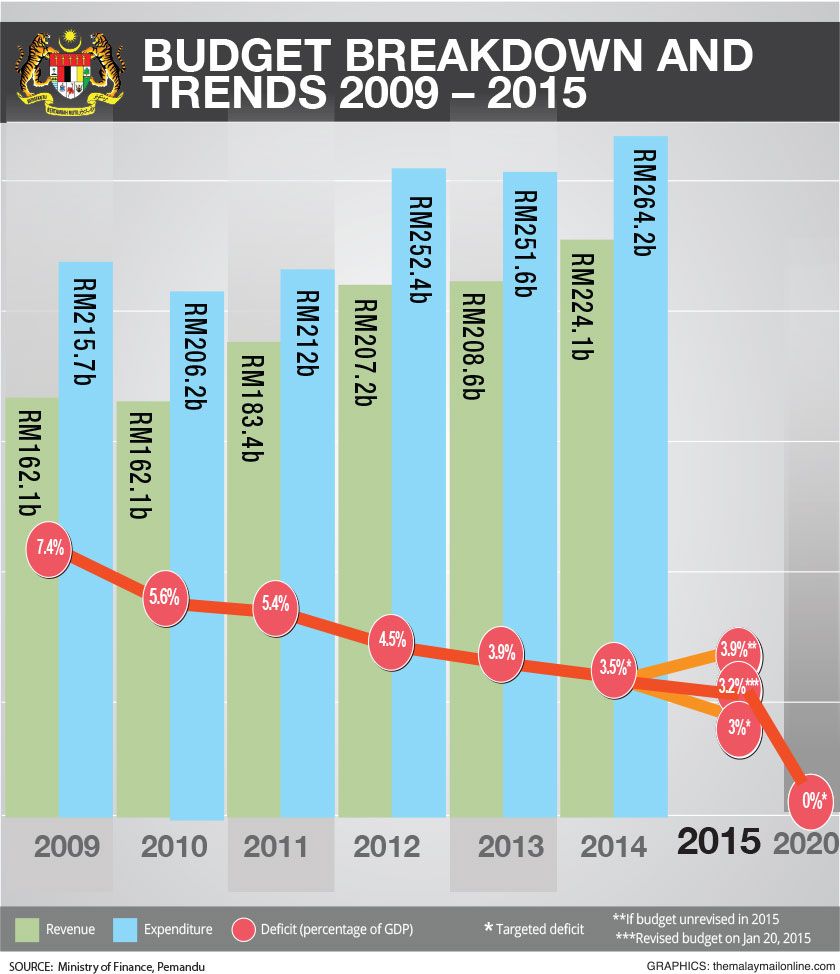
Najib said during his announcement Tuesday that the Budget for 2015 that was announced when crude oil prices were hovering above US$110 per barrel was no longer realistic as oil price has fallen below US$50 per barrel.
He added that there would be a revenue shortfall of RM13.8 billion based on the government’s forecast price of US$55 per barrel this year.
As a crude oil exporter, Malaysia is highly dependent on petroleum income. Its oil-related revenue totalled RM63 billion in 2013, accounting for 29.5 per cent of total government income.