





MELBOURNE, Dec 15 — In a decade, commuters in Klang Valley could look to what by today’s experience would be a haven in daily commutes to and from work, and school.
By 2025, the master plan of the Ministry of Works to “migrate” 40 per cent of commuters to public transport would have been in place, flushing a bottleneck that today backs up kilometres of traffic on either sides of toll booths.
Minister of Works Datuk Fadillah Yusof revealed this yesterday, in assuring Malaysians in Melbourne that measures are at hand to ease the jam that chokes development and lifestyle in Kuala Lumpur and its surrounds.
Fadillah, in Melbourne on a study tour that began in Sydney on Thursday, was responding to a question from expatriate Malaysian chartered accountant Dr Chooi S. Beh about his experience at tollways every time he returned to Kuala Lumpur.
“Have the jams to do with too many tollways, or inefficiency in processes of collection?” Beh posed, drawing comparisons with electronic collection of toll fares in Melbourne.
Fadillah, who spent yesterday at the Consulate meeting Malaysians over lunch hosted by Consulate General Datuk Dr Mohamad Rameez Yahaya before his return later in the day to Kuala Lumpur, took the gathering through what was in the works and those on the drawing board to ameliorate traffic congestion, especially in the Klang Valley.
They included the electronic collection of toll fares — the first two of which are to be soon implemented — the star rating of roads, bus systems, and the Klang Valley Mass Rapid Transit project, the first such project in Malaysia, which will be integrated with the different lines of the existing rail network.
Fadillah, close on a similar meet and greet with Malaysians in Melbourne of Minister of Rural and Regional Development Datuk Seri Mohd Shafie Apdal on Thursday, fielded other questions — some of them curly — before he mingled with Malaysians working and studying in Melbourne over lunch of Malaysian staples and delicacies.
Fadillah was on a field trip to Sydney and Melbourne to study public-private partnerships, and work protocols of building conglomerate Lend Lease, which had just signed a memorandum of understanding for collaboration with the ministry’s Construction Industry Development Board (CIDB).
CIDB is a statutory body under the ministry charged with workforce training and accreditation.
Travelling with Fadillah were ministry officials, and representatives of the private sector. Among them were CIDB chief executive Datuk Seri Professor Ir Dr Judin Abdul Karim, PLUS Expressways managing director Datuk Noorizah Abdul Hamid, and Datuk Lim Keng Cheng, managing director of engineering company Ekovest Berhad.
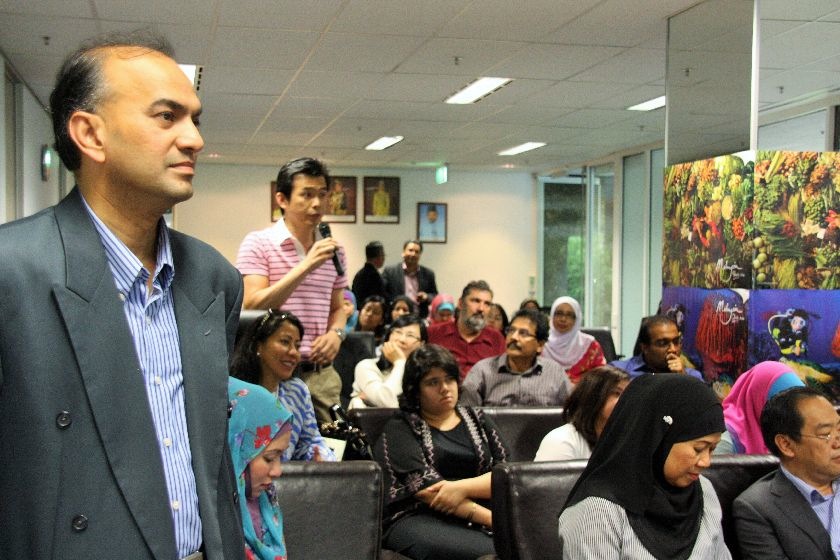
Electrical engineer Marcus Wong wanted to know how best Malaysians working overseas could “contribute back to Malaysia”; how they could go about returning to work in Malaysia.
Within Fadillah’s portfolio, he singled out the need for development of soft-soil technology and “green” initiatives, inviting collaboration for pilot projects.
“We are looking into the sustainability of our nation for [the] construction industry,” he said, “so, do come back,” he said.
Monash University final-year law student Ahmad Hamidi Abdul Rahim posed what Fadillah described as “a good question”, put to him as Youth chief of Parti Pesaka Bumiputera Bersatu (PBB), Sarawak component party of Barisan Nasional.
Hamidi’s query centred on the book Money Logging: On the Trail of the Asian Timber Mafia, written by Lukas Straumann, executive director of the Bruno Manser Fund in Basel, Switzerland, officially launched in Yokohama onNovember 3 in conjunction with the 50th session of the International Tropical Timber Organisation, at which Straumann was denied permission to speak.
Straumann in Money Logging singles out former PBB president and Sarawak Governer Abdul Taib Mahmud as “the kingpin” of this “Asian timber mafia” from which Taib’s family — “with the complicity of global financial institutions — have profited to the tune of US$15 billion (RM52.4 billion)”, according to the book’s promotion material.
The book is said to be the subject of legal proceedings against its Swiss publisher Bergli Books by a law firm in London claiming to represent Taib,.
“Will (the Malaysian government) initiate investigations, or initiate legal proceedings against the publisher?” Hamidi wanted to know.
Fadillah referred to legal action in Japan and Hong Kong that have found in favour of Taib, and that “the people who made (those allegations) have apologised”.
On forestry practices in Sarawak, Fadillah, acknowledging failings in the past, said Sarawak had signed on to international protocols and was now recognised as among those in the forefront in sustainable logging practices.
He invited “further investigation” into Sarawak’s logging practices and “if you find any more evidence (of shortcomings) I, as a practising lawyer, is ever ready to take up the case”, he said.
Fadillah told Malay Mail Online that he was heartened by the dialogue.
“There were some hard questions,” he said, “but it’s very good … for us to feed back (to Government), on policies and implementation strategies.”


