


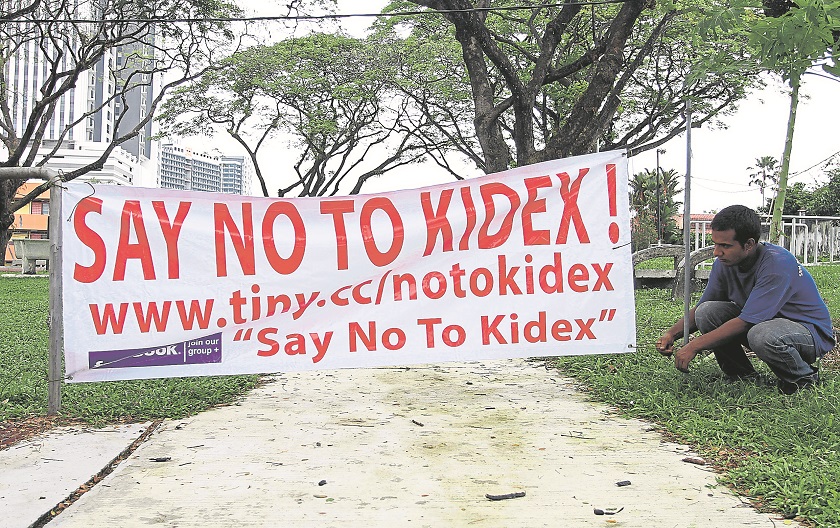


KUALA LUMPUR, Dec 9 — An international body’s expert evaluation of the Kinrara-Damansara Expressway’s (Kidex) environmental report has found “deficiencies” in two key areas of the study - the project’s impact on air quality and an analysis on whether the RM2.42 billion highway is necessary in the first place.
The evaluation, prepared by the Environmental Law Alliance Worldwide (ELAW), said the Kidex preliminary environmental impact assessment’s (PEIA) air quality impact analysis was “woefully incomplete” as it zeroed in on only one possible pollutant from the project - carbon monoxide.
“Inappropriately, the air quality impact analysis in the PEIA for the Kidex focuses on a single pollutant- carbon monoxide- (CO) and not on the other pollutants, ultrafine particulate matter, O3 (regional ozone) and nitrogen dioxide (NO2) that impact the health of children,” said the report prepared by ELAW member Mark Chernaik which was sighted by Malay Mail Online.
ELAW is a network of organisations from 70 participating countries that helps communities speak out for clean air, clean water, and a healthy planet.
Its members and associates comprise attorneys, scientists and pro-environmental rights advocates.
The environmental rights body acknowledged that while Kidex’s projected carbon monoxide levels were below Malaysia’s air quality guidelines, the PEIA had failed to include the possible impact of other pollutants, something that would have been compulsory under international guidelines like the US Federal Highway Administration.
The ELAW document added that Kidex’s PEIA showed that the highway would be in “extraordinary close proximity” to to dozens of locations where children live and go to school.
The expressway is also sited within 20 metres of a hospital.
The report also took issue with Kidex’s conclusion that the existing air quality at the areas along the highway’s planned alignment route was below Malaysia’s air quality level guidelines, saying that the measurements of guidelines only accounted for “short term” exposures.
“Measurements reported in the PEIA for Kidex were collected over a period of less than two months (September and October 2011).
“If these measurements accurately reflect particulate matter levels that generally prevail at these locations, the PEIA for Kidex should have reported that air quality at these locations is already impaired.”
Besides that, ELAW zoomed in on Malaysia’s public works department standards on any highway projects, saying that it is consistent with international practices which requires consideration of all types of traffic congestion alleviation and transportation alternatives alongside with consideration of a new road project.
“Contrary to these guidelines, the PEIA for Kidex does not include a description of alternative transportation management systems.
“Considering the high capital cost of constructing a 14.9km elevated expressway and the probable impacts of the highway on air quality, there is a necessity to consider other alternative transportation management systems, such as upgrades to existing roads, traffic management options and improved public transportation infrastructure,” the report stated.
The ELAW assessment was requested by Say No to Kidex (SNTK) through local NGO Sahabat Alam Malaysia.
The Kidex project has been rejected on three occasions by the Petaling Jaya city council as the developer failed to provide sufficient details.
Under Section 18 of the Town Country and Planning Act, construction cannot start unless a highway fits with the MBPJ’s local plans.
The Kidex highway is currently not incorporated into the council’s blueprint for Petaling Jaya.
Among the areas that could be affected by the project are Tropicana Mall, SS2 Mall, Rothman’s traffic lights, Section 14, Amcorp Mall, Hilton Petaling Jaya, Tun Hussein Onn Eye Hospital, Jalan Templer roundabout, Taman Datuk Harun, Taman Medan Baru and Bandar Kinrara.


