KUALA LUMPUR, Nov 20 ― Umno must send a clear signal at its meet next week that the country's biggest political party has no room for extremism of any sort if it hopes to continue its uninterruption hold on Malaysia, DAP's Lim Kit Siang said today.
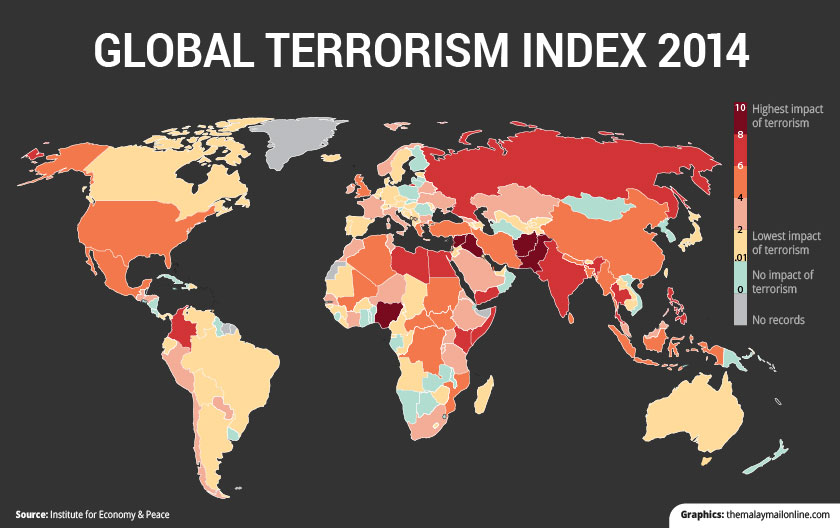
The federal opposition lawmaker reminded the ruling Barisan Nasional coalition lynchpin it was standing in the spotlight on the world stage and needed to showcase its brand of leadership, especially after Malaysia's sharp climb into the top 50 list of countries in a global index on terrorism impact indicators.
“This is why all eyes are on the Umno General Assemblies next week, whether they will send out a clear and unmistakable message to Malaysians and the world of the triumph of moderation or whether the rhetoric and politics of hatred, intolerance and extremism are to continue their march in Malaysia,” the Gelang Patah MP said in a statement.
Lim expressed concern over Malaysia's speedy climb from the 91st spot to 48th within the span of two years, asking what had “gone wrong” with a country that prides itself as a model for “inter-racial and inter-religious understanding, tolerance and harmony”.
Malaysia should have instead be listed as a country having no negative effects from terrorism, he said, pointing out that 43 countries and 39 countries had in 2012 and 2014 received such a ranking.
“Let the Global Terrorism Index 2014 be a wake-up call to all political parties, NGOs and Malaysians that we jeopardise the future of Malaysians if we do not check the rhetoric and politics of hatred, intolerance and extremism and hew to the path of moderation,” the DAP parliamentary leader said in a statement.
Lim also noted that the Malaysia should be particularly concerned with the index's findings that Islamic extremism was the lead cause of terror attacks last year, saying that religious intolerance was on the rise here.
He also pointed to Deputy Home Minister Datuk Wan Junaidi Tuanku Jaafar's reaffirmation that 39 Malaysians were found to have joined violent jihadist movements aiming to form a global Islamic caliphate, also noting that many were joining the terror group Islamic State in the ongoing Syrian revolution.
Malaysia itself was also once home to several suspected key figures in groups such as al Qaeda offshoot, Jemaah Islamiyah, the terror group blamed for the deadly 2002 Bali bombings and numerous other attacks, Lim said.
All these underscored the importance for Umno ― the Malay-based party which is also the most powerful in the ruling Barisan Nasional (BN) coalition ― to issue a signal that political extremism will give way to moderation, he said.
In the 2014 results, Malaysia’s score on the index measuring the number of terrorist incidents, fatalities and casualties as well as damage to property has also risen steadily from 2011, going from 0.42 out of a possible 10 to the current 3.04. Ten signifies the highest impact of terrorism.
According to the report, Malaysia registers 13 terrorist incidents and two related deaths in a given year.
Regionally, the Philippines, (9th/7.29), Thailand (10th/7.19) and Indonesia (31st/4.67) scored worse than Malaysia. Singapore was 124th with a score of zero, indicating no negative effects from terrorism.
In the report that registered a five-fold increase in terror-related deaths since 2000, the authors cited religious extremism as the main driver of terrorism in sub-Saharan Africa, the Middle East and North Africa (MENA), and Southeast Asia.