


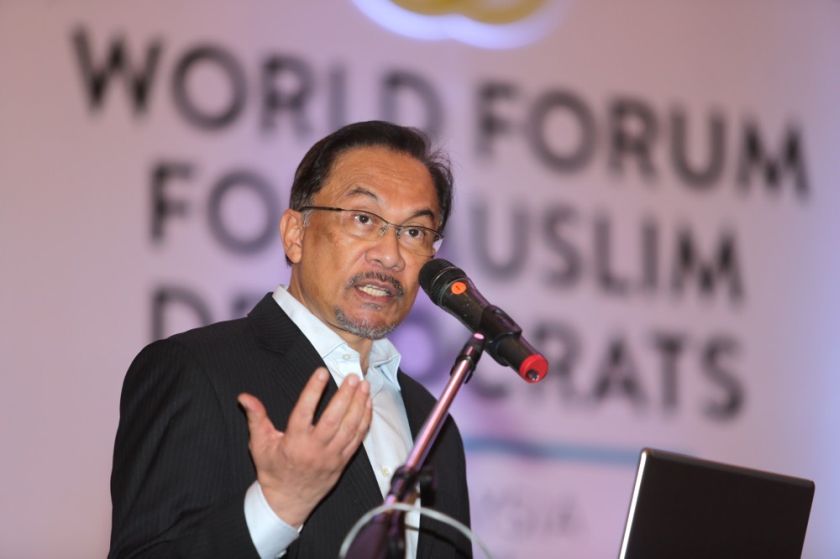
PETALING JAYA, Nov 3 ― Muslim democrats must be ready to let opposing views flourish instead trying to stifle them, a forum was told today amid rising concerns of rigid Islamisation in the region.
The World Forum on Muslim Democrats also extolled the need for Muslim leaders to embrace pluralism and tolerance in countries with differing ethnic and religious composition, in order to combat religious extremism.
“The way forward for Muslim countries or Muslims is to understand, they need to be inclusive and pluralistic,” said Opposition Leader Datuk Seri Anwar Ibrahim, who was the convener for the forum.
“In a sense not to suggest that Islam is similar to all religion … not to say you can pray like others pray. But to be more inclusive, and appreciate the need to collaborate with one another.”
According to Anwar, an individual cannot label himself a “democrat” in Malaysia if he does not believe in media freedom, an independent judiciary and if he believes in fatwas ― religious edicts ― against those whom he disagrees with.
Former Indonesian president Bacharuddin Jusuf Habibie also said he made pluralism as one of the pillars of democracy while reforming the country with the largest Muslim population during his short-lived administration between 1998 and 1999.
Habibie said religious freedom and pluralism in Indonesia is protected through the Pancasila, the five principles which became the foundation of the country, similar to Malaysia’s Rukunegara.
“Pancasila was a compromise between those who wanted an Islamic state, and those who wanted a fully secular state,” Habibie said according to his speech text, which was read by Ahmad Watik Pratiknya of the think-tank Habibie Center.
Habibie could not attend the forum as he was hospitalised last week.
Former Thai foreign minister Dr Surin Pitsuwan also suggested that the Muslim world has suffered from poor social conditions by losing its culture of tolerance.
“Somehow along the way we have lost sight ... We have become rigid, absolute, we have become very narrow,” said the former Asean secretary-general, as he urged the use of personal reasoning to come up with solutions to modern problems.
Surin also claimed that a Muslim community that is more open to opposing views would be better-prepared to tackle interpretations of Islam, which espouses extremism and violence.
“Extremism occurs when you close down the system, when the choices are whether you just flow along or you take arms against what you don’t think is right,” said Surin, who is of Malay descent.
“But if you open up the system, the contestation takes place. Let the people decide, let the people be the judge. I think we can take care of extremism.”
The two-day forum was jointly-organised by Japan’s Sasakawa Peace Foundation, Indonesia’s Habibie Center, Turkey’s Foundation for Political, Economic and Social Research, and Malaysia’s Institut Kajian Dasar.
“Religious pluralism” has recently come under attack by Malaysia’s religious authorities, with Selangor’s fatwa council gazetting an edict against it and “liberalism”.


