

KUALA LUMPUR, Oct 17 ― A survey demonstrating Malaysians’ concern over racial and religious hatred shows that Putrajaya must clampdown on extremism and bigotry to avoid losing investors’ faith, economist Tan Sri Ramon Navaratnam said today.
Commenting on a Pew Research Centre survey in which nearly one in three Malaysians viewed racial and religious hatred as the worst global threat, Ramon said the government must address the problem here to ensure the country’s continued development.
“The high response indicates our great concern, that this is a serious problem and because of that the government has to take note and act more strongly, delivering with a strong political will to combat extremism, racism and religious bigotry.
“Otherwise this really serious concern of Malaysians will be shared by the world outside and investor confidence can decline and this can affect our economic progress,” the Centre for Public Policy Studies chairman told Malay Mail Online when contacted today.
When elaborating on the actions that the federal government should take to further cement public confidence, Ramon said that individuals who spread or make hate remarks “must be pulled up”, saying that too many have done so but were not hauled up by the authorities.
He then cited as example racist remarks, as well as remarks on bible-burnings, alluding to the threat to burn Malay-language bibles containing the word “Allah” by Perkasa president Datuk Ibrahim Ali - whom he did not name.
Earlier today, Malay Mail Online reported that nearly one-third of Malaysian respondents of the Pew Research Center’s poll see religious and ethnic hatred as the world’s greatest danger.
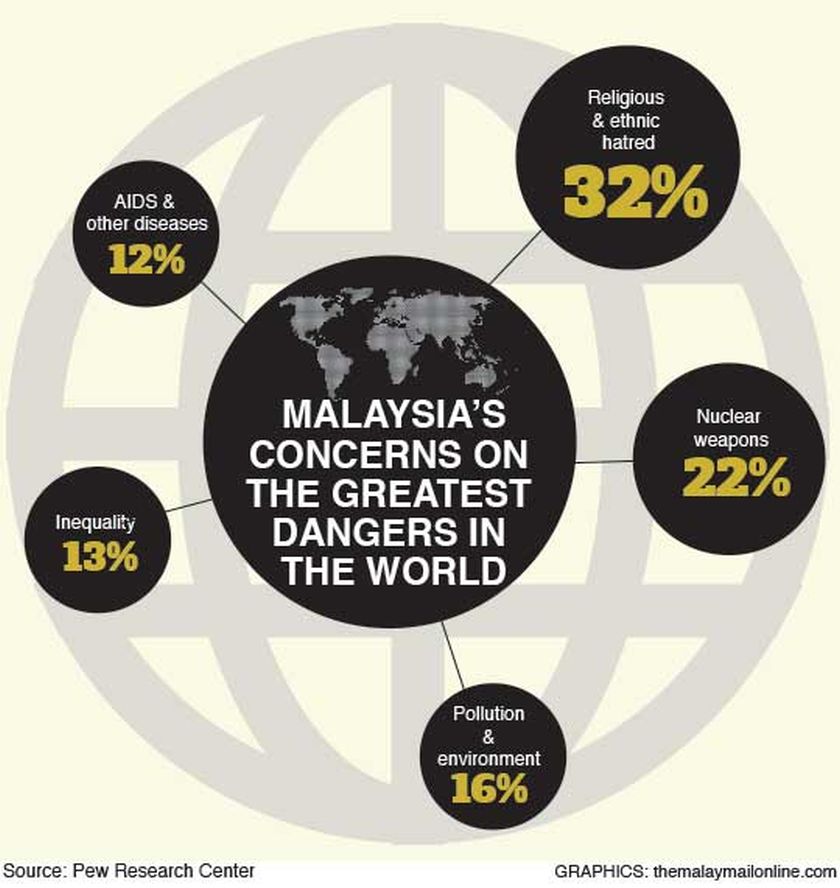
The Washington-based research group’s Greatest Dangers in the World survey released yesterday showed 32 per cent of Malaysians who cited religious and ethnic hatred as the biggest global threat today.
In contrast, 22 per cent Malaysians surveyed pointed to nuclear weapons, 16 per cent said environmental damage, 13 per cent cited increasing income inequality and 12 per cent highlighted AIDS and other diseases as major global threats.
Concerns about religious and ethnic hatred ranked the highest in Malaysia among Asian countries, followed by Bangladesh (30 per cent), Indonesia (26 per cent) and India (25 per cent), while other Southeast Asian nations such as Thailand, Vietnam and the Philippines viewed pollution and environmental issues as the greater threat.
The global survey of 44 countries among 48,643 respondents was conducted by the Pew Research Center from March 17 to June 5.
Today, Ramon also touched on Malaysia’s election yesterday into the United Nations’ Security Council (UNSC), saying that the country’s one-year membership in the influential council presented both an opportunity to contribute and a “challenge to lead by example”.
“But we have to make sure that what we say at the United Nations is matched by our performance at home, especially with regards to human rights, and peaceful and harmonious living, national unity, in accordance with UN principles. If we succeed, we'll be a model of a mini United Nations in Malaysia,” he told Malay Mail Online.
Failure to do so would put Malaysia in an “embarrassing” situation as the country would be at the top of the world stage, he said.
“But if we support the principles of UN and human rights but don’t show good results at home here, then there is a danger our credibility can be affected and public confidence in us could decline instead of increasing,” the Asian Strategy and Leadership Institute (ASLI) director added.
Pointing out that Malaysia had yet to ratify many international conventions relating to human rights, he said the successful entry of the country into the UNSC was an opportunity for Putrajaya to improve the nation’s human rights record.