


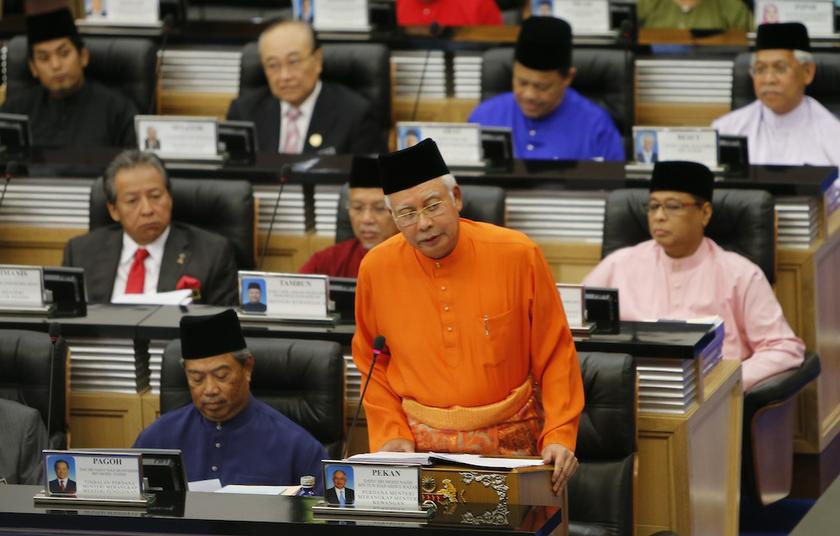


KUALA LUMPUR, Oct 6 — Malaysia’s Prime Minister Najib Razak will be present the government’s annual budget for 2015 on Oct 10. Below are some items expected by analysts, compiled from research notes and media reports.
Targeted fuel subsidy scheme
Najib could announce reform of the fuel subsidy regime in order to move away from a blanket subsidy for all consumers in favour of a system that benefits lower to middle-income earners. Abdul Wahid Omar, a prime ministerial aide, has said private firms have submitted proposals for fuel prices to be charged based on income levels, vehicle types and engine capacities.
Further subsidy cuts
The government may look to reduce subsidies on essential food items, such as flour and cooking oil, as well as household gas, said RHB Research.
New exemptions from Goods and services tax (GST)
The GST will be implemented in April 2015 at a rate of six per cent. Fresh food, public transport, education fees and healthcare are currently exempted. Maybank Investment Bank Research expects the government to announce an amended list that may include more exemptions. Maybank reckons GST revenues could decline to RM2.4 billion from RM4 billion for the April to December period, and RM7 billion for 2016 from the initial projection of 9 billion ringgit.
Operational expenses
The Fiscal Policy Committee may introduce measures to contain the size of the civil service and limit the portion of total operating expenses that salaries take, said RHB Research.
Cash aids, higher minimum wages
Bantuan Rakyat 1Malaysia (BR1M), a programme to hand out cash assistance to households earning less than RM4,000 a month and individuals earning less than RM2,000 , could be increased by RM300, said AmResearch. The expansion in BR1M will likely cost the government RM7.5 billion in 2015, up from RM4.6 billion last year, the bank added.
The minimum wage may be raised, accompanied by measures to enhance productivity, said Hong Leong.
Property market
Exemptions on stamp duty for first-time house buyers may be extended, said Alliance DBS Research. The current incentive saves buyers 50 per cent of stamp duty costs on residential properties below RM400,000 , and is due to expire at the end of this year.
Real property gains tax (RPGT) may be raised further this year, to curb speculation, said Kenanga Research. The RPGT rate was increased in 2013 to 30 per cent for properties held for less than three years. For disposals within the holding period up to 4 and 5 years the rates rose to 20 per cent and 15 per cent.
Strong measures to curb property speculation still risk slowing down consumption and domestic demand, said Affin Investment Bank.
A GST rebate may be introduced on building materials used in the construction of medium to low cost properties, MIDF Research said in an interview with Business Times.
Lower corporate, personal taxes
Corporate taxes may be lowered by more than the 1 per cent cut announced for 2016, as Malaysia’s tax rates are still higher than regional peers, said Kenanga Research. Other banks predict that the government is more likely to bring forward the cut in corporate taxes rather than increase the amount of the cut.
New tax reliefs for households may be announced, to further alleviate the cost of living, said Alliance DBS.
Infrastructure spending
More funds may be allocated to improve the country’s railway infrastructure and network. This includes ongoing work in Kuala Lumpur, and the planned commuter train linking Singapore to Johor Bahru, said Maybank.
The government may allocate more development funds for states in eastern and northern in peninsula Malaysia, said Kenanga Research. Sarawak state, on Borneo island, could also receive more funds, mainly for its rail network and the Sarawak Corridor of Renewable Energy, said Maybank.
Higher oil royalties
The states of Sabah, Sarawak and Terengganu may be awarded higher royalties on oil production than the current 5 per cent rate, said Maybank. In May, Sarawak requested that the rate be raised to 20 per cent. Other states would expect the same treatment, said Maybank.
Islamic finance
Tax incentives could be offered to promote Islamic bonds in foreign currencies, Maybank said. Non-ringgit sukuk account for less than ten per cent of all issuances.
FDI
More incentives may be offered to attract higher value-added export oriented foreign direct investment (FDI), said RHB Research. — Reuters


