PERTH, June 4 — An undersea data device situated in the Indian Ocean operated by scientists from Curtin University detected low-frequency noises at around the same time missing Malaysia Airlines plane transmitted its last satellite signals, it has emerged.
The noise, which was in the 0-100 Hz range, was also picked up by a hydroacoustic station in Cape Leeuwin, the south-westernmost point of Australia. That station is run by the Comprehensive Nuclear Test Ban Treaty Organization.
Data suggests the low-frequency noise could have been emitted from near the southern tip of India, some 3,000 miles northwest of Australia, according to the Telegraph.
If true, this would deviate greatly from the current search area, which was calculated based on the satellite data provided by tracking company Inmarsat.
“It’s not even really a thump sort of a sound — it’s more of a dull oomph,” said Alec Duncan, a marine scientist leading the research, in an interview with the New York Times. Duncan put the probability of the sound emitted by MH370 at 25 to 30 per cent, which he believes is “worth taking a very close look at”.
In another interview with CNN, Duncan said the sound could be produced by “the impact of the aircraft on the water”, or “the implosion of parts of the aircraft as it sank”.
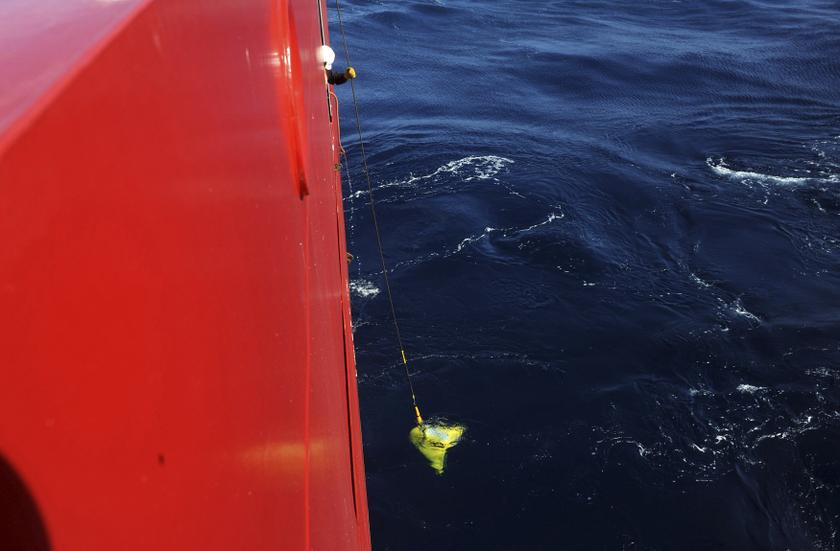
The device Duncan used is intended to listen and record noises made by whales and other marine life.
But experts say the mysterious undersea noises could also have come from a natural source, such as a small undersea earthquake.
The sound could also have bounced off a seamount, an undersea mountain whose top does not reach the sea surface, as the sound travelled to two receivers.
Sound travels at almost a mile per second through water, five times faster in the sea than through air. Low-frequency noises can travel thousands of miles through water in favourable conditions. — Reuters