


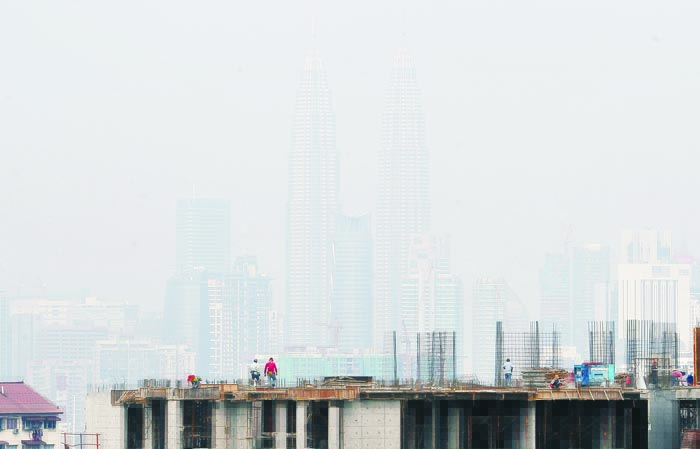


KUALA LUMPUR, Jan 27 — The cold winter conditions in China that is forcing its citizens to rely heavily on burning coal to keep warm could be the contributing factor of the hazy situation in the country.
Pollution scientist Prof Dr K. Narayanan observed that the winds may have carried fine soot to the Southeast Asian region.
“There are many factors that contribute to such instances. As coal is heavily used in China, the winds could carry the soot to this part of the world resulting in the current hazy conditions in Kuala Lumpur and elsewhere,” said Narayanan.
“The winds from China are known to carry dust particles from the Gobi desert to as far as Japan, Korea and even California.”
He said Malaysia was experiencing a strange phenomenon as hazy conditions in the country were usually seen later in the year.
Narayanan, who was with University of Keil in Germany and had been with Universiti Putra Malaysia faculty of environmental studies for the past 10 months, said the automobile pollution in the country further aggravated the situation.
“The pollution level is very unhealthy. I call this local cooling, global warming.”
Narayanan said tropical countries would experience more rainfall resulting in landslides due to the drastic changes in global weather.
“I was in Germany for Christmas last month and it was 12° C. It was the hottest Christmas I have ever experienced.
“Now we are experiencing chilly weather in some parts of Malaysia. This is all the result of climate change which is driven by human activity.”
He was also in Korea for eight months and was told by the locals that Korea no longer experienced four seasons but only a long summer and a short winter.
He stressed the need for people to change their lifestyle.
“Why are there four vehicles in a single household? There needs to be a proper public transportation system and we must encourage car pooling.”
The Malaysian Meteorological Department said yesterday’s Air Pollution Index (API) reading was moderate in several locations. SK Jalan Pegoh was 82 (at 3pm), 80 in Cheras (3pm) and 77 in Banting (3pm).
Good API readings are between 0-50, moderate (51-100), unhealthy (100-200), very unhealthy (200-300) and hazardous is a reading of 300 and above.
 Last June, the API in Muar, Johor, hit 746. The worst API reading in the country was 860, recorded in Sarawak in 1997.
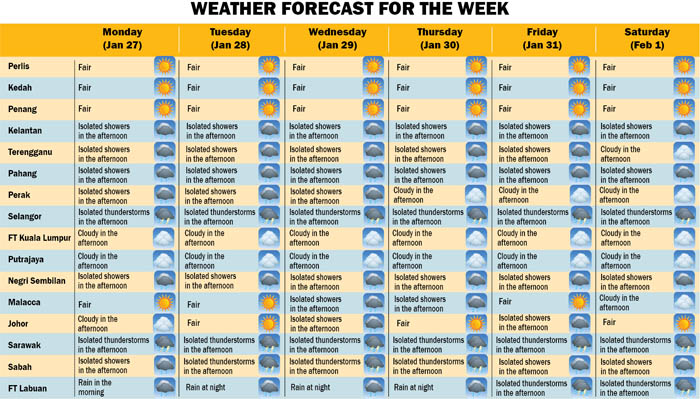
“While the peninsula can generally expect a decrease in rainfall for the next few days, rain and thunderstorms are expected to occur during Chinese New Year in West Coast states such as Perak, Selangor, Negri Sembilan and Johor, especially in the afternoons,” read a statement from the Meteorological Department.
A press statement from the department on January 23 explained temperatures in January and February were relatively low compared to other months.
“The cooler-than-normal air temperature in most areas this week, especially those in the eastern and northern areas of the peninsula, is due to strong north easterly winds from mainland China, which is currently experiencing winter,” it said.
Areas that recorded low temperatures on Saturday were Batu Embun (22°C), Chuping (22°C), Kuantan (21°C), Kota Baru (20°C) and Kuala Krai (19°C).


