




KUALA LUMPUR, Jan 13 — With high government spending on subsidies, Malaysia and Indonesia are more exposed than others to “external shocks”, The Economist said in its latest edition.
But as countries worldwide look to ease the burden of providing cheaper energy at the public’s expense, the case for cutting back on energy subsidies seems easily undone by politics, the British financial and current affairs weekly said.
“The IMF forecasts that Malaysia’s cuts will push up its inflation rate only slightly, from 2 per cent in 2013 to 2.6 per cent this year,” it said in its Banyan column, which covers Asian politics, of the International Monetary Fund’s predictions.
“While it may put a dent in real wages, slightly higher inflation would chip away at the country’s public debt and help its government avoid a breach of its statutory debt ceiling of 55 per cent of GDP,” the weekly said in its latest edition last week.
It noted the two Southeast Asian nations face increasing budget deficits that leave them vulnerable to rising global interest rates.
“Whether more countries will follow the lead of Indonesia and Malaysia, however, does not depend only on economics,” it said.
The Economist predicted that austerity measures could be expected to become the global norm as subsidies become increasingly unaffordable in the face of exponential hikes in crude oil prices.
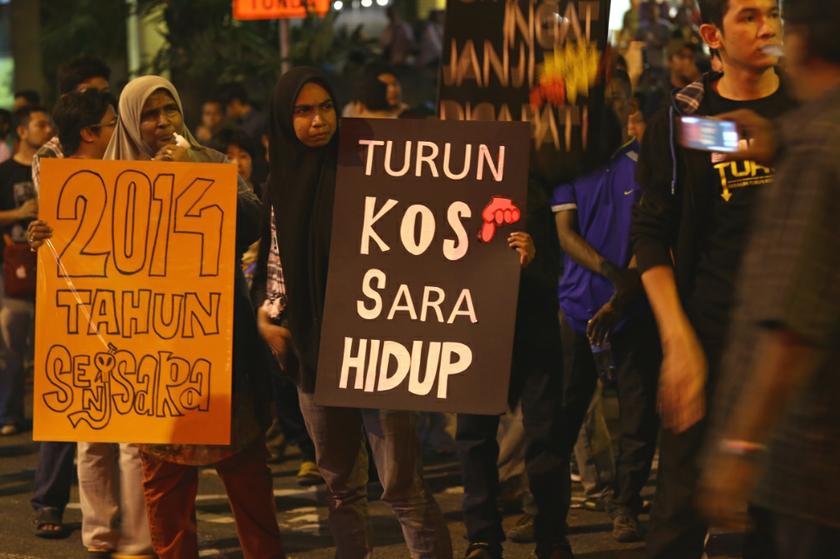
Putting the spotlight on Malaysia, where thousands attended a rally on New Year’s Eve against subsidy cuts and rising rates, The Economist argued that the inflationary impact of subsidy cuts is minimal and would go a long way in helping bring down national debt.
It noted too that in neighbouring Indonesia, its people’s opinion has put politicians under pressure to roll back some of the reforms this year.
“When it comes to cutting subsidies, politics can still trump even the best economic or environmental arguments,” it said.
Subsidy cuts would also reduce inequality, The Economist argued, as the money saved could be channelled to more targeted cash-transfer schemes for the poor, such as Malaysia’s Bantuan Rakyat 1Malaysia (BR1M).
Citing IMF research data, the weekly noted that only 7 per cent of fuel subsidies in poor countries reach the bottom 20 per cent of households, while 43 per cent of the subsidies end up in the pockets of the richest 20 per cent.
The cost of government subsidies for fossil fuels has increased from USD311 billion (RM1.02 trillion) in 2009 to USD544 billion (RM1.78 trillion) in 2012, it added, citing estimates by the International Energy Agency (IEA).
“Cutting subsidies now would help them prepare for when borrowing gets harder as quantitative easing ends. It would also leave more money for growth-boosting policies, such as infrastructure investment,” it said.


