


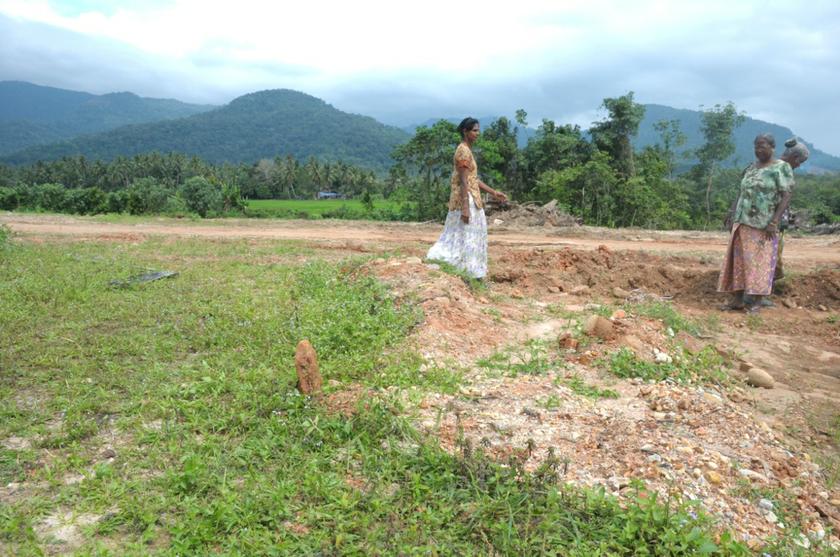


KUALA LUMPUR, Dec 3 — Hit by brickbats for bulldozing the remains of an ancient Hindu civilisation in Lembah Bujang in Kedah, a housing developer for the area has claimed to be unaware of the site’s historical significance.
Saw Guan Keat, project manager for Bandar Saujana Sdn Bhd, was reported in The Star newspaper as saying the company would have left candi number 11 alone if they had known the stones on the land were the temple ruins of a once-great civilisation.
“We had a site visit before land clearing started in September. We saw a stone structure (the candi). We did not know what it was,” Saw was quoted saying.
He added: “If we had known the structure was a historical site, we would not have cleared it.”
According to Saw, the company had learnt of the stones’ significance only through news reports, by which time it was too late as its contractors had already discarded the demolished structure as debris.
He related that Bandar Saujana had taken over the development project for the area from another builder, adding that the project had been approved by the Sungai Petani municipal council in the mid 1990s.
Saw said Bandar Saujana had twice carried out land searches at the Kedah Land Office — on January 14 this year before purchasing eight plots of land from the previous developer and again on July 30.
On both occasions, the land search showed that there were no encumbrances for the land, which Bandar Saujana subsequently purchased in February this year.
A local archaeologist has also said the 8th century candi can be rebuilt if drawing plans of the temple are available.
“As long as we have the plans, we can reconstruct it,” Prof Dr Mokhtar Saidin, who is the director of USM Centre for Global Archaeological Research (CGAR), was quoted saying.
He reportedly said that the candi could be rebuilt using laterite and pebbles found in Lembah Bujang if those materials were originally used.
 Tourism and Culture Minister Datuk Seri Nazri Aziz said the National Heritage Act 2005 could be used to impose a stop work order even if private property is involved.
The Kedah state government has since asked the developer to stop the land clearing pending investigations into the issue, which it has complied with.
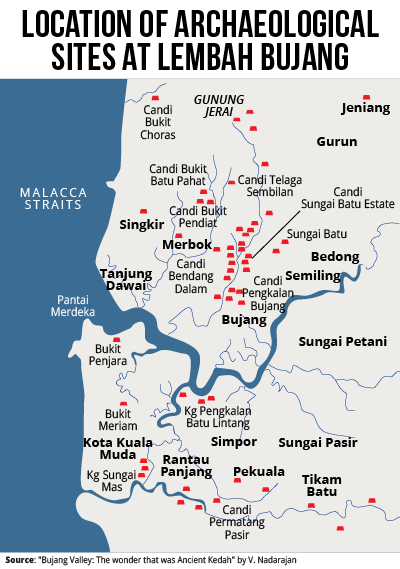
Lembah Bujang is the richest archaeological site in Malaysia and the home of the oldest man-made structure recorded in Southeast Asia — a clay brick monument dating back to 110AD.
Excavations on the site have also uncovered jetty remains, iron smelting sites and relics with Hindu and Buddhist influences that point towards a Hindu-Buddhist kingdom there as early as 110 CE.
British colonists first discovered the ancient ruins in the 1840s and ever since, archaeologists from the world over have visited the site to conduct extensive research.
In 1974, the then Museum Department commissioned a team of archaeologists to reconstruct 10 of the candi where four were relocated to the current museum grounds while the rest were left in situ.
Since then, researchers and archaeologists have found more candi located all over the Lembah Bujang and a recent study by Universiti Sains Malaysia (USM) revealed that there are 127 archaeological sites in Kedah with over 90 candi in Lembah Bujang.
Many sites are still in the midst of being excavated and a team from the USM Centre for Global Archaeological Research (CGAR) also has a base there excavating and researching some of the sites in the valley.


