


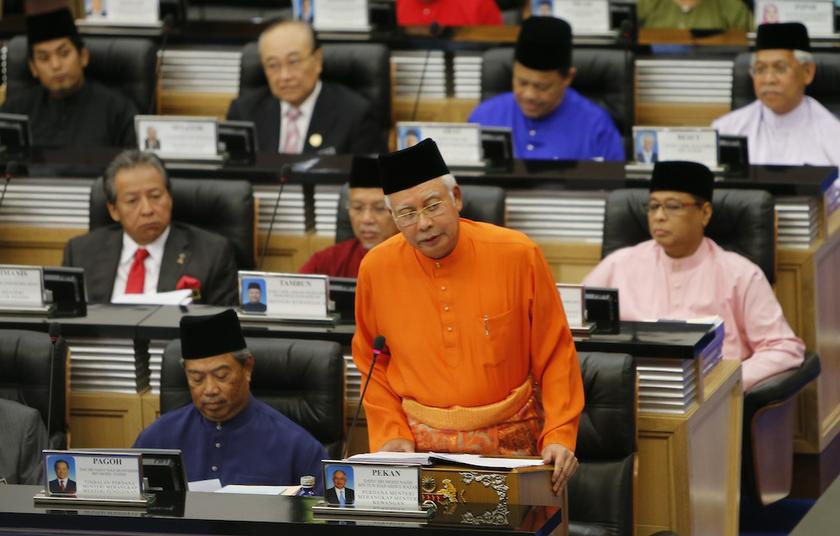


KUALA LUMPUR, Oct 25 — Malaysia will finally implement the long-delayed Goods and Services Tax (GST) at 6 per cent beginning April 2015, Prime Minister Datuk Seri Najib Razak announced today as Putrajaya seeks to tackle its chronic deficit.
The replacement to the current Sales and Services Tax comes amid public concerns that it will increase the cost of living through a hike in the inflation rate, especially after a fuel subsidy cut in September.
To offset the new tax, Najib also announced that personal income tax will be reduced by 1 to 3 percentage points, depending on the income bracket.
A one-off payment of RM300 under the 1 Malaysia People’s Aid (BR1M) will also be made following the implementation scheduled for April 1, 2015.
“The fact is, the government has taken a few years, sufficient time to run a detailed and comprehensive study, and has taken into account the views of every strata of the public,” said Najib while tabling the Budget 2014 here.
“Thus, based on the principle of putting the people first, the government has decided for a taxation system that is comprehensive and fair, which must quickly be implemented to benefit all Malaysians.”
According to Najib, the timing was right to roll out the GST as Malaysia’s inflation rate has stayed at a relatively low rate of between 2 and 3 per cent.
The GST is a consumption tax, meaning all Malaysians will be taxed according to their level of spending, regardless of income. This differs from income tax that is only applicable after a certain salary level is exceeded.
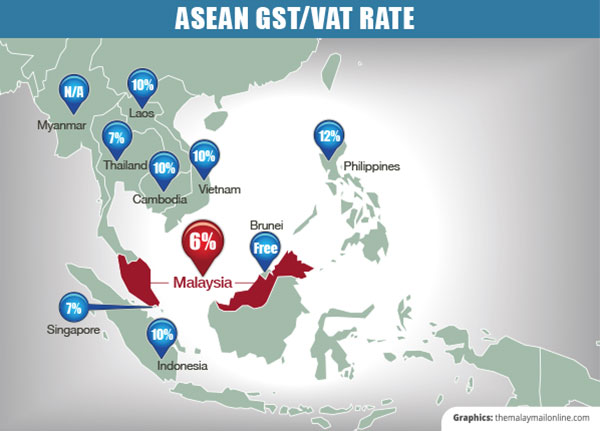
Malaysia’s proposed GST rate of 6 per cent is the lowest in the region, whereas most countries implement a 10 per cent value added tax (VAT).
Najib announced today that essential food items would be exempted from the tax, in addition to tap water and the first 200 units of electricity. Government services and public transport will also be exempted.
The tax was first announced during Budget 2005 and was originally scheduled to be implemented in 2007 before it was deferred.
The GST Bill was then tabled for the first reading in 2009 for implementation in late 2011, but was withdrawn during the second reading in 2010 following fierce public resistance.
But Najib signalled yesterday that Putrajaya is finally ready for the measure, following the revision of its sovereign debt outlook from “Stable” to “Negative” in July by rating agency Fitch Ratings owing to rising government debt and budget deficit.
“The government will do what is right for our economy. Some measures may not be popular now, but over the medium term, what is good for the economy is also good for the people,” Najib said in an emailed statement late yesterday.
Malaysia runs a relatively high government debt of 53 per cent of its gross domestic product (GDP) ― just under the legal ceiling of 55 per cent ― and has one of Asia’s highest household debt levels, at over 80 per cent of GDP.
Putrajaya has stated that it aims to reduce its budget deficit-to-GDP ratio to 4 per cent this year and gradually to 3 per cent by 2015.


