


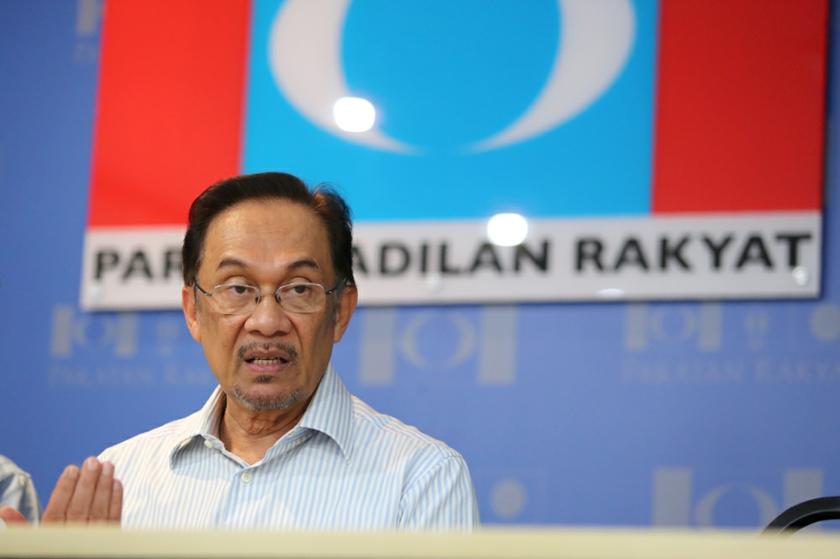


PETALING JAYA, Aug 12 — Malaysia risks signing away its sovereignty to the US if it ratifies the Trans-Pacific Partnership Agreement (TPPA), said Datuk Seri Anwar Ibrahim who today alleged the free trade deal is aimed at expanding “American hegemony” in the region
This is the first time the opposition leader, once a darling of Washington and a known free market advocate, has spoken out against the 12-nation free trade arrangement (FTA) that the Najib administration appears keen to join.
“Being the major trade policy initiative of the Obama administration, little wonder that the US is the leading negotiator behind most proposals while the TPPA is mainly based on the typical US FTA template.
“With its 29 chapters in total as opposed to at most 10 chapters in a usual preferential FTA, Keadilan views TPPA as an attempt by the US, as its main driver, to impose its brand of economic model of total free market, laissez-faire approach, deregulation and small government,” he told a press conference at his party’s headquarters here.
The PKR adviser claimed the TPPA went beyond conventional free trade deals. Apart from the removal of tariff and non-tariff barriers, it contains cross-cutting “horizontal issues” that have a direct impact on Malaysia’s legal and judiciary system, economic structures and democratic institutions.
He said the US move not to include other East Asian economic powerhouses or countries already under its influence was the clearest indicator of Washington’s intentions.
“The glaring absence of China, South Korea, Taiwan and Indonesia in the TPPA only lends credence to this theory of modern-day American hegemony that promotes primarily the US economic, business and geopolitical interests,” he said.
Putrajaya had been adamant in pointing out the benefits it stand to gain from signing the TPPA, claiming that Malaysia could earn up to RM41.7 billion in exports and RM26.3 billion in gross national income per annum by 2025, according to a study conducted by the Washington-based Peterson Institute for International Economics.
But Anwar noted that the federal government has declined to divulge the cost-benefit analysis (CBA) it used to back its support of the free trade deal.
International Trade Minister Datuk Seri Mustapa Mohamed had recently told Parliament that Putrajaya’s refusal to disclose its approach was for “strategic” purposes, which appears to be the same reason behind why details of the negotiations must be kept confidential.
“In the absence of a full public disclosure of a comprehensive and thorough CBA undertaken by the Malaysian government, we should take with a pinch of salt,” he said.
Anwar claimed leaked papers of the TPP negotiations clearly indicated a lopsided agreement that would help enhance US businesses instead of other participating nations.
“For illustration, although the TPPA may theoretically give Malaysian companies access to the USD500 billion in annual US government procurement market, the of this market is defence, which is exempt from the TPPA while all 50 US states have the authority to determine their own procurement policy and hence, no obligation to observe any US FTAs”.
Anwar also noted that the US have set a completely different approach in its FTA talks with stronger economies like the European Union where it allows more transparency.
The PKR advisor said on this ground alone Malaysia should reject the TPPA until a comprehensive and impartial CBA are conducted and made available to the public.
Malaysia's involvement in the TPPA talks have met strong resistance not only from the opposition, but also from business groups close to the Najib government as well as then prime minister Tun Dr Mahathir Mohamad.
Detractors of the agreement claim signing the deal would see American companies dominating Malaysia's weaker market and shoot up prices of basic goods like medicines.
Another key concern is the investor-to-state dispute settlement mechanism that is said to favour the companies more than the state, a longstanding contention that had fueled the global anti-free trade movement.
To allay fears, Putrajaya had agreed to set up a multi-partisan Parliamentary Caucus on the TPPA although Anwar said this was a far cry from the much preferred Select Committee.
The opposition leader, however, said he welcomes the move and is expecting the Caucus to act as a strong pressure group with the ability to exert influence on Cabinet decisions regarding the TPPA.
He also urged Putrajaya to focus more on enhancing FTAs with the South East Asian Nations (Asean), China, Japan and Singapore which provides access to 60 per cent of the world population and 40 per cent of the global market.
Malaysia is currently involved in several other FTAs including the Asean Free Trade Agreement which would be in place by 2015.
Putrajaya has in the past engaged in a direct FTA talk with the US but has since been suspended.


