


KUALA LUMPUR, July 14 — Malaysia’s “Look East” policy is almost as old as I am but when it comes to healthcare perhaps it would do us good to look south instead — to Singapore.
I spent an afternoon there to witness demos on how SingHealth, the country’s largest public healthcare group, is leveraging technology in ways that are not so much sci-fi flashy but instead, are more usable and accessible.
As someone with a lot of experience with Malaysia’s own public healthcare it was certainly interesting, perhaps even discomfiting, to see in person the stark differences between Malaysia and Singapore’s public healthcare infrastructure.
But that is another story.
That afternoon I was ushered into a designated area where media from various South-east Asian countries witnessed demos of how SingHealth is incorporating devices such as iPhones and iPads into healthcare practices.
Taking a walk
Singapore has been a very enthusiastic adopter of Apple Health solutions, as can be evidenced by the now-retired Apple Watch-centred LumiHealth initiative.
So it was unsurprising to see Apple tech finding its way into other aspects of the country’s healthcare.
The question must always be asked, when technology solutions are adopted in areas where public accountability is paramount, if what is being implemented is truly necessary or just tech for tech’s sake.
The proof needs to be in the pudding; just saying “we use iPads in the wards” demonstrates nothing — even a toddler or, pet animals even, can use iPads but what can an iPad do in a health setting that would be trickier for not-iPad tablets?
Apparently, judging how you walk.
That’s what healthcare firm CareCam did with the app 3DGait.
Install it on an iPad, point it at a person and have them walk a specified (very short) distance so the app can record and then analyse a video of your walk.
I asked CareCam CTO Ramanpreet Pahwa how long it took to build the app.
“I would say from inception to the first version, it was about two or three years,” he said.
As to how accurate the app is compared to, say, a motion analysis lab, Ramanpreet said that in benchmarks against the studio, 3DGait’s accuracy was about 95 per cent accurate.
“So in terms of angular measurements, we are within three degrees. That’s the gold standard. In terms of spatial-temporal (measurements) that would be three centimetres and 0.03 seconds, literally one frame. “So, we are within that range of accuracy,” he said.
Why is this a big deal? Because generally gait analysis when done in motion analysis labs is expensive and requires strapping patients to various sensors and equipment, a very expensive and very uncomfortable affair.
3DGait works on an iPad, does not need an internet connection or physical contact and takes just minutes.
At Singapore’s age care centres, seniors enthusiastically try out the app when asked, even going for more than one round as all the app needs is for them to walk a very short distance — six to eight metres.
“Even right now, we have clinicians in hospitals, taking our solution to HDBs.”
Because watching YouTube would literally take more time than this, I did the 3DGait walk and... it was fairly insightful.
It detected my arm injury (I need to stop smashing my controller too hard), the slight asymmetry in my hips (an older injury) but otherwise my gait speed was normal.
These little things, Ramanpreet noted, aren't always easily discerned at first glance but the app? The app can record the data.
@ernamh Where an iPad detects my walking funny - CareCam’s 3DGait app can detect and analyse data about the way you move or walk via just a 6-8m walk. Obviously my catwalk cannot make it. #CapCut
original sound - Erna Mahyuni - Erna Mahyuni
When your phone saves you a hospital visit
Wound care can be a challenge for carers and that is where eKare comes in.
eKare specialises in wound care, saying it is focused on “transforming wound care through advanced imaging, AI, and clinical data intelligence.”
The demo showcased inSight, a digital wound imaging and documentation platform and healBot, an AI-powered assistant.
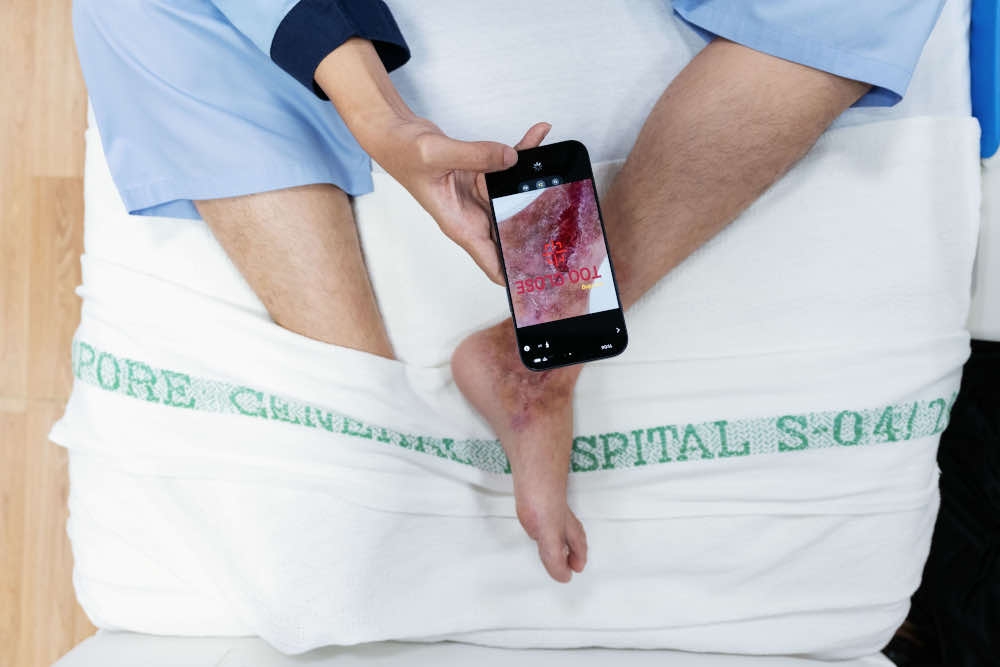
What eKare’s tech does is allow carers to take a picture of a wound, send it to be reviewed by a care worker who can then assess the condition of the wound without the patient needing to travel or spend a lot of time in waiting rooms.
The tech helps identify a wound’s stage of healing so the appropriate action can be taken, saving time and lessening the discomfort of a patient.
I was rather amused at how the demo went beyond just a YouTube video on a screen.
Instead, an actor, in hospital PJs, with disturbingly realistic wound makeup was there, in a hospital bed, while actual nurses demonstrated just how the system worked.
The nurse would take the phone, take a picture as directed by the app, send it over for analysis and within just minutes there would be feedback.
You could see how this would be useful in busy hospital settings where nurses are often scurrying to get to as many beds as possible or home visits where a nurse could check-in on a patient and then relay details of the day’s visit.
Also demo-ing their tech was New Zealand’s Blue Mirror.
Blue Mirror’s platform is about using AI in its hands-on training, delivered on iPad.
We got to see how a module for training health workers to properly don PPE (useful should there be another large health emergency) with the camera sensors and app guiding you through the steps.
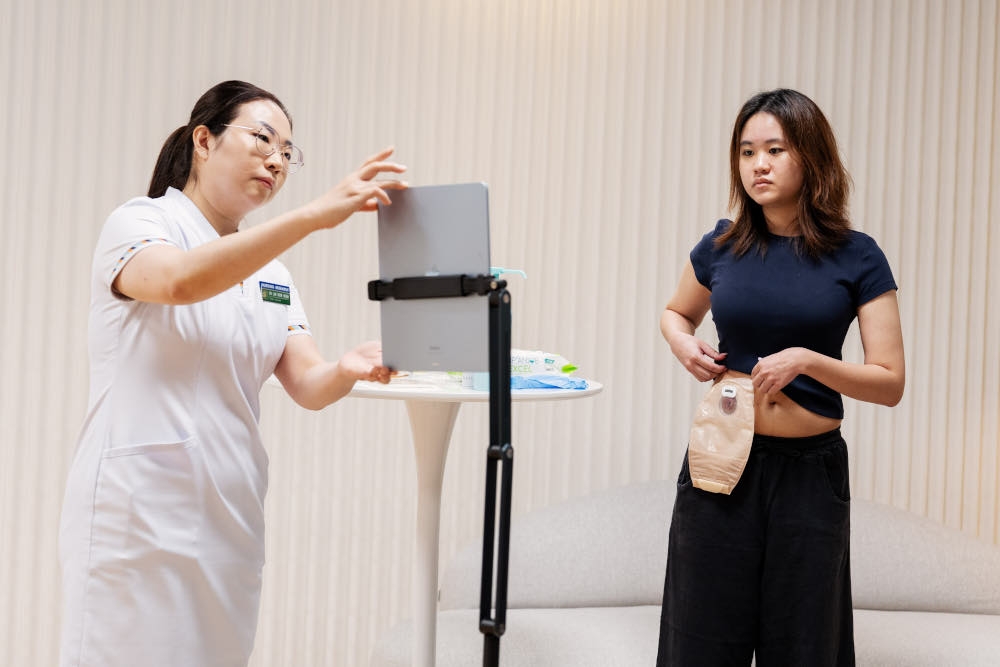
Then there was a demonstration, where again another actor appeared, this time made-up to look like a stoma bag user.
It was very realistic; we watched as the model started the demo, opened up a brand-new stoma pack, went through all the required steps, the app telling her what to do at each turn, including removing her old stoma bag and then putting on a new one.
The process is an involved one; also one that needs careful attention to hygiene so an app that helps ease the mental load of a patient who needs to go through it on a daily basis, certainly would be helpful.
SingHealth’s Kenneth Kwek, deputy group chief executive officer (Digital and Future Health), said in a statement:
“At SingHealth, we believe that healthcare transformation is accelerated through our strategic relationships with global technology partners and developers that extend the reach of innovation, enabling new capabilities to enhance everyday clinical practice.
“By bringing these solutions into real workflows, we empower our people to work smarter and more efficiently, enhance clinical decision-making to elevate care delivery, and create care pathways that achieve optimal health outcomes for patients beyond hospital walls.
“Ultimately, the digital tools we implement should serve a core purpose: to improve patient care through deeper human interaction and connection. Through these partnerships, we will continue to advance and scale technologies that meaningfully improve how care is delivered, experienced and measured.”
Uncomfortable comparisons between Singapore and Malaysia’s public healthcare systems aside, solutions such as the ones I saw at the demo did comfort me in one aspect — that handheld, everyday devices used by the everyman could be used to make healthcare both more accessible and more comfortable for the average patient.
Maybe in a few more years, perhaps phones will also be instrumental in improving Malaysia’s own public healthcare, instead of being devices ruining the peace in hospital waiting rooms.


