


KUALA LUMPUR, Dec 5 — So, hey, we’d like you to come talk to these people at Faithful Music.
I like music.
I like stories.
My hope was the invitation to talk with the people at Faithful Music would be a good combo of both and not just another “sales case study”.
Lord knows I’ve seen enough of those over the decades.
Cozy nooks for making songs
I got WhatsApped a video about how to get there and I needed it — Emhub, where Faithful Music is headquartered, is a bunch of little silos with a very roundabout way of placing their office lots.
First, though, I’ll have to explain who these people are.
Faithful Music is in the business, or so they say, of “creating and augmenting songwriters careers and catalogs by extending opportunities, creating collaboration and defending their rights.”
In other words they’re a music studio/publishing house.
As I walk on the carpet, past a piano (but of course there’s a piano) and I’m ushered into “where the magic happens” — a studio made expressly for musicians to learn how to work or rework their tunes into spatial audio.
Spatial audio is, for the less audiophile-inclined, a technology meant to create a more immersive audio experience.
Stereo sound is what most of us are used to, namely two channels, left and right.
What spatial audio does is create a 360-degree experience, with you feeling like you can hear sound not just from two directions but from behind, in front of you or all around.
Apple’s own Spatial Audio tech uses sensors in the AirPods Max and Pro to position sound in relation to where you are.
Faithful Music’s spatial audio setup has a sofa with a 7.1.4 speaker setup, hooked up to the Apple Mac Studio M3 Ultra.
It’s one of the first spatial audio studios in Malaysia, but the first that has made it accessible to all local artists and not just their in-house creatives.
Is it really that good?
Mike Chan, one of the founders of Faithful, says that very little, maybe in the single digit percentage, of Malaysian-produced music is created with spatial audio.
Chan’s a pretty prolific producer and songwriter with more accolades than I have space in this feature for.
In many cases, he says, local artists have their songs sent off to audio outfits overseas and having songs mastered for spatial audio wasn’t something that was easy or at least, cheaper to do.
That was before.
Apple’s Logic Pro music production software has a feature — Stem Splitter that makes it possible to isolate different instrument and vocal parts in a mix, with each isolated part called a “stem”.
These stems can then be extracted and then mixed together in a variety of ways, though Logic Pro does have a few presets you can use to your liking.
Producer and songwriter Adib Hussin aka Adib Sin says that Logic Pro has become a sort of equaliser, giving musicians more access to something that would have been prohibitively expensive not so long ago.
“If you can do it for free, do it for free, right?” he says, as something like Stem Splitter is built right into Logic Pro.
A one, done, pay for your license, no need for add-ons, no need to pay extra to producers, engineers, even writers if you want to use Stem Splitter to remix your stereo-song into a spatial experience.
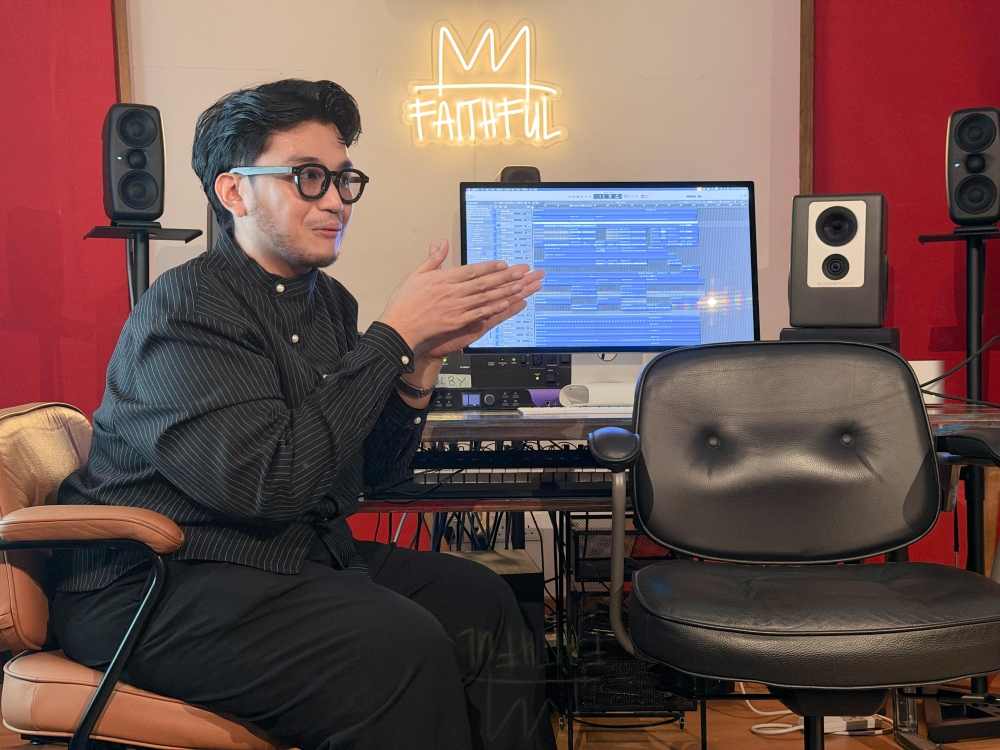
Naki, a singer-songwriter from Sarawak, said that after he got a taste of what spatial audio provided, he spent hours listening to whatever he could find in spatial audio or Dolby Atmos (Dolby’s own surround sound codec).
Technically Dolby Atmos is spatial audio but not all spatial audio is Dolby Atmos as Dolby has very specific parameters for object placement.
Naki said of his “audio awakening” of sorts: “I feel like, oh, this is fun. I want to do it with my own songs, to see how they would come out in Atmos. I had so much fun doing it with (Logic) and the experience of spatial audio.”
He also says he is inspired to one day have a show with this spatial audio experience, to have the audience themselves experience the immersion.
Adib sees Faithful Music as a hub for education, welcoming any creative who’s curious about spatial audio to experience it for themselves, to see how it works.
He sees it as being able to say to keen musicians: “Hey, let’s come in, let me teach you about Logic, and let me teach you how to turn two speakers into 12, do it all (yourself) in your own time.”
“Just give us a call,” Mike says.
Adib agreed, adding that Faithful’s facilities are always open to the knowledge-seeking.
“I don’t think culture should only be available to those who can afford it.”
You can listen to some of Faithful Music’s creative’s work here.
If you’re on Apple Music, listen to Naki’s Masa featuring Fahimi here, among Faithful Music’s first artists to transform their tracks from stereo to spatial audio.
Caught the music production bug? You can try Logic Pro’s 90-day free trial, which requires macOS Sequoia 15.4 or later and check out the user guide here.
A Mac exclusive, Logic Pro retails on the Mac App Store for RM999 and on iPad is RM199 per year or RM22.90 per month, with a one-month free trial for new users, supported on iPadOS 18.4 or later.


