


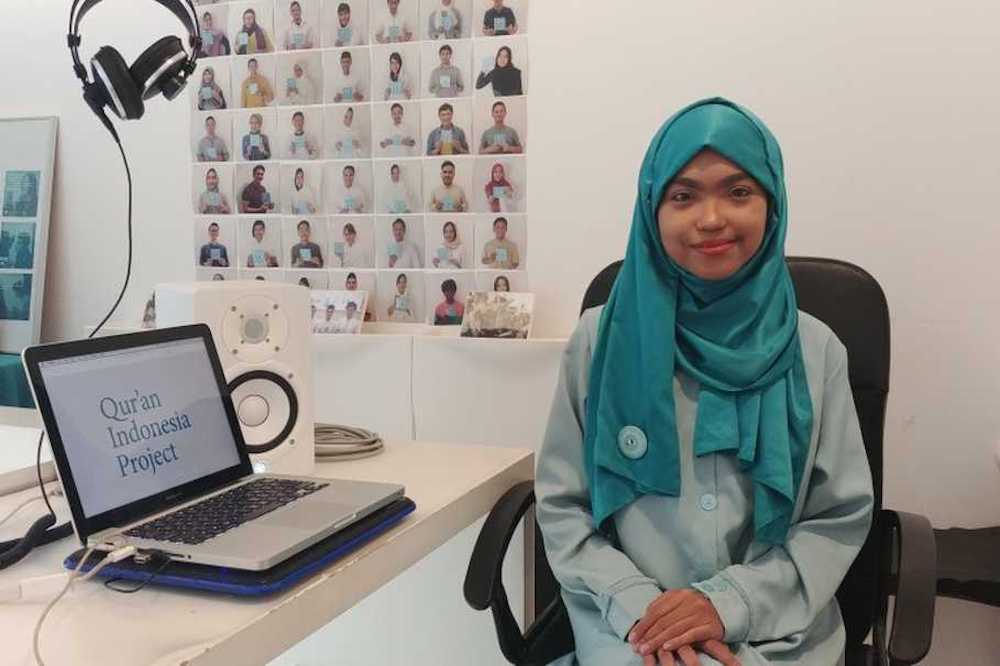
JAKARTA, May 29 — Qur’an Indonesia Project is an online service created in 2015 that offers sound recordings of Quranic verses in Arabic, English and Indonesian, read by volunteers. It also provides videos of sign language translation of the holy book. The service has been a godsend for both the deaf and the general public to understand the meaning of the Quran, whose verses are often committed to memory but rarely understood.
24-year-old Annisa Rachmania, who calls herself a deaf activist, told the Jakarta Globe last Tuesday she joined the project to provide sign language translation after experiencing herself how hard it is for deaf Muslims like her to learn the meanings of the Quran’s original Arabic.
Nia began volunteering by doing a sign language version of Al Ikhlas, a popular four-verse chapter in the holy book that many Muslims recite during prayer.
Nia said when she was a child her maid had taught her some parts of the Quran so she could use then when praying, but not what the words meant.
“I never knew the meaning [of the verses]. This [Qur’an ID] project is so inspiring. Now people can find out what the words mean,” she said.
The Qur’an ID Project now has around 70 deaf and hearing volunteers.
Inclusivity
The project began early this year after Archie Wirija met Surya Sahetapy. Like Nia, Surya is a deaf activist who has been campaigning for more and better public facilities for the deaf.
Archie also met Galuh Sukmara Soejanto, the founder of Little Hijabi Homeschooling in Bekasi, West Java, a school that teaches sign language to the deaf.
Surya and Galuh inspired Archie to make his own contribution to the deaf community and introduced him to Quran ID’s first batch of volunteers, including Nia.
So far, Quran ID has translated four chapters of the Quran into sign language: Al Fatihah, Al Ikhlas, Al Falaq and An Nas.
The videos explain the meaning of the original Arabic verses in sign language.
Qur’an ID also has a sign-language adzan (call to prayer) video on its YouTube channel.
“Our videos are posted on YouTube and Instagram so everyone can access them, including students at special needs schools [SLB],” Archie said.
He said translating Quranic verses into sign language is a long and difficult process and progress has been slow. The biggest challenge is to get the hearing and deaf volunteers to work well together so they can produce an accurate translation.
Qur’an ID has also collaborated with interpreters from the Centre of Sign Language Interpreter Service (PLJ), the Indonesian Association for the Welfare of the Deaf (Gerkatin) and the Indonesian Muslim Council for the Deaf (MTTI).
Archie said Qur’an ID also has plans to gain experience from more established institutions like Global Deaf Muslims, because their ultimate goal is not just to translate the Quran into sign language but to make Islamic studies more accessible to deaf Muslims.
One challenge he has not found an answer for is how to provide sign-language translation for Friday prayer sermons.
“We need sign-language interpreters at Friday prayers. Or we can display the translation of the sermon on a screen, so deaf people can understand what is being talked about,” Archie said.
Deaf, not hard of hearing
Qur’an ID regularly uses two unique hashtags on social media: #CahayadalamSunyi (Light in Silence) and #TULIbukanTunaRungu (Deaf, Not Hard of Hearing).
The first hashtag refers to the project’s long-term goal of making religious studies available for more people, including the deaf.
The second hashtag is the local deaf community’s call to arms to take back the word “deaf” from its negative connotations.
Nia said in Indonesia people usually refer to deaf people as “tuna rungu,” or “people with impaired hearing,” because the phrase is considered more polite than “tuli” or “deaf.”
But according to Nia, the former implies weakness, while the latter shows acceptance of being born different.
“In our community, the word ‘deaf’ is respectful because it shows pride,” she said.
Nia said the term “tuna rungu” also implies that deaf people must try to “cure” their condition by having cochlear implants or undergoing speech therapy. It undermines the fact there is a way for them to communicate without the pressure to be “normal,” which is through sign language, their mother tongue so to speak. — Jakarta Globe


