


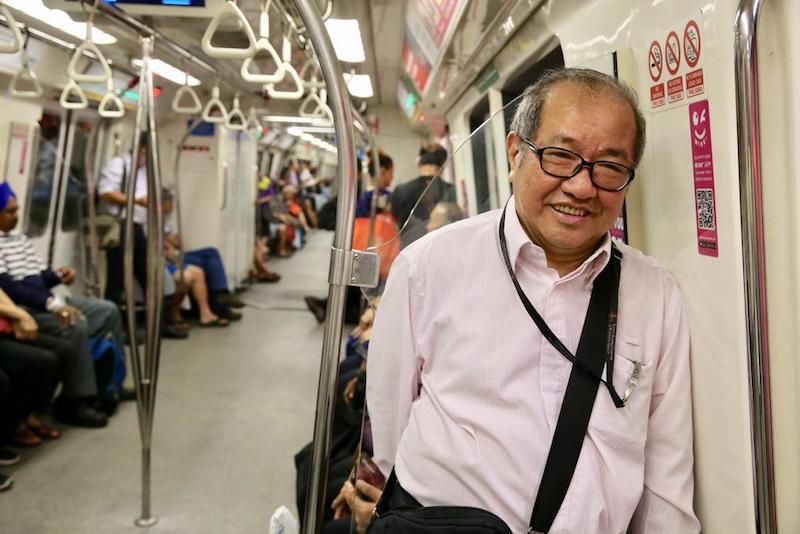


SINGAPORE, Jan 25 — To Kuok Chee Meng, who survived a stroke in 1997, the rush-hour crowds on MRT trains can be daunting.
He has lost the ability to fully control the left side of his body and walks with an unusual gait, dragging one foot as he takes his steps.
To avoid getting knocked about in crowded spaces, and to give himself “a little more spare time” to cover distances, he has been taking the first train at around 5.45am to get to work.
In doing so, Kuok, who turns 64 this year, gets to ease into his work day stress-free — unless there are disruptions to train services, which then throws him off his familiar trail.
Kuok has been working as an information and administrative officer at the headquarters of the Housing and Development Board (HDB) for more than 30 years.
His work day begins at 8am, but he is already at Toa Payoh station, where his office is located, at 6.20am. “I take the chance to have a leisurely breakfast, sip my tea, get into the frame of mind for work. It’s not so rushed,” he said.
He suffered a stroke when he was 43, due to high blood pressure and “heavy drinking”.
Before that, he used to be able to get to work by walking the distance of about two MRT stations from his home along Stirling Road in Queenstown to Bukit Merah Central, where the HDB main office used to be situated.
After he recovered “within months” from the stroke and could return to work, he gamely tried to resume his routine. “I was left huffing and puffing,” he recalled. That was when he switched to taking the MRT from Queenstown to Redhill because it was “less strenuous” than walking long distances.
In 2002, when the HDB moved its headquarters to Toa Payoh Hub, Kuok decided he would start taking the first MRT train of the day, thinking that he had better give himself more time with the office being farther away.
“I walk rather slowly and with a slight limp. Travelling when it is less crowded also means that I will not have to jostle with the crowds during peak hour,” he added.
Savings from discount scheme
Every month, Kuok has been spending about S$80 (RM240) to S$100 on transport, but since the start of the year, he has managed to make some savings, thanks to a new discount scheme. In the first three weeks of this month so far, his transport cost has not reached S$50 yet.
Kuok used to tap out at Raffles Place station before entering again to board the train to Toa Payoh, so that the “first half” of his trip from Queenstown to Raffles Place would be free. The Free Pre-Peak Travel scheme allowed commuters to travel for free if they exited selected MRT stations in the city area before 7.45am.
The scheme stopped last month, and the Public Transport Council offered discounts of up to 50 cents for commuters who tap in at any MRT or LRT station before 7.45am, regardless of where they end their trips.
Kuok believes he will get to save up to S$40 with this.
“My daughter is very young… she still needs to go to school. We live comfortably, but I will try my best to save where I can,” he added, indicating that there are no plans for retirement just yet.
Kuok has a three-year-old daughter from his second marriage to a Chinese national. His wife does part-time work.
He did not want to talk about why his first marriage broke down, only that he no longer keeps in contact with his first wife and their two children, who are in their 30s.
Slower than most
At work, Kuok is still able to meet most of the demands on the job, just that he may take “double the time” to deliver documents from one place to another, and he cannot “chase after customers if they leave behind things at the counter”.
He also admitted that he is “considerably slower than most other guys who are younger and have the use of both hands”.
“Working at the counter, we are in the frontline. We have to show up, and be punctual,” Kuok said.
After getting off work at around 6pm, Kuok goes home by bus, which drops him right outside his housing block. Again, this is to avoid the peak-hour crowd. The journey takes about an hour, compared to what could have been a 30-minute train ride.
“I take the bus from the interchange, so it is relatively empty, and I do get a seat. I don’t take the bus in the mornings because the arrival timings are often unpredictable,” he explained. “Comparatively, the train timings are more accurate and they come at more frequent intervals.”
Still, schedules do not always run like clockwork, even when he is on the first train.
Recounting a recent incident on Jan 11, when there was a 20-minute delay due to a track fault between Outram Park and Bugis stations, Kuok said: “Suddenly, the train stopped at Outram Park station and we had to get out. I ended up taking a bus to somewhere in Yishun, before taking the train again to Toa Payoh... I was still early for work, but I didn’t get to have my usual breakfast.”
He added that for older passengers like him, train delays and having to find a different way to get to their destinations can be “confusing”, because they are not too knowledgeable about alternative routes to take.
There is a certain comfort in routines, such as recognising many of the older residents in his neighbourhood while waiting for the first train every morning.
“We have been walking the same road and taking the same train for so many years... I don’t normally speak much to them. They just wave hello and continue on their journey,” he said.
“I also walk slower than them, so I don’t wish to slow them down... but it would be nice if I had a friend who doesn’t mind walking at my pace every morning.” — TODAY


