
KUALA LUMPUR, Dec 24 ― As Malaysia is targeting itself the goal of becoming a high-income nation by 2020, it must be stressed that this objective can only be realised with the aid of more innovation-driven growth of the economy.
In this journey, Malaysia’s national intellectual property system can contribute quite significantly to supporting innovation and the government is continuously making various efforts to refine and strengthen the national innovation ecosystem.
Malaysia’s position in filing for Intellectual Property Rights
Malaysia’s position in filing for Intellectual Property Rights is very well reflected under the Statistical Country Profiles on the World Intellectual Property Organisation (WIPO) website. www.wipo.int. Let us have a look at some data available on how well we are doing in this respect.
We compared statistics from Malaysia (Ranked 44 on WIPO in 2014) and the republic of Korea (Ranked 27 on WIPO in 2014).
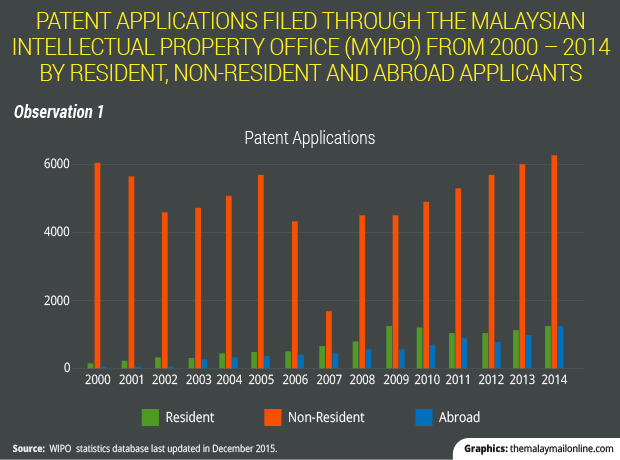 As per Graph 1 it is daunting to notice that Non-Resident and Abroad applicants have filed most patent applications in Malaysia. When calculated using the available data on the WIPO website, it becomes evident that approximately 88 per cent of the patent applications made to MyIPO are from Non-Resident and Abroad applicants and as such, only 12 per cent are by Malaysian residents!
This means that 88 per cent of patents filed from 2000 to 2014 do not belong to Malaysians but to foreigners who filed their patents in Malaysia.
If we were to benchmark ourselves against the Republic of Korea, we notice that that only 40 per cent of the patent applications made to the Korean Intellectual Property Office are from Non-Resident and Abroad applicants and as such, an impressive 60 per cent are by Korean residents!
This means that 60 per cent of patents filed from 2000 to 2014 belong to Koreans.
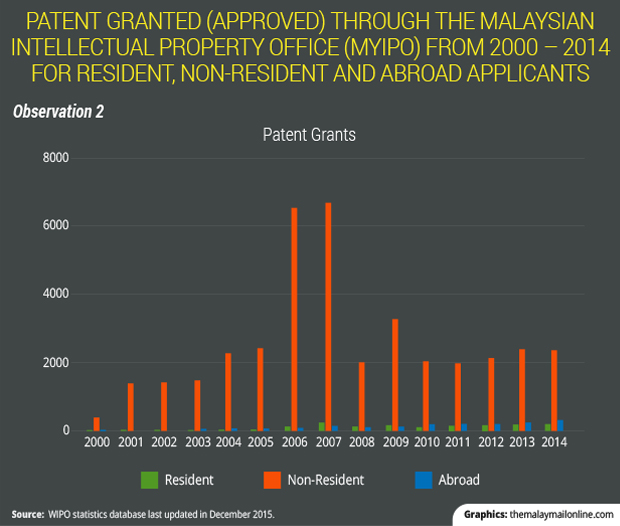 Graph 2 further indicates that the total number of foreign patent applications approved in Malaysia far exceeds the number of local applications approved which is pretty much in line with the number of applications made by the two categories of applicants.
When calculated using the available data on the WIPO website, it becomes evident that approximately 94 per cent of patent applications approved by MyIPO are from Non-Resident and Abroad applicants and as such, only 6 per cent have been approved for Malaysian residents!
This means that 94 per cent of patents approved from 2000 to 2014 do not belong to Malaysians but to foreigners who filed their patents in Malaysia.
If we were to benchmark ourselves against the Republic of Korea, we notice that only 40 per cent of patent applications approved by the Korean Intellectual Property Office are from Non-Resident and Abroad applicants and as such, an impressive 60 per cent have been approved for Korean residents!
This means that 60 per cent of patents approved from 2000 to 2014 belong to Korean residents.
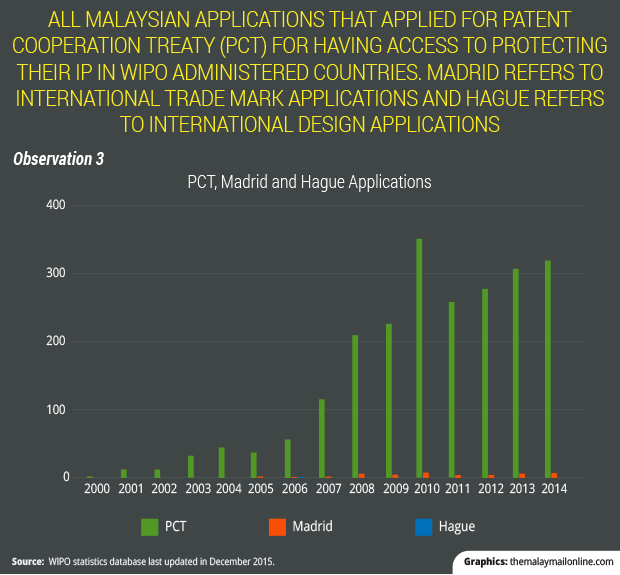 Referring to the Graph 3 and working out the mathematics for year 2014 for patent applications that progressed into PCT applications (gaining access to protection of patent rights in up to 148 countries), it is evident that Malaysia files far too few PCT applications for future protection of their Intellectual Property Rights in other countries.
Amongst the top 10 PCT applications, MIMOS Berhad topped at 54 per cent with 119 applications in 2014 and Universiti Malaya (UM) scored the second place at 10 per cent.
When observing the Korean landscape for 2014, it becomes clear that Samsung (36 per cent) and LG Electronics (30 per cent) filed the highest number of PCT patent applications.
When looking at the number of total applications made by the top 10 PCT applicants in 2014, Malaysia made 220 and Korea made 3,815 PCT applications in 2014.
What does all this mean?
The above observations indicate that Malaysian residents file far too less patents (12 per cent) as opposed to non-residents and abroad applicants (88 per cent). The numbers are still very low and this could be a major hindrance in transforming ourselves into a knowledge-led economy.
The number of PCT applications filed by Malaysians for gaining access to protecting their innovations in foreign countries is much less than optimal. One organisation amongst the top 10 Malaysian PCT applicants accounting for 54 per cent of all applications is MIMOS Berhad, followed by Universiti Malaya (10 per cent).
This observation with Malaysia filing only 220 PCT applications and Korea filing 3,815 applications is an indication that Malaysia should look into up scaling the protection of their patent filings in foreign jurisdictions to support its transformation into a knowledge-led economy.
In conclusion, it is evident that Malaysia should make more of an effort in raising awareness on Intellectual Property Rights and their protection.
Further barriers such as high costs involved in protecting Intellectual Property Rights should be addressed in order to facilitate more filings.
However, it is important that high volume must be aligned with high quality of Intellectual Property Rights filed since the core of IP protection is commercialisation or monetisation.
Therefore, any initiative to increase the number of filings for Intellectual Property Rights should be well aligned with commercialisation strategies of the Intellectual Property Rights protected.
* Your feedback is welcome at [email protected]
** Dr Viraj Perera is the CEO of PlaTCOM Ventures Sdn Bhd, the national technology commercialisation platform of Malaysia which is a wholly owned subsidiary company of Agensi Inovasi Malaysia(AIM) formed in collaboration with SME Corp Malaysia.