KUALA LUMPUR, March 2 — I have always had a soft spot for the Toyota Corolla. Back in the 1980’s, it was the Corolla XE that helped me to an outright win in the Rally of Malaysia 1983. From 1984 to 1987, it was the Corolla Levin that took carried me faithfully with performance, handling, and reliability to three Malaysian Rally Championship titles.
The Corolla XE and the Levin were both rear wheel drive models, and great cars to drive, with excellent handling, and both had the most important attribute of being totally reliable.
If there is one word I can use to describe the Corolla, the word would be RELIABLE – and not many would disagree with me on that. I am still a rear wheel drive fan, but since many car makers have gone on to adopt front wheel drive, I am doing what I should do when in Rome, so to speak.
Somehow, I have not bought a Corolla since I stopped rallying many years ago, gravitating towards cars that offered more performance and perhaps more exciting shapes.
When I took the new Corolla Altis, recently launched by UMW Toyota Motor, it was more to check it out and report to my readers about the car, but after driving it for a few days, I actually feel good about it – so please read on to see why.
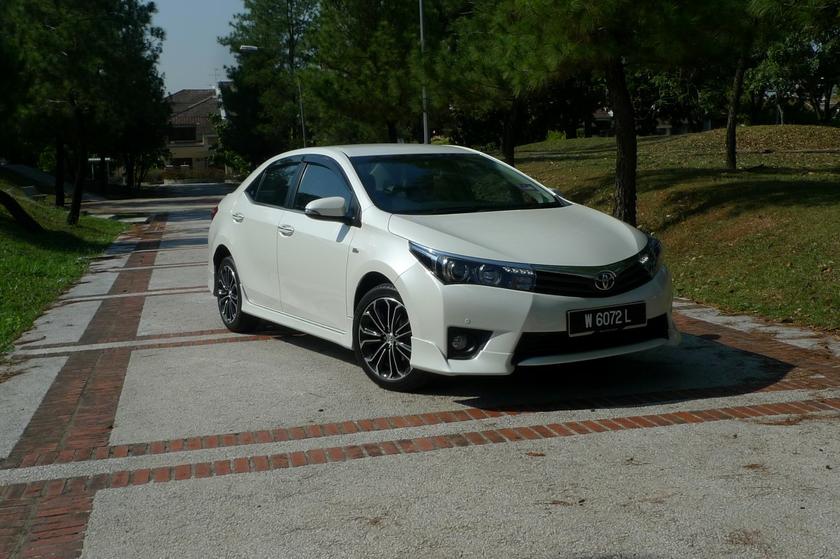
First off, the new shape looks more refreshing than the outgoing Altis model, which has probably been around too long – this is probably the best-looking Corolla yet. It is not as emotion-evoking as the Levin I used to race in, but it has a good size, is well-proportioned, and decent, mainstream look that will appeal to mainstream people, which applies to perhaps 80 per cent or more of our population.
If you look at the evolution of the Corolla since it went front wheel drive in the early 1980’s, you would agree that the new Altis is the best –looking, and the largest to date.
Just as it was a challenge for the Camry designers to make a better looking Camry than the previous model, the Altis designers will be faced with just as great a challenge to top this current Altis for the next model change.
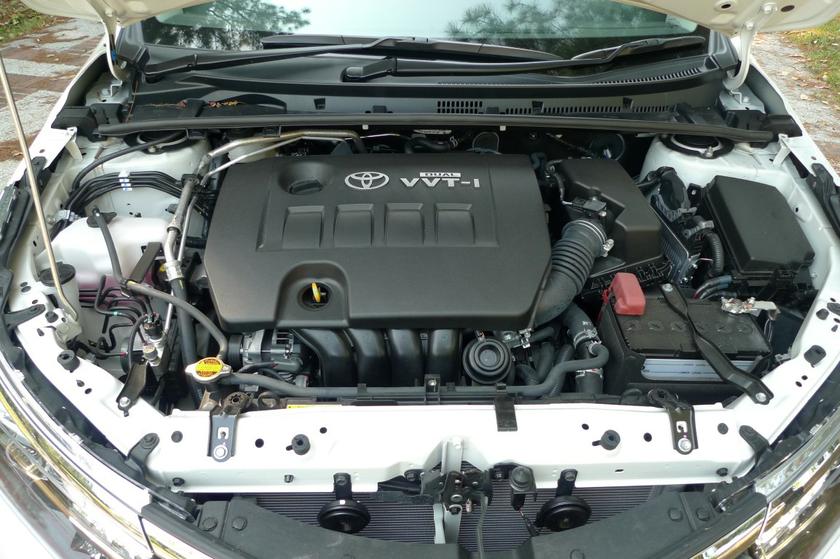
Secondly, the power train package is impressively faultless. There are two engine options available, a 1.8 litre and a 2.0 litre – my test car this time was the 2.0 litre, and insofar as the power department is concerned, there is decent get-up-and-go, although admittedly, it is not breathtakingly fast.
With 145PS of power and 187Nm of torque, there is enough, and the average Joe who buys this car may even say that there is plenty of power.
However, power is not everything – how it is delivered, and the fuel economy are also factors that will come into play when you actually put your money down, and the package offered by the Altis is possibly the best that one can get at this point of time.
Power delivery through the electronically controlled CVT (Constantly Variable Transmission) is smooth; I have not been a CVT fan, and never liked the ‘rubber band’ effect of the engine revving up on acceleration, and waiting for the road speed to catch up.
Well, it has been a good umpteen years since the CVT first appeared, and having evolved in leaps and bounds, the new CVT boxes are much improved.
The driving feel is so much better, and in the Altis, if you didn’t know that it has a CVT, you would probably not even notice the difference between it and a normal slush box.
Toyota describes the CVT in the Altis as a ‘CVT with 7-Speed Sports Sequential Shift’, and added on a pair of paddle-shifters which are quite nice to use, or not to use, if you don’t care to.
Whatever you decide, the Altis shifts seamlessly, and smoothly.
It is a proven fact that CVTs do contribute to fuel efficiency, and in the Altis, the fuel economy is something to marvel at. In city type driving, which included some bumper to bumper traffic and long waits at traffic lights, I got quite a decent figure of 10.8 kilometres per litre (9.2 litres per 100 km).
On the highway, driving at speeds between 90 kph and 120 kph, I am pleasantly surprised to see the kilometres per litre figure on the on-board data readout climbing up, as high as 16.3 kilometres per litre (6.13 litres per 100 km).
This makes the Altis the most economical 2.0 litre cars I have ever tested.
To put things into proper perspective, I used gentle, but not ‘pussy-footing’ acceleration, and maintained a steady speed, with the air-conditioner on, doing nothing out of the ordinary.
Thus, the excellent fuel economy would be the third reason I am impressed with the Altis.
The last reason would be the interior space, ride comfort and handling. In terms of dimensions, the Altis is more or less the same size as its main competitors, plus or minus a couple of millimetres her and there.
Ride comfort is excellent, also on a plus minus basis when compared to its competitors, being on the firm side of comfortable and handling is good, no issues at all.
Creature comfort is on par, with some pluses and minuses; what I particularly like is the keyless entry and keyless start, the reverse camera, easy to use navigation system, and the new dashboard design that has more flat surfaces rather than those cars that come with curved surfaces.
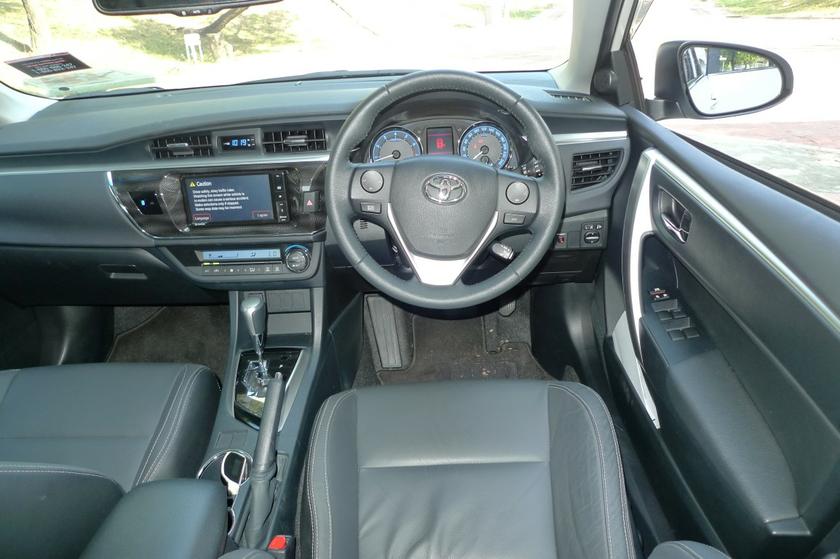
The LED headlamps, available only with the 2.0V, are appreciated for night usage, and the 2.0V only black leather seats are nice.
Similarly, it is only the 2.0V that comes with VSC (Vehicle Stability Control), and the 17-inch wheels look good, besides helping to improve the handling as well.
The 2.0V is priced at RM136, 000 (on-the-road with insurance), compared with the 2.0G at RM123,000, and the 1.8E at RM114, 000. Like they say, you get what you pay for; not having tested the 1.8 litre Altis as yet, at this moment, I would go for the top-of-the-range 2.0V for the extra goodies, but the choice is yours really.