


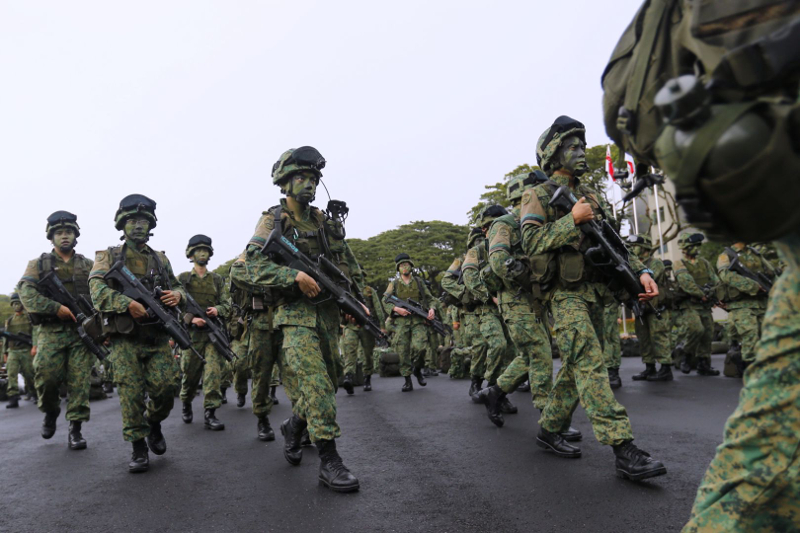


SINGAPORE, June 30 — From deploying more naval assets and ratcheting up its air defences to training more soldiers for homeland security, the Singapore Armed Forces (SAF) is beefing up its capabilities to deal with the terror threat.
Speaking to the media earlier this week ahead of SAF Day tomorrow, Defence Minister Ng Eng Hen said more NSmen will be trained for homeland security.
From July, the Island Defence Training Institute will train about 18,000 soldiers from both active and operationally ready National Service (NS) units yearly in homeland-security operations.
Operationally ready national servicemen (NSmen) will have their roles enlarged to include homeland-security operational duties. Selected NS units in the Army will carry out such operations during in-camp training (ICT) even as they perform their existing operational duties.
NSmen could be roped in to take part in operations such as islandwide deterrence patrols with the police, cordon-and-search operations, as well as those to keep public order during major events like the National Day Parade. NS units will also have refresher training during ICT to ensure skills are kept up to speed and servicemen can be deployed for operations readily.
Dr Ng said the SAF previously trained “smaller numbers”, but such capabilities may be needed in the SAF should multiple terrorist attacks hit, for example.
The training will further hone the skills that soldiers pick up from the SAF’s urban-operations training, tailoring them to homeland security. It will cover areas such as search-and-arrest procedures to be carried out by SAF personnel, knowledge of legal powers and the rights of private defence.
The SAF and the Home Team are also validating their plans and working closely in the fight against terrorism, said Dr Ng, noting the two outfits’ “increased linkages”.
They are also coming up with a common command-and-control information system so that “agencies can talk”.
“When multiple attacks occur in Singapore, you’ve to be very swift… Various units need to know what to do, so the command centre must be nimble, flexible and decisive,” he said.
At sea, Dr Ng said maritime security measures will be improved, pointing to how Singapore is “surrounded by water” and that the 2008 Mumbai terror attack in India was a “sea-borne” one. An attack mounted from the sea can “wreak havoc to a densely crowded city”.
Hence, the Navy will deploy more unmanned assets. Two fully autonomous Mine Countermeasure unmanned surface vessels are now undergoing operational testing, with the Navy set to have unmanned surface vessels deployed for maritime security by 2020.
The soldiers overseeing these operations also need not be regulars. Full-time national servicemen will be trained for these roles too, Dr Ng said.
On the shift towards more unmanned platforms, he said: “We can invest in this because we think it’s a long-term threat, so we might as well build those capabilities up.”
The Maritime Security Task Force, set up in 2009, will also lead Exercise Highcrest in October. This will allow the SAF to test its “various capabilities” with a range of agencies, as well as improve its computer networks, information-sharing and data analytics at the back-end, he added.
In the air, Dr Ng said the Republic will burnish its air defences, noting that a scenario similar to the September 11, 2001 attacks in the United States remains “an operational threat” to Singapore.
He pointed to the deployment of the Aerostat, a floating radar-equipped balloon tethered to land and which can scan Singapore’s skies and seas for threats, as a “useful” unmanned platform.
It allows “early warning and better air situational awareness”. Multi-mission radars have also been added to detect such threats.
The Air Force also has a Combat Management System, which fuses information from various sources, such as pictures from sensors as well as flight information from the Civil Aviation Authority of Singapore.
The system, which can take out multiple threats, helps advise soldiers and commanders on the key responses and make swift decisions, Dr Ng said.
Calling terrorism an “endemic threat” that is here to stay, he said eradicating its root causes is “going to take a long time”.
Asked if the SAF is concerned about the recent arrests of two auxiliary police officers for terrorism-related offences, Dr Ng said this is something “all Singaporeans must be concerned with”.
He said the SAF and Home Team have internal mechanisms that try to counteract radicalising influences and commanders spend time with their subordinates. “But that’s not all or none. You may be less susceptible to infection, but you’re not entirely immune,” he added.
The arrests, announced last week, involved uniformed officers for the first time: Muhammad Khairul Mohamed, 24, was detained under the Internal Security Act for wanting to take part in the sectarian conflict in Syria by taking up arms for the Free Syrian Army. Mohamad Rizal Wahid, 36, was issued a restriction order for supporting his intention to undertake armed violence.
Dr Ng said there is “no vaccine” against radicalising influences, but the community can do its part by alerting the relevant authorities.
“We may have to save him from himself and the harm that he or she can potentially do to someone else. That’s not called spying; that’s called helping one another.”
Still, he does not see the problem of radicalism waning in the next one or two decades.
“If the problem is diminished in Iraq and Syria, I can be almost certain that a new wave will come from (elsewhere), whether it’s Yemen, Libya, Asean (the Association of South-east Asian Nations).” — TODAY


