


JUNE 1 — Every year, on the first Monday of June, Malaysians observe the Official Birthday of the Yang di-Pertuan Agong. For many, the day arrives quietly. Roads become less busy, offices close for the public holiday, and televised royal ceremonies play in the background of family gatherings at home. Yet beneath the formalities and traditions lies something deeper about how a nation understands itself.
National identity is not shaped only through constitutions, policies, or political institutions. It is also formed through rituals, symbols, and places that people continue to recognise across generations. In Malaysia, one of those places is undoubtedly Istana Negara.
For most Malaysians, the National Palace is a familiar presence despite never having entered its gates. It appears repeatedly at important national moments: royal ceremonies, state visits, official appointments, investitures, and national celebrations. Over time, the palace becomes more than a physical structure. It becomes part of the country’s shared visual memory.
Architecture has always played a quiet but important role in expressing the identity of nations. Around the world, buildings such as parliaments, palaces, memorials, and public squares often carry meanings far beyond their practical functions. They become places where continuity is preserved and national narratives are repeatedly reinforced. This is especially true for ceremonial architecture.
Istana Negara represents this role in the Malaysian context.
Before the current palace at Jalan Tuanku Abdul Halim became the official royal residence, the institution of the monarchy was closely associated with the former Istana Negara at Jalan Istana. Originally built in 1928 as a private mansion, the old palace later evolved into one of the nation’s most recognisable royal landmarks, serving several generations of Yang di-Pertuan Agong.
As Malaysia developed, however, the demands placed upon the institution also grew. State ceremonies became larger and more complex, diplomatic functions expanded, and modern security requirements increased significantly. The transition to a new palace was therefore not simply about relocating royal functions into a larger building. It reflected the challenge of modernising a national institution while preserving continuity with its traditions and symbolism.
When the Royal Standard was officially raised at the new Istana Negara on November 15, 2011, the moment symbolised more than the opening of a new complex. It represented the continuation of the monarchy within a contemporary national setting, where heritage and modern governance could coexist.
The palace itself deserves recognition as one of Malaysia’s most significant contemporary architectural landmarks. Designed through the collaboration between the Malaysian Public Works Department (JKR) and the local architectural firm Kumpulan Seni Reka Sdn. Bhd., the project also reflected confidence in the capabilities of Malaysian architects, engineers, craftsmen, and construction professionals in delivering a development of national significance.
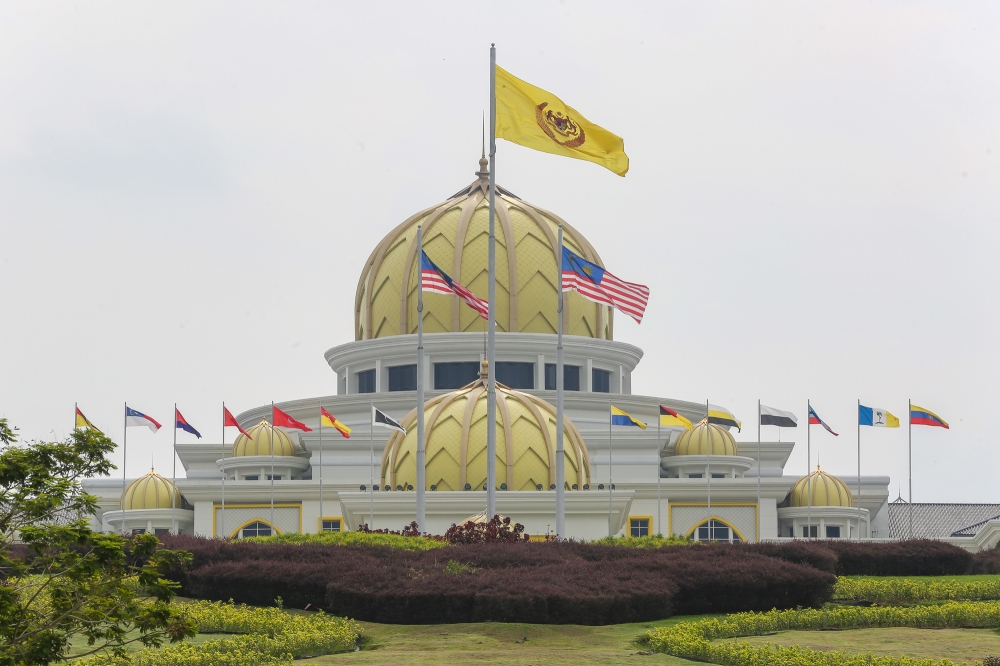
Its location reinforces this symbolic role. Constructed on elevated ground overlooking Kuala Lumpur, the palace occupies nearly 100 hectares along Jalan Tuanku Abdul Halim. The commanding site gives the complex a strong visual presence within the capital city, while also reflecting the dignity and stature associated with the institution it represents.
Yet the significance of Istana Negara is not defined merely by scale or grandeur. What makes the palace meaningful is how architecture is used to communicate identity, continuity, and cultural memory.
Visitors approaching the palace encounter expansive ceremonial gateways and carefully organised forecourts that create a gradual sense of arrival. Such features are common in royal and ceremonial architecture throughout history. They are designed not only for movement, but also to establish hierarchy, dignity, and respect for the institution housed within.
The architectural language of Istana Negara also reflects a deliberate balance between Malay cultural identity and Islamic design traditions. The palace’s most recognisable elements are its golden domes, including the central dome that rises prominently above the complex. These domes contribute to the visual identity of the palace while symbolising unity, sovereignty, and aspiration.
At the same time, Malay artistic influences appear throughout the building in the form of carvings, floral motifs, decorative patterns, and interior detailing inspired by traditional craftsmanship. The Balairong Seri, which serves as the ceremonial heart of the palace, hosts royal investitures, diplomatic functions, and official ceremonies within spaces enriched by Islamic calligraphy and local artistic traditions.
Such elements matter because architecture is never entirely neutral. Buildings communicate values, priorities, and cultural aspirations, sometimes more effectively than words. In the case of Istana Negara, the architecture expresses an understanding of nationhood that is rooted in continuity rather than rupture, combining modern state functions with longstanding traditions and symbols.
This becomes especially meaningful during the celebration of the Yang di-Pertuan Agong’s Official Birthday. Malaysia’s constitutional monarchy remains unique in the world through its rotational system among the nine Malay Rulers, a system that reflects cooperation, mutual respect, and historical continuity since independence in 1957. Ceremonies associated with the occasion therefore serve not merely as formal state events, but also as reminders of the structures and traditions that continue to shape the nation.
In an increasingly fast-changing world, such symbolic spaces continue to play an important role. They provide societies with a sense of stability and continuity amid constant transformation. Long after speeches conclude and celebrations end, places like Istana Negara remain as physical reminders of the nation’s collective memory and identity.
Ultimately, Istana Negara is more than a palace. It is one of the spaces through which Malaysia continues to see itself, not only as a modern nation-state, but also as a society that still values continuity, heritage, and the enduring relationship between institutions and the people they serve.
Dirgahayu Tuanku. Daulat Tuanku.
* Sr Dr Zuraini Md Ali is an Associate Professor at the Building Surveying Department, Faculty of Built Environment, Universiti Malaya, Kuala Lumpur. Nurul Alia Ahamad is a Senior Lecturer at Taylor's University's School of Architecture, Building and Design and is registered as an architect with the Board of Architects Malaysia.
** This is the personal opinion of the writer or publication and does not necessarily represent the views of Malay Mail.


