


MARCH 12 — The recent public discussion surrounding Minister in the Prime Minister’s Department (Federal Territories) Hannah Yeoh wearing a tudung during an official event has once again revealed how deeply appearance is politicised in Malaysia.
What might otherwise be an unremarkable moment quickly became the subject of online debate.
Yet the reaction tells us less about a single politician’s clothing choice and more about the broader political culture in which race, religion, and symbolic identity continue to dominate the public imagination.
In Malaysia, politics has long been intertwined with questions of identity. Ethnicity and religion are not merely social categories; they are central organising principles of political discourse.
From electoral campaigns to policy debates, political narratives frequently revolve around protecting community interests, defending religious values, or preserving cultural identity.
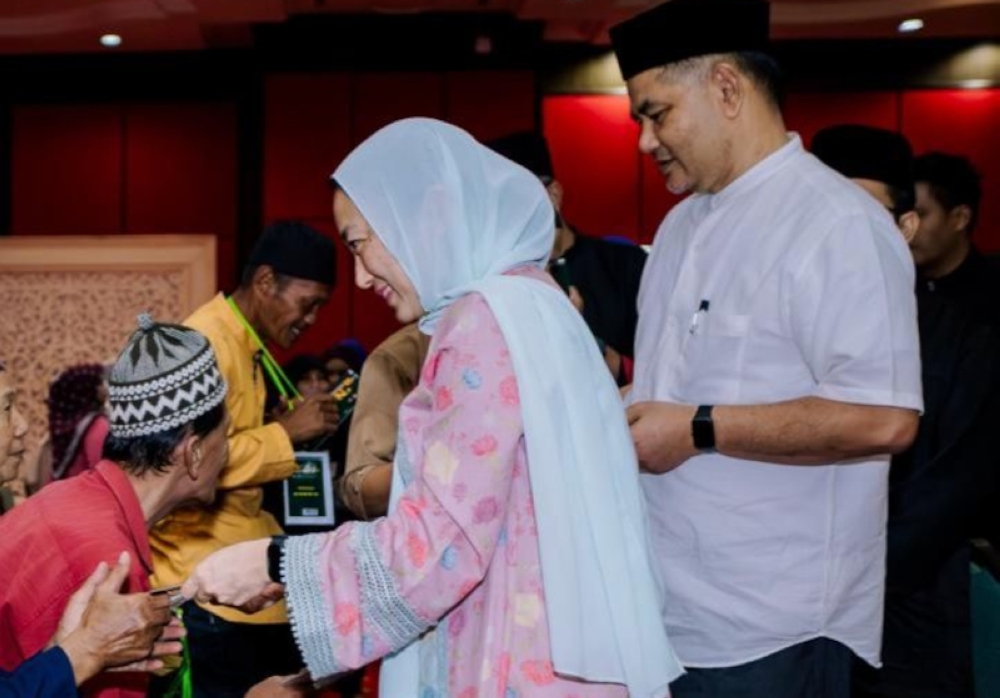
In such a landscape, visual symbols, including clothing, inevitably acquire political meaning.
A tudung, for instance, is not merely an item of attire. In Malaysia’s social and political context, it is often associated with religious modesty and Muslim identity, and is sometimes read as a cultural marker within the Malay-Muslim majority.
When worn by a politician, particularly one who does not typically wear it, the public reaction often moves quickly from curiosity to interpretation.
Some see it as a gesture of respect toward a particular audience or setting. Others interpret it as political signalling, identity positioning, or strategic accommodation within Malaysia’s identity-driven political environment.
But there is another layer to this debate that deserves attention. While the public may read symbolism into appearance, politicians themselves are often fully aware that visual cues matter.
In politics, clothing can become a form of communication. Leaders frequently dress in ways that resonate with the communities they are engaging with — wearing baju Melayu and songkok during festive celebrations, donning traditional attire at cultural events, or adopting religiously appropriate dress when attending faith-based gatherings.
In this sense, appearance can function as a subtle political tool. It signals familiarity, respect, and sometimes solidarity.
In a country as culturally and religiously diverse as Malaysia, these gestures may be intended to bridge social boundaries and demonstrate sensitivity toward different communities.
Yet once such symbols enter the public arena, they rarely remain neutral. They become open to interpretation, speculation, and political debate.
This raises an uncomfortable but necessary question: when politicians adopt certain visual symbols, are they simply demonstrating respect — or are they also responding to a political environment where identity signalling carries electoral and cultural significance?
This is not necessarily about casting doubt on individual intentions. Rather, it reflects the reality that Malaysian politics has conditioned both leaders and voters to interpret identity cues.
Clothing, language, and ritual gestures are frequently read as indicators of political positioning. When politicians appear in traditional Malay attire during official functions, it is often interpreted as affirming cultural belonging.
Similarly, when leaders attend religious events dressed in particular ways, their attire may be viewed as signalling alignment with religious sensibilities.
The issue becomes even more layered when gender enters the equation. Women politicians often face greater scrutiny over their appearance than their male counterparts.
Their clothing choices are more likely to become headlines, more likely to invite commentary, and more likely to be interpreted as symbolic statements.
In Malaysia, where debates around modesty, religion, and morality frequently intersect with politics, the attire of women leaders can easily become the centre of public discourse.
But the deeper issue goes beyond gender or fashion. It concerns how Malaysia understands political representation in a multicultural society.
If the aspiration is to build a political culture that gradually moves beyond race- and religion-based divisions, then the reliance on symbolic identity cues becomes increasingly complicated.
Malaysia’s political leaders frequently speak about unity and inclusivity. Prime Minister Datuk Seri Anwar Ibrahim, for example, often emphasises the values of compassion, mutual respect, and social harmony through the framework of Malaysia Madani.
Yet the persistence of identity-based political narratives means that symbols — whether clothing, language, or religious gestures — continue to be interpreted through racial and religious lenses.
This creates a paradox in Malaysian politics. On the one hand, leaders may adopt cultural symbols to demonstrate respect for different communities. On the other hand, these same gestures can reinforce the idea that political legitimacy must constantly be negotiated through visible markers of identity.
In other words, even well-intentioned acts of respect can unintentionally sustain the very identity frameworks that many leaders claim to transcend.
This is why the debate surrounding Hannah Yeoh’s attire should not be reduced to either criticism or defence of a single clothing choice.
The more important conversation is about what kind of political culture Malaysia is trying to build. If the country aspires to move towards a political environment that is less defined by race and religion, then public discourse must also evolve.
A race-blind or religion-neutral political culture does not mean erasing cultural identities. Malaysia’s diversity is one of its defining features, and cultural expression will always remain part of public life.
But it does require shifting the emphasis away from symbolic identity markers toward substantive issues — governance, policy, social justice, and public accountability.
When public attention focuses overwhelmingly on what politicians wear, it risks distracting from these larger questions.
Clothing becomes the headline, while policy becomes secondary. This pattern is not unique to Malaysia, but the country’s long history of identity politics makes the phenomenon particularly visible.
The debate around Yeoh’s tudung therefore offers an opportunity for reflection. Instead of asking simply whether the gesture was appropriate or strategic, Malaysians might ask a broader question: why do such symbols continue to carry such heavy political meaning?
Until political legitimacy is no longer measured through racial or religious signalling, appearance will remain part of the political conversation. And until that culture changes, what politicians wear will continue to attract attention far beyond the fabric itself.
Perhaps the real challenge for Malaysian politics is not whether leaders wear symbols of identity, but whether the country can eventually reach a point where such symbols no longer determine how leadership is judged.
* Khoo Ying Hooi, PhD is an associate professor at Universiti Malaya.
** This is the personal opinion of the writer or publication and does not necessarily represent the views of Malay Mail.


