


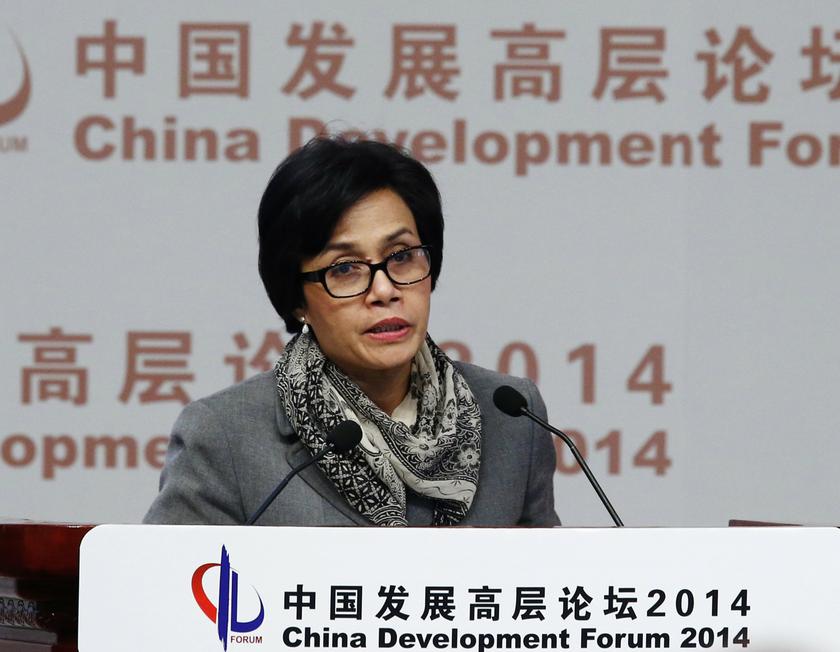
JAKARTA, July 27 — Indonesian President Joko Widodo picked Sri Mulyani Indrawati as his new finance minister, returning her to a post she held six years ago in which she built up a reputation as a tough technocrat and reformer.
Indrawati, 53, will replace Bambang Brodjonegoro in the second cabinet reshuffle since the president — known as Jokowi — took office just under two years ago. It signals his commitment to push through an ambitious infrastructure program to transform South-east Asia’s largest economy, and meet a pledge of boosting growth to seven per cent.
During her term as finance minister between 2005 and 2010, Indrawati steered the economy through the global financial crisis, helped to spur investment and curbed inflation. Still, her tenure was marred by an opposition campaign accusing her and then-Vice President Boediono of abusing their authority. She resigned in 2010 to join the World Bank as one of three managing directors.
“Given her experience as a finance minister, plus the global reach that she has had over the past five years or so, I think it’s definitely a plus,” said Wellian Wiranto, an economist at Oversea-Chinese Banking Corp. in Singapore. Her appointment will “be seen as a way for Jokowi to consolidate his grip on the economic agenda.”
Budget risks
Indrawati faces the challenge of boosting growth while keeping the budget deficit under control. Under Brodjonegoro, the country missed its growth and tax revenue targets last year as falling commodity prices curbed revenue from exports such as oil and rubber. The government targets the budget deficit at 2.35 percent of gross domestic product.
The economy grew at a slower pace of 4.9 per cent in the first quarter, the statistics office said in May. Exports have remained weak and it’s likely there will be limited improvement in growth in the second quarter, Bank Indonesia said last week. It forecasts expansion of five per cent to 5.4 per cent in 2016.
Jokowi has in recent months consolidated power in parliament after Golkar, the nation’s second-largest political party, backed his government. With a two-thirds majority, Jokowi has been able to push through changes including a tax amnesty aimed at repatriating billions of dollars that the government plans to use for infrastructure.
The president named Brodjonegoro as national planning minister and Wiranto as coordinating minister for security affairs.
In August last year, Jokowi replaced six ministers in a move he said was needed to reinvigorate infrastructure spending and make the country more attractive to foreign investment. The president has warned in the past that he won’t hesitate to get rid of under-performers. — Bloomberg


