





KUALA LUMPUR, Sept 24 - Despite having successfully persuaded Bank Negara Malaysia (BNM) into phasing out cheques as a mode of payment within Malaysia, most banks here have yet to price electronic alternatives to be equal or less than the 15 sen stamp duty now imposed on cheques.
This has become a critical issue for many small firms paying staff wages as such issuance makes up a significant number of the over 200 million cheques issued annually.
Even after factoring in the extra 50 sen to be imposed as a cheque processing fee come April 1 next year, it is still cheaper for small firms to issue monthly salary cheques when compared to most of the electronic alternatives now available (see table).
The cost for paying monthly staff salaries can even rise to as high as RM10 per transaction per person when firms send full staff account details and wage amounts via email to the bank branch — and this is for transfers within the same bank.
This is because the banks treat this as a manual process and many have admitted to BNM the fee is actually higher than the processing cost — it is set high on purpose as a deterrent, but the same banks have apparently also failed to inform the firms affected of cheaper alternatives.
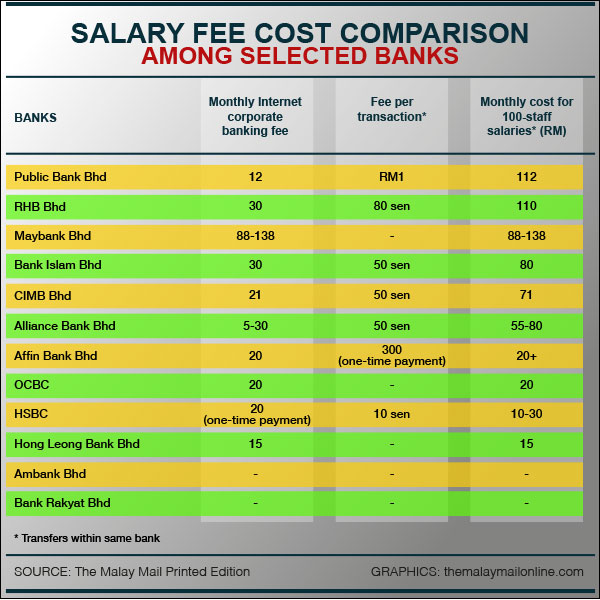 So, if a firm has to pay 100 employees a month, it effectively pays the bank RM1,000 monthly for the “manual” system — where the emailed data is on a “copy-and-paste” basis — whereas issuing 100 cheques will cost RM15 at most.
And the only difference compared to the “manual” processing system is that staff will likely get their salaries one or two days later if the cheques are deposited in parallel timing.
Even the semi-automated monthly payroll system — when a firm sends over the duly filled out diskette using the software provided by bank — will attract a minimum fee of RM1 per person per transaction for transfers within the same bank.
This is despite all the work having been done at the firm's level and all the bank branch has to do is simply upload the data from the diskette — an automated process that takes barely 30 seconds.
In short, paying monthly staff salaries by cheques remains a far cheaper option at 15 sen per person per transaction now — and even when the cost rises to 65 each from April 1 next year.
Some firms have also run into hurdles when trying to use Internet banking facilities — which are provided free — to pay staff salaries as these will immediately hit daily transaction limits of between RM5,000 and RM10,000.
The same daily limit applies to transfers between banks using inter-bank Giro (IBG) services, where the fee has now been reduced to 10 sen per transaction from RM2 each before July 1 this year.


