











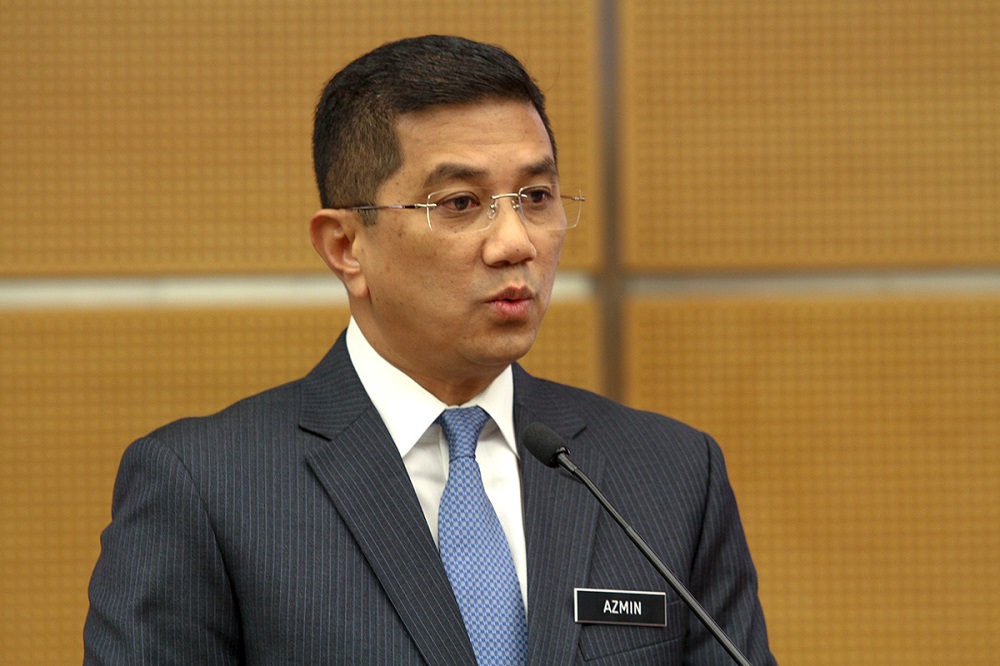


KUALA LUMPUR, July 23 — The government will be reviewing the New Economic Policy (NEP) and the New Economic Model (NEM) to determine their relevance in the 12th Malaysia Plan (RMP12), Economic Affairs Minister Datuk Seri Azmin Ali said today.
Azmin said preparation for RMP12 (2021 to 2025) would involve evaluating existing policies, and formulating new policies, for the development of the overall economic plan to spearhead national development post 2020.
“Therefore, in line with the new Malaysia aspiration, the country’s key policies will be reviewed, including the New Economic Policy and the New Economic Model, to ascertain if these policies are still relevant or not,” he said, adding that this was to ensure a vibrant national economic growth, which can ensure distributive justice.
“Therefore, a new policy that is more responsive to the aspirations of the people will be formulated, based on needs and the direction of the country’s socio-economic development,” Azmin said in a written reply to Selayang MP William Leong in Parliament.
Leong had asked Azmin to state if the government will be reviewing existing key policies and economic development plans, such as the NEP and NEM, in addition to conducting a mid-term review of the 11th Malaysia Plan (RMP 11).
Earlier this month, Azmin said the mid-term review of the RMP11, will be presented to Parliament on October 18.
While the review is customarily tabled in July, Azmin said the Cabinet has allowed the deferral as the Pakatan Harapan coalition just took over the government in May.
“Our approach this time is different, as we are not only going to do a thorough research on two years ago, but we will also clarify the direction of the new government based on our manifesto and policies of Pakatan Harapan,” he told reporters after the launch of the 18th Edition of the Malaysia Economic Monitor.
“The mid-term review will seek to address the disparity of growth across the states and income inequalities, particularly for the B40 income group, high youth unemployment rate and the rising cost of living.
“The government will also address outstanding structural challenges, such as raising labour productivity, ensuring quality investment and innovation, and pushing industries to move up the value chain,” he added.
The NEP was originally planned to eradicate poverty among Malaysians and narrow the economic gap between the Malays and the ethnic Chinese, by redistributing wealth to promote a 30 per cent economic ownership by the Bumiputra.
Although technically expiring in 1990, many of the NEP’s policies continue to be enforced and even expanded, resulting in simmering discontent among the non-Bumiputera communities who complain that it deprives them of equal treatment and opportunities.
After coming into power in 2009, the then Prime Minister Datuk Seri Najib Razak launched the NEM on March 30, 2010, with an eye on doubling the nation’s per capita income by 2020 to an estimated US$15,000 (RM49,500).
The three underlying themes of the NEM were “high income, sustainability and inclusiveness”, as Najib stressed on the need to reduce fiscal disparity between the rich and poor without relying on affirmative action policies like those in the NEP.
But critics were quick to argue that Najib’s NEM was merely a watered-down version of the NEP.
On September 14, 2013, Najib announced the new Bumiputera Agenda that will offer the country’s largest community access to over RM30 billion in aid and contracts — an apparent continuation of NEP-like affirmative action that he had pledged to do away with under the NEM.