


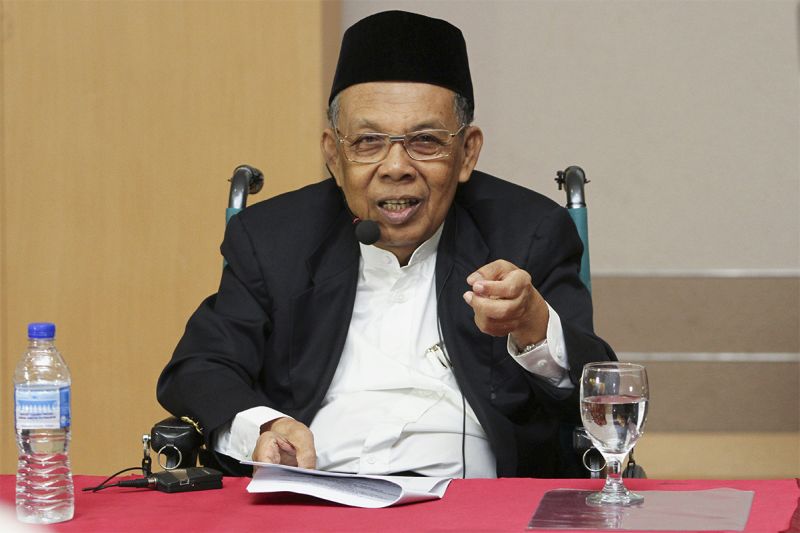


KUALA LUMPUR, June 10 — In a fervent defence of judicial independence, former Chief Justice Tun Abdul Hamid Mohamad insisted today that nobody from the Barisan Nasional (BN) government ever tried to influence his case judgments during his tenure.
However, Hamid acknowledged that there was an attempt to “bypass” him after he acquitted former deputy prime minister Datuk Seri Anwar Ibrahim of his first sodomy charge when he was the most senior Federal Court judge then, and the posts of the President of the Court of Appeal and the Chief Judge (Malaya) were vacant.
“In the 39 years of my carrier (sic), never once did I receive a phone call or a note from, nor did anyone approach me on behalf of the administration, executives or politicians to direct, request, suggest or indicate that I should decide a case one way or the other,” Hamid wrote in an article titled “Independence of the Judiciary: My Personal Experience” published today on his website.
“Yes, it is true that before I heard Dato’ Seri Anwar Ibrahim’s case, someone (not a politician) did say to me ‘If you do it right, one of the posts could be yours.’ I replied, ‘I don’t know which way it will go. But I am prepared to retire as a Federal Court judge.’
“Later, I passed a remark, ‘If anybody tries to influence me, I’ll go up on the bench, declare it publicly and disqualify myself.’ No one ever tried to influence me after that. I don’t know about other judges,” the former Chief Justice added.
He then posed a question on whether he would have been made Chief Justice if Pakatan Rakyat (PR) had come to power after Anwar was convicted of sodomy, and answered his own query, saying: “Your guess is as good or as bad as mine.”
PKR de facto leader Anwar is currently serving a five-year jail term after being convicted and sentenced in February in his Sodomy II case.
Hamid said no one has questioned the independence of the judiciary more than Anwar, but pointed out that the former opposition leader would only do so when a judgment was not in his favour.
He noted that Anwar had not labelled the judiciary biased when he was acquitted by the High Court during Sodomy II, but later changed his mind when he was convicted by the Federal Court.
“Quite often, people who criticise the independence of the judiciary are themselves not ‘independent’.
“To them the court is ‘independent’ when it decides in their favour but ‘not independent’ when it decides against them, especially if the opposite party is the government?” he said.
Hamid also pointed out that after he ruled in an appeal as an Court of Appeal judge in a case that caused a BN chief minister to be disqualified, he was later promoted to the Federal Court.
He also pointed out that after the controversial VK Lingam tape, which showed attempts to fix the appointments of top judges, went public, he was offered the President of the Court of Appeal post and a month later, Chief Justice.
Hamid noted too that he had ordered the former Yang di-Pertuan Agong to pay the plaintiff in a civil case US$1 million, when he presided the Special Court as Chief Justice then.
“First, he complied with the order and paid. Show me one country in which such a thing happens. Even the Queen of England in (sic) above the law,” he said.
Hamid also said although the appointment of judges is the prerogative of the prime minister, Malaysia has a Rulers’ Conference, “which is no rubber-stamping machine”, and the Judicial Appointments Commission.
“Of course, the prime minister is not bound to follow the recommendation of the Commission. But, during my term, as far as I can remember, there was not a case in which the prime minister rejected the recommendation of the Commission,” he said.


