




KUALA LUMPUR, Nov 15 ― The Federal Constitution does not permit for a Shariah equivalent of the Federal Court, a Bar Council official said yesterday when stressing that Islamic courts are only on level with the civil subordinate courts.
Bar Council constitutional law committee chair Firdaus Husni cited the Federal Court decision in the 2007 case of Latifah v Rosmawati, in which the country’s highest court ruled that the civil superior courts ― the High Courts, Court of Appeal and Federal Court ― were established by the Federal Constitution, while the Shariah courts were formed under state laws.
“In fact, the position of the Shariah courts, in this respect, is similar to the session courts and the magistrates' courts,” Firdaus told Malay Mail Online, quoting the ruling.
In Malaysia’s civil court system, the Federal Court is the most senior court and final venue of appeal while the magistrates’ courts are the most junior.
She said Article 3(1) of the Federal Constitution, which states that Islam is the religion of the federation, did not mean that Malaysia is an Islamic country as Article 4(1) stipulates that the constitution is the supreme law of the federation, and not the Quran or hadith.
“Further, Article 3(4) does not allow for Article 3(1) to override the rest of other provisions in the Constitution,” said Firdaus.
Article 3(4) states that nothing in the Article derogates from any other provision of the constitution.
The Malaysian Islamic Development Department (Jakim) on Wednesday confirmed that Putrajaya is planning to upgrade the current three-tier Shariah court system to a five-tier system, with the proposed highest court ― called the Shariah Appeal Council ― on par with the civil Federal Court.
While the civil High Court in Malaya, High Court in Sabah and Sarawak, Court of Appeal and Federal Court constitute a federal judicature, the Shariah courts are state courts that have jurisdiction only within their individual states.
The federal Islamic authority also said a working paper on its proposal was presented back in 2011 at the National Council for Islamic Religious Affairs Malaysia and subsequently to the 14 state religious councils.
Firdaus said if the government wished to set up more Shariah courts, it can only be done within the respective states.
The constitutional lawyer added that Article 121 (1A) of the Federal Constitution, which states that the civil High Courts shall have no jurisdiction in Shariah court matters, was intended to give exclusive jurisdiction to the Islamic courts only over issues like personal laws involving Muslims.
She said that based on the Federal Constitution’s Ninth Schedule, List II, Shariah courts have jurisdiction over Muslims in personal and family law matters like inheritance, marriage and divorce.
Constitutional challenges, on the other hand, can only be dealt with by the civil courts as the Shariah courts have no jurisdiction over such issues.
“Judicial review on the constitutionality of a legislation such as Section 66 Negeri Sembilan Shariah Criminal Enactment can only commence in the civil courts,” said Firdaus.
“Interfaith custody cases should be decided by civil courts, simply for the reason that Shariah courts have no jurisdiction over non-Muslims. Any order given by a Shariah court involving a non-Muslim would be null and void and of no effect as it is given in excess of jurisdiction,” the lawyer added.
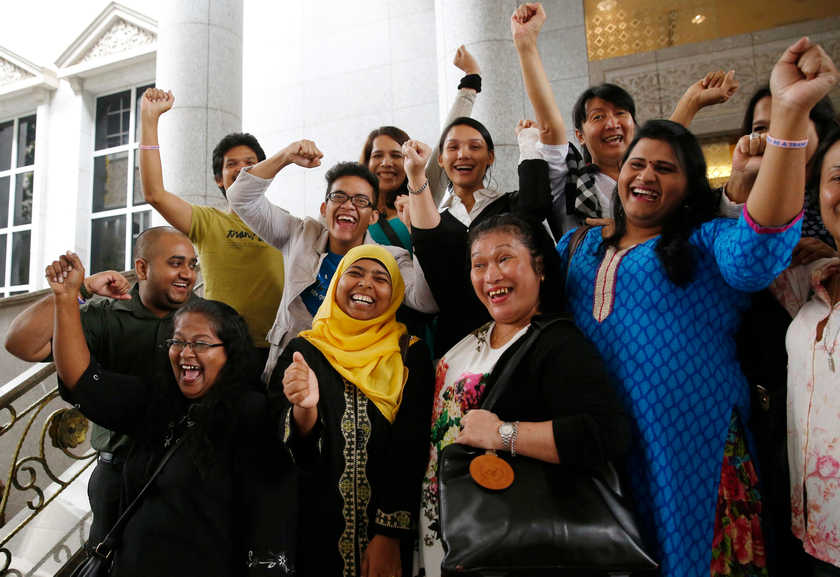
In a landmark ruling, the Court of Appeal ruled on November 7 that Section 66 of the Negri Sembilan Shariah Criminal Enactment 1992, which prohibits Muslim men from cross-dressing, was unconstitutional and void.
According to the court, the Islamic state law violates several fundamental liberties, notably the constitutional rights to liberty, equality, freedom of movement and freedom of expression.
The appellate court had labelled the law discriminatory as it fails to recognise men diagnosed with gender identity disorder ― in which male sufferers identify themselves as women ― and ruled in favour of three Muslim transgenders ― Muhamad Juzaili Mohd Khamis, Shukur Jani and Wan Fairol Wan Ismail ― who were convicted of cross-dressing under the Negri Sembilan shariah law.
Although technically distinct, Malaysia’s dual-track legal system has led to jurisdictional conflicts between the civil and shariah courts, most notably in interfaith disputes.
Lawyers have already expressed concern about the gradual invasion of Shariah law into areas beyond Muslim family matters, a jurisdiction that Islamic courts were not meant to overstep.


