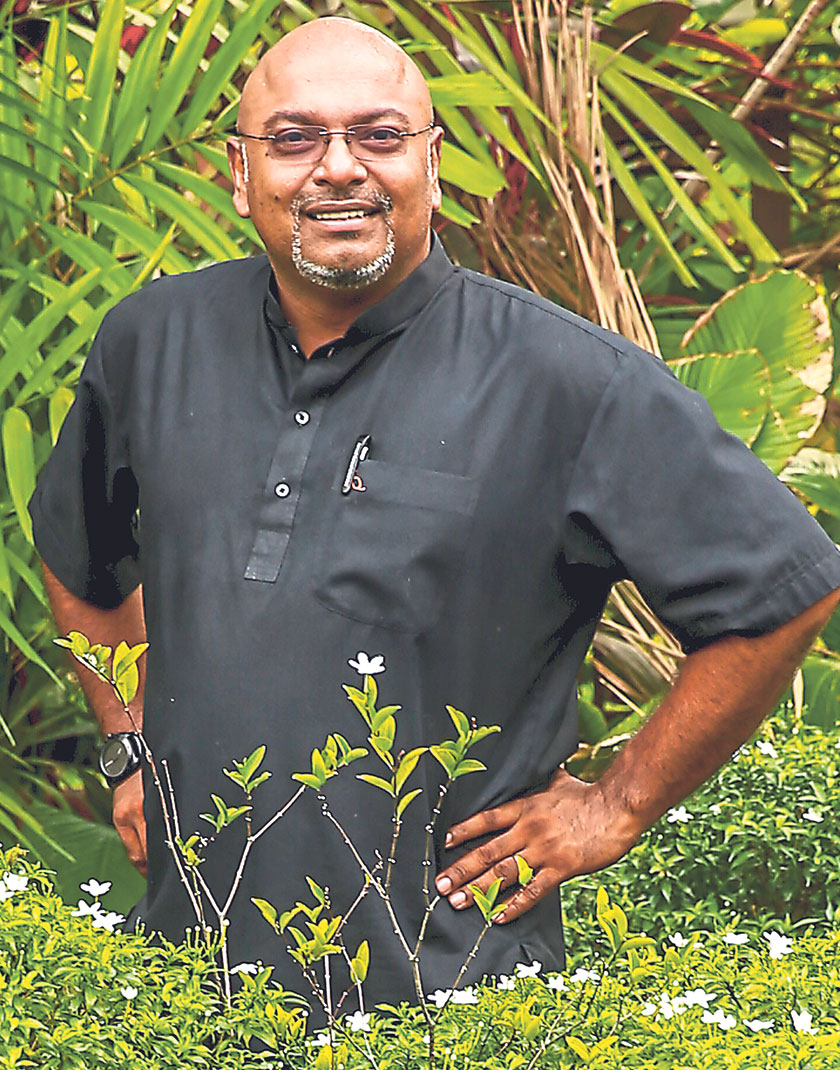
KUALA LUMPUR, Oct 12 — If he’s not coaching top executives from some of Malaysia’s biggest companies, he’s on radio sharing strategies on how businesses can run a more efficient operation.
In between, he busies himself as co-owner of a newly-opened comedy club in Taman Tun Dr Ismail, and insists on making time to watch Manchester United on television whenever they’re playing.
Suffice to say, there isn’t a time when Shankar Santhiram is not doing something.
Having built up his reputation over the years as one of the country’s more recognisable corporate trainers, the 43-year-old exudes an infectious zest for life, which he says drives his desire to help others realise their full potential.
In his own words, he shares how he got to where he is now and what it’s like to do what he does:
- When I was young I talked a lot, as I still do now, and people said I’d be a good lawyer. I remember watching LA Law, and I went “Wow, that’s what I want to do”. Then I went to university to study law, and in my first year I realised, “This has nothing to do with LA Law!” But I had to finish it... I didn’t have the luxury like some kids nowadays to quit school to find themselves. My dad would’ve killed me before I found myself.
- I came back (to Malaysia) in 1993 with a law degree, but in the first three months when I got back I couldn’t do anything because I didn’t want to practice (law). My father threatened to throw my things out of the house if I didn’t go do my CLP (cetificate in legal practice) or get a job, so I got out and started looking for a job. I wrote a nice resume, went out around Penang which is where I’m from, and got a job teaching law at a college in Penang. Imagine that, a 22-year-old teaching law.
- I was made head of legal courses within a year, and it was great but I was getting very little salary then and I was restless. I was offered a position as head of professional studies in another college, and I took it but they didn’t want to invest money in books or teachers. It was then I thought I could run a college better than these people, so I raised RM100,000 from family, got a few investors and started Kolej Utara in 1995.
- I was muscled out (of Kolej Utara) because I only had a small shareholding, so in 1997 I decided to move to Malacca where I established Institut Teknologi Informasi. I focussed on helping the students on learning how to learn and communication skills. One day the HR director of Matsushita called. He said they have 10 of our students there, and was astounded by their EQ. He asked what we were doing to them, I explained what I did, and he said, “Can you come and teach this to some of our staff”? And that was the beginning of my career in corporate training.
- One of the worst experiences I’ve had, was a programme I did for a smaller private company in Brunei. The CEO asked me to run a programme and listed out a list of problems of 15 of his people. When I ran the programme, it turned out all the 15 people were great and it was the CEO who was the problem. When I went back to him and told him, “You’re the problem”, I didn’t get paid.
- When I get a note from someone who writes to me and says; “You know, I’ve been working in this company for the last 20 years and it’s been a real tough slog, but having sat with you for two days, I’ve come out and felt now I understand why I come to work. I thank you and my kids thank you”... it’s stuff like that that makes it all worthwhile.
- Like any performer, probably the toughest thing is when you stand in front of 200 people and you forget what you were going to say. There you are, with everyone expecting something from you, and all you can do is go “uhh... ahh...” You then start making things up as you go along and people are wondering why you don’t make any sense! That was a problem when I was younger, but now I have more experience so I can handle it better.
- There is an oversupply of mediocre corporate trainers. I don’t want to sound like a twisted, bitter person, but I take a lot of pride in what I do, I spend hours preparing. I don’t shortchange my clients, I don’t take programmes I don’t understand. When I stand in front of a group of people, I completely understand that I have the power to influence them, to change their lifestyles and think of their jobs better because they should be thinking of providing a better life for themselves and their families.
- My career has given me travel opportunities around the world, and it’s given me business opportunities. I’ve owned a restaurant, gone into the textile industry in partnership with an Italian company from outside Milan. I’ve had a boutique in KL and gone for fashion shows. It leads to a partnership in a comedy club, so my career has opened many opportunities for me.
- (To become a corporate trainer) understand who you are first. Be clear about what skills you have, be interested in people and their wellbeing. If not, you’ll be seen through almost immediately. Do not give advice, share knowledge. You don’t wake up and suddenly say I want to be a corporate trainer.