




KUALA LUMPUR, July 1 ― New Zealand courts removed today its previous suppression order barring the country's news agencies from identifying the foreign diplomat ― now confirmed to be a Malaysian ― at the heart of a sexual assault scandal there.
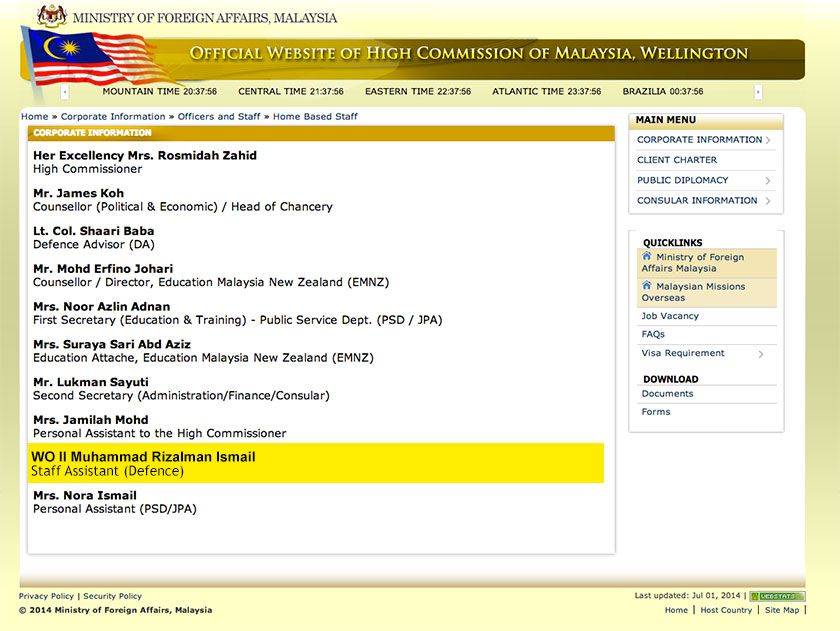
New Zealand media named the envoy as Muhammad Rizalman Ismail, adding that he had worked at the Malaysian High Commission in Wellington before he was recalled home recently.
A check with the Malaysian High Commission's website in New Zealand showed Muhammad Rizalman to be staff assistant on the defence portfolio, with the rank of a warrant officer II.
New Zealand news has been afire over the identity of the foreign diplomat accused of breaking into the home of a 21-year-old woman and sexually assaulting her.
According to news site Dominion Post, New Zealand High Court judge David Collins said he would give the grounds for his decision to lift the May 30 suppression order in writing later.
The news site also said Muhammad Rizalman could face a military inquiry in Malaysia.
It reported that Grant Burston, the lawyer representing the New Zealand police, did not object to the application to overturn the suppression order, saying that there was no risk of the alleged victim being identified if Muhammad Rizalman was named as the two have no ties.
Burston also told the High Court there that reversing the suppression order would not prevent Muhammad Rizalman from getting a fair trial as diplomatic immunity had been invoked.
Dominion Post also reported that Barbara Hunt ― the lawyer for Muhammad Rizalman on his first court appearance on May 10 ― was appointed to aid the court today as the diplomat was unrepresented.
Today, Hunt told the court she was asked to apply for a remand without plea, legal aid and seek the suppression of Muhammad Rizalman’s name on May 10.
Muhammad Rizalman had asked for the court order to suppress his identity due to the serious nature of the charges and because he wanted to inform his family of the case.
She expressed concern that the High Court was deciding on the suppression of Muhammad Rizalman’s identity without first hearing from him.
Earlier today, Radio New Zealand reported that it had appealed to the High Court along with other media organisations for an urgent lifting of the Wellington District Court’s suppression order on the name of the diplomat and his home country.
The appeal was filed today at the Wellington High Court as the New Zealand media noted that a press conference is expected to also be held today by the diplomat’s home country.
In seeking the urgent lifting of the suppression order, the media agencies noted that they would be at risk of violating the court order if they reported on the statement in the press conference.
Invoking diplomatic immunity, the suspect is said to have been recalled home and was yesterday confirmed by Malaysia's Foreign Minister Datuk Seri Anifah Aman to be a Malaysian envoy.
Anifah, who had said Malaysia is not protecting the diplomat and will return him to New Zealand provided he is assured of a fair trial, is expected to give a press conference this noon.
New Zealand’s Foreign Minister Murray McCully had expressed support for the country’s media organisations’ move to lift the suppression order, saying that he wished them “well”, the New Zealand Herald reported today.
“I can’t see any good public policy reason why you’d want to protect someone from publicity given there won’t be a trial,” he was quoted saying today.
However, he said the New Zealand government will not join in the legal action and had also been advised by the country’s Solicitor-General to comply with the court order by not identifying the diplomat.
According to New Zealand police, the diplomat said to be in his 30s was arrested after he allegedly followed a woman aged 21 to her house on May 9 and attacked her.
He was then charged with assault with intent to rape and burglary, but the case had to be dropped after he was recalled home a day after he was charged, news wire AFP reported.
New Zealand had asked for the diplomatic immunity of the man to be waived so that he could face trial there, but the request was refused by Malaysia.
Prime Minister John Key said it was New Zealand’s “strong preference” for the man to face trial there, but said this was not possible after his home country invoked diplomatic immunity.
“Though I would make the point that it’s our expectation he will be held to account in his home country,” he was quoted saying by the Australian Associated Press yesterday.


