


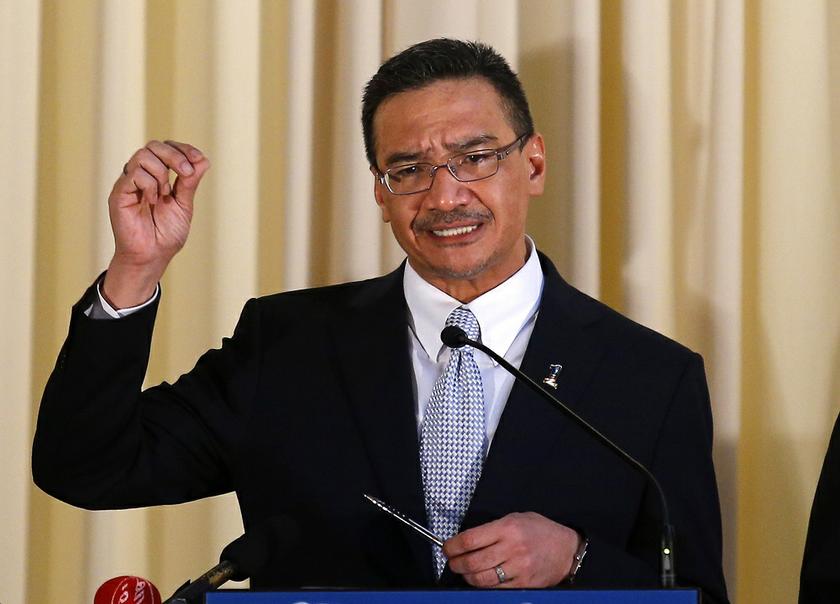


BEIJING, May 30 — A commercial effort — to be paid for by Petronas and DRB-Hicom Defence Technologies Sdn Bhd (DEFTECH) — using a remote operated vehicle will be deployed to join the search for MH370, acting Transport Minister Datuk Seri Hishammuddin Hussein said yesterday.
He said the Malaysian effort would be to deploy the ProSas Deep Towed Synthetic Sonar and Remira Remotely Operated Vehicle as part of the next phase of the deep sea search operation.
Hishammuddin, a member of the entourage accompanying Prime Minister Datuk Seri Najib Razak on his visit to Beijing, said he was happy with the commitment shown by the Chinese government, especially by being a party to the tripartite grouping with Australia and Malaysia, in the continued search for the missing Boeing 777.
Meanwhile, Reuters reported that the search for MH370 suffered a further setback yesterday after Australian officials said wreckage from the aircraft was not on the seabed in the area they had identified.
Flight MH370, carrying 239 passengers and crew, disappeared from radar screens on March 8 shortly after taking off from Kuala Lumpur bound for Beijing.
Investigators say that what little evidence they have to work with, including the loss of communications, suggests the plane was deliberately diverted thousands of kilometres from its scheduled route.
The search was narrowed last month after a series of acoustic pings, thought to be from the plane’s black box recorders, were heard near where analysis of satellite data put its last location — some 1,600km off the northwest coast of Australia.
“The Australian Transport Safety Bureau (ATSB) has advised that the search in the vicinity of the acoustic detections can now be considered complete and, in its professional judgment, the area can now be discounted as the final resting place of MH370,” the agency in charge of the search said in a statement in Sydney.
ATSB chief Martin Dolan said he expected the team to take two to three weeks to reassess and reanalyse the data, although he was “confident” that the final resting place of the aircraft was the Indian Ocean.
“We don’t know what those pings were,” Dolan said over the phone.
“We are still analysing those signals to understand them better.”
The discovery of the pings on April 5 and 8 was hailed as a significant breakthrough, with Australian Prime Minister Tony Abbott expressing confidence that searchers knew where the plane wreckage was within a few kilometres.
However, a thorough scan of the 850 sq km area around the pings with an unmanned submarine failed to find any sign of wreckage.
No debris linked to the plane has been picked up despite the most extensive and expensive search effort in aviation history.
“We concentrated the search in that area because the pings were the best information available at the time,” Australian Deputy Prime Minister Warren Truss, who is also the transport minister, told the Australian parliament.
“We are still very confident that the resting place of the aircraft is in the southern (Indian) Ocean, and along the seventh ping line,” he added, referring to an arc identified by analysis of satellite communications data from UK company Inmarsat.
Earlier yesterday, CNN quoted Michael Dean, the US Navy’s deputy director of ocean engineering, and said authorities now almost universally believe the pings did not come from the plane’s onboard data or cockpit voice recorders.
“Our best theory at this point is that (the pings were) likely some sound produced by the ship ... or within the electronics of the Towed Pinger Locator,” Dean told CNN.
The search zone had already been extended to a 60,000 sq km zone that is being surveyed by a Chinese vessel.
It will then be searched by a commercial operator in a mission that is expected to start in August and take up to a year, at a cost of US$55 million (RM177 million) or more.
Malaysia’s government and Inmarsat released data this week used to determine the path of MH370.


