


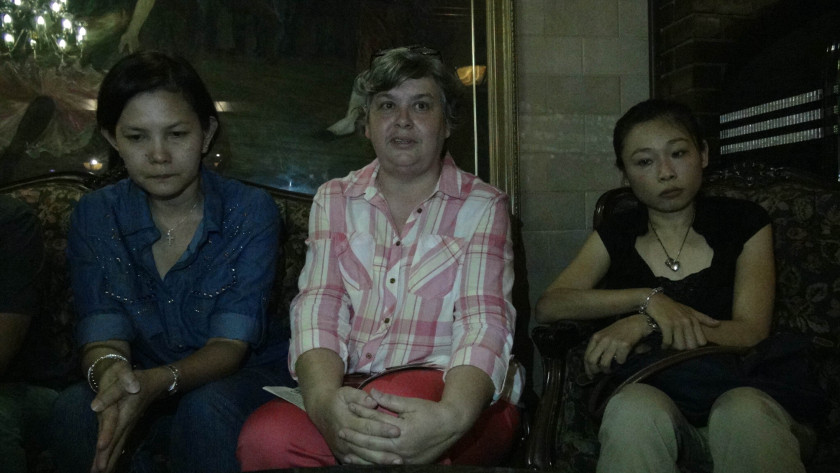


KUALA LUMPUR, May 30 ― It was like a punch to the gut for Jacquita Gonzales when she found out that flight MH370 was nowhere in the vast area where search teams had spent weeks looking.
After holding on to a sliver of hope since the plane went missing on March 8, the 52-year-old and her family now feel that it was all just wasted time.
“It's frustrating. I'm really upset about it. All this while they gave us a bit of confidence saying they were sure they were searching in the right place... now nothing is there,” she told The Malay Mail Online when contacted.
Yesterday, Australian authorities declared the end of the search for the missing Malaysia Airlines jet in the southern Indian Ocean, after a deepsea hunt using a drone had not been able to detect any trace of aircraft debris in more than 850 square kilometres of the ocean floor.
The Joint Agency Coordination Centre (JACC) said the underwater sub Bluefin-21 had completed its last mission searching the remaining areas where several “pings” believed to have originated from the missing passenger plane had been detected in early April.
Work, however, will enter a new phase, involving a review of all data and analyses covering up to 60,000 square kilometres along MH370’s probable flight arc over the southern Indian Ocean.
A bathymetric survey map of the sea floor and specialist services for a comprehensive search of the defined area will also be conducted.
Mapping the sea floor is expected to take three months, but JACC added that the Chinese survey ship Zhu Kezhen was already working on the areas identified as most likely.
Gonzales, whose husband and in-flight supervisor Patrick Gomes was among the 239 people aboard the Beijing-bound flight, said there is nothing left for them to cling on to as they continue to wonder over the fate of everyone on the plane.
“We are just so mixed up now. The thing that gave us so much hope, to find out it is actually not there... it is as if we have been fooled.
“And now nothing is going to be done for the next few months because they want to do mapping. In two, three months so many things can happen. Another cyclone could hit and shift things around, and they will have to do a whole round of calculations again.
“I know they have to map the sea bed and all that, but for us who are waiting, it's not easy. It's just... very exhausting,” she said.
Selamat Omar, whose son Mohd Khairul Amri was one of the passengers on the plane, said he felt vindicated by the latest development as he remains firm in his belief that his son and the plane, along with the other passengers and crew, are safe.
The 60-year-old retiree, who said last March that he was confident the plane and its occupants were in “good condition”, told The Malay Mail Online that he agreed with former prime minister Tun Dr Mahathir Mohamed's claim that it may have been hijacked.
Dr Mahathir had argued in a post on his blog, chedet.cc, earlier this month that “someone is hiding something”, and that the plane was “somewhere”, possibly with its identifying markings removed.
“We see the experts and all their findings, saying that it is in the indian Ocean. If it were there, we would have already found it. Now the Australians said it's not there, so it could be on land or anywhere,” Selamat said when contacted.
“I am positive and fully confident that it is not in the water,” he added.
With the end of the first phase of the search in the southern Indian Ocean, Selamat urged the Malaysian government to re-evaluate their strategy and focus on other areas where the plane could have possibly ended up.
Gonzales, however, was far less optimistic of the authorities' ability to make any headway in the search.
“I just hope they get their act together and not do this (stop the search). How do you expect us to have closure and believe that you are doing the right thing?
“All the ifs, the should haves... unfortunately I don't have a big ship to take me there. If not, I'd do it on my own and bring whoever is willing to help me,” she said.


