


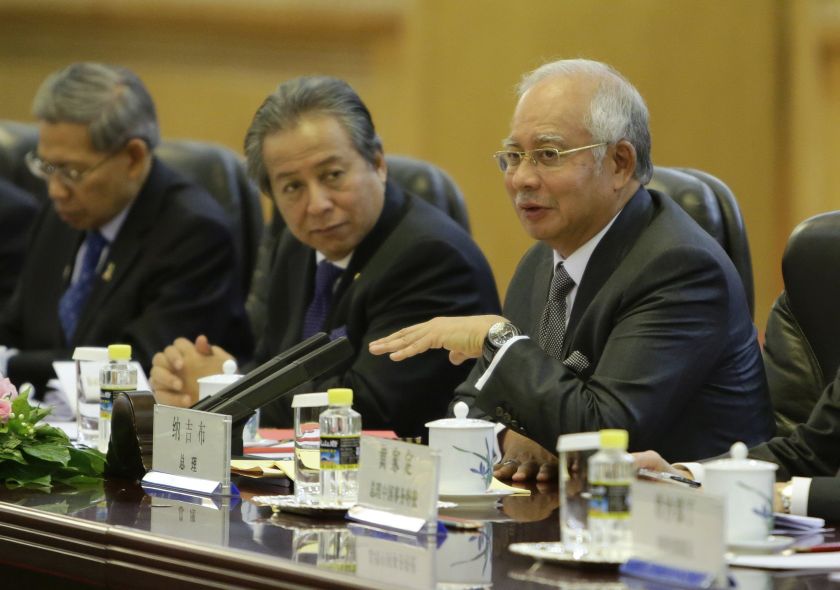


BEIJING, May 30 ― Malaysia and China will celebrate its 40th anniversary of diplomatic ties this Saturday, and Prime Minister Datuk Seri Najib Razak is here in the Chinese capital for various functions to commemorate the occasion.
The relationship has gone through many rocky patches but overall, China and Malaysia see each other as “hou pengyu” (“good friends” in Chinese).
The two countries' bilateral ties have been solid and on many multi-lateral occasions, they backed each other.
Najib’s visit comes in the wake of the MH370 tragedy where the family members of Chinese passengers of the missing aircraft had attacked Malaysia for apparently not doing enough.
The fact that the Chinese authorities had allowed the families to hold demonstrations over this issue surprised many Malaysians and its government.
However, the two countries seem to have moved beyond MH370, which after more than three months, is still missing.
Malaysia and China relations seem to be now back on track.
China is said to have bigger battles to fight on the economic and political front including its relations with Asean or more accurately its worsening ties with nations in South East Asia.
It has got problems with Philippines over territorial claims of various atolls that make up the Spratlys which is also jointly claimed by Brunei, Vietnam and Malaysia.
Its recent venture with military vessels into the disputed area was seen by many as provocative and Philippines led the way to “scold” China by sending out their own navy to confront the Chinese ships.
The other claimant states, especially Vietnam, joint in voicing their criticisms.
Ties with Vietnam have always been a thorny one but this time round, the feelings in the Indo-China country have led to its citizens attacking Chinese businesses ― regardless of whether they are local or foreign.
The attacks have been seen as a direct result of the anger and distrust ordinary Vietnamese have for anything Chinese. Factories and shops have been torched and hundreds of Chinese descendants have been attacked.
Chinese Singaporeans, Malaysians and Chinese nationals fled Vietnam by the thousands.
Traditional foes like the US and Japan painted a picture of China as an aggressor with expansionist policies.
China’s economic prowess has drawn further attention and it could be said that its speed of growth may have been the cause of many of the attacks this most populous country is now facing.
As all these are happening, Malaysia has remained steadfast in its relations with China ― through quiet diplomacy and supportive engagement.
This weekend’s commemoration of the ties between the two countries could not have come at a more opportune moment for Malaysia and China.
Malaysia assumes the chairmanship of Asean at the end of this year and in the following 12 months Malaysia will use its leadership to guide the grouping with its own brand of quiet diplomacy.
China will be depending on Malaysia’s chairmanship as an opportunity to improve ties with Asean.
The present chairman, Myanmar, has been too busy using its post to promote its own domestic agenda as the country has just started to gain acceptance by the international community since it started moving towards democracy.
Malaysia, on the other hand, has its eye on the bigger picture of how to handle Asean’s giant neighbor China and how best to engage it positively.
The best way to deal with China is perhaps in direct but quiet diplomacy.
A senior Malaysian government official points out that Asean members must recognise that by 2015 China would probably be the country with the biggest economy outstripping the US.
“We have to deal with China differently. We have to realise that we cannot do without China and China cannot do without Asean. Asean countries have strong cultural, historical and economic ties with China and confronting it aggressively is not the correct way to do it,” the official said.
Malaysia has in the past successfully trade with China ― albeit more Malaysians invest in China instead of the other way round ― but the apparent shift by China to focus on the domestic economy has affected the coffers of South East Asian nations.
For Malaysia, it's time to move on from the MH370 tragedy and the violent reaction from relatives of the Chinese victims.
Najib is hoping that his visit here will be a new chapter in the ties between the two countries and to repair the damage MH370 may have caused.
Chinese tourists, who make up about 30% of all arrivals, have all but stopped coming to Malaysia. MAS has even cut its operations in Beijing to just a single flight a day compared to twice daily previously.
Getting them to come back would be a sure sign of repaired ties.
China relations with Malaysia has always relied on the personal relationship level.
They have always treated Malaysian leaders as personal friends or “pengyu”.


