


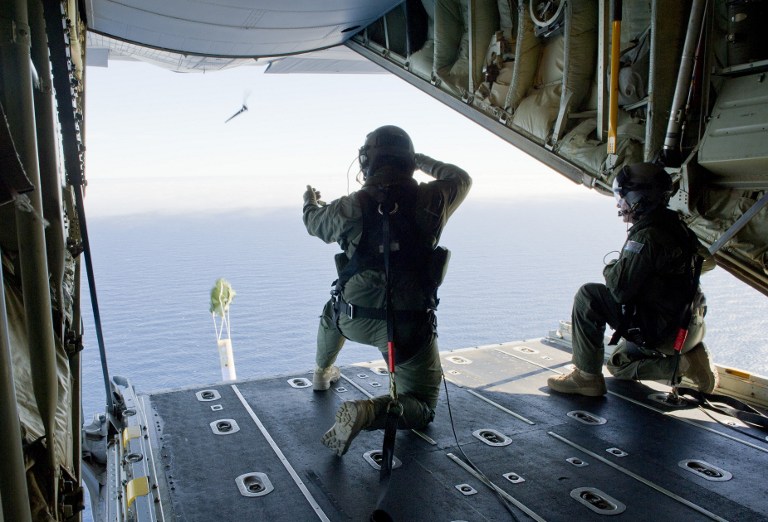


KUALA LUMPUR, March 26 — Bad weather may not be the only thing hampering the already daunting task of searchers looking for signs of Malaysia Airlines flight MH370 in the isolated, southern part of the Indian Ocean.
According to an Australian marine geologist, debris from the aircraft could be lying over a massive undersea volcanic mountain range at a part of the ocean's wildest waters — unreachable even by many high-tech sea equipment.
In a report on the Sydney Morning Herald yesterday, Robin Beaman from the James Cook University reportedly said that very little of the ocean floor where searches are currently being carried out has been mapped out in great detail.
He said that the debris spotted last week by the Australian authorities that was believed to be linked to the missing aircraft lay 60km southwest of the active zone of the Southeast Indian Ridge.
The ridge, according to the article, is a chain of underwater volcanoes running from southwest of Australia to below New Zealand. It separates the Indo-Australian Plate to the north from the Antarctic Plate to the south.
A few days after the sightings, more objects were sighted near the search zone - this time by a Chinese aircraft. The SMH noted that the second sighting was about 180km southwest of the ridge.
On Monday, an Australian aircraft reported more sightings of alleged debris. Beaman said the latest sighting was about 200km northeast of the ridge.
''On the flanks of the ridge, which is very likely where any crash zone occurred, there has been virtually no … mapping apart from the odd strip.
''It's all going to have to be remapped, there's no doubt,'' he was quoted saying.
Any attempt to retrieve the wreckage, SMH continued, "would require extensive 3D mapping, possibly by ships with multi-beam echo sounders."
A multi-beam echo sounder is used by hydrographic surveyors to determine the depth of water and the nature of the seabed, according to a description online.
The device sends out fan-shaped pulses to the ocean floor, which then registers a return signal that help determines ocean depths.
According to the daily, Australian vessels do not have the capacity to scour depths of up to 3,000m, which is just the average depth of the current search area.
The only such vessel capable of this, SMH said, is the RV Southern Surveyor, which has already been decommissioned.
A replacement ship is being built in Singapore at present, according to Beaman, but is only at the stage of going through sea trials.
''It's bad timing, really. Australia has no capability of mapping these depths,'' he was quoted saying.
Beaman added that the last sea floor survey on this part of the Indian Ocean was conducted almost 20 years ago and used "out-dated technology".
Rough weather conditions forced searchers to call off their mission yesterday, despite protests from the family members of those aboard MH370.
The missing Malaysia Airlines jetliner carrying 239 people disappeared off the coast of Kota Baru mysteriously in the early hours of Saturday morning on March 8 and has remained missing since, nearly 19 days later.
On Monday, Malaysia finally announced that the Boeing 777 aircraft had "ended" its journey in the southern Indian Ocean, citing refined calculations gleaned from satellite data collected by British firm Inmarsat.
According to Prime Minister Datuk Seri Najib Razak, the aircraft, which was initially bound for Beijing from Kuala Lumpur, had veered off-course in mid-flight and then piloted to the west before heading to the Indian Ocean.
It is believed to have ran out of fuel and crashed some 2,500km southwest of Perth in Australia.
But the waters of the Indian Ocean has been described by oceanographers as a wild, unforgiving watery expanse, located in one of the most isolated parts of the planet.


